Cohen Craig R, Grossman Daniel, Onono Maricianah, Blat Cinthia, Newmann Sara J, Burger Rachel L, Shade Starley B, Bett Norah, Bukusi Elizabeth A
Department of Obstetrics, Gynecology & Reproductive Sciences, University of California San Francisco, San Francisco, California, United States of America.
Ibis Reproductive Health, Oakland, California, United States of America.
PLoS One. 2017 Mar 22;12(3):e0172992. doi: 10.1371/journal.pone.0172992. eCollection 2017.
To determine if integration of family planning (FP) and HIV services led to increased use of more effective contraception (i.e. hormonal and permanent methods, and intrauterine devices) and decreased pregnancy rates.
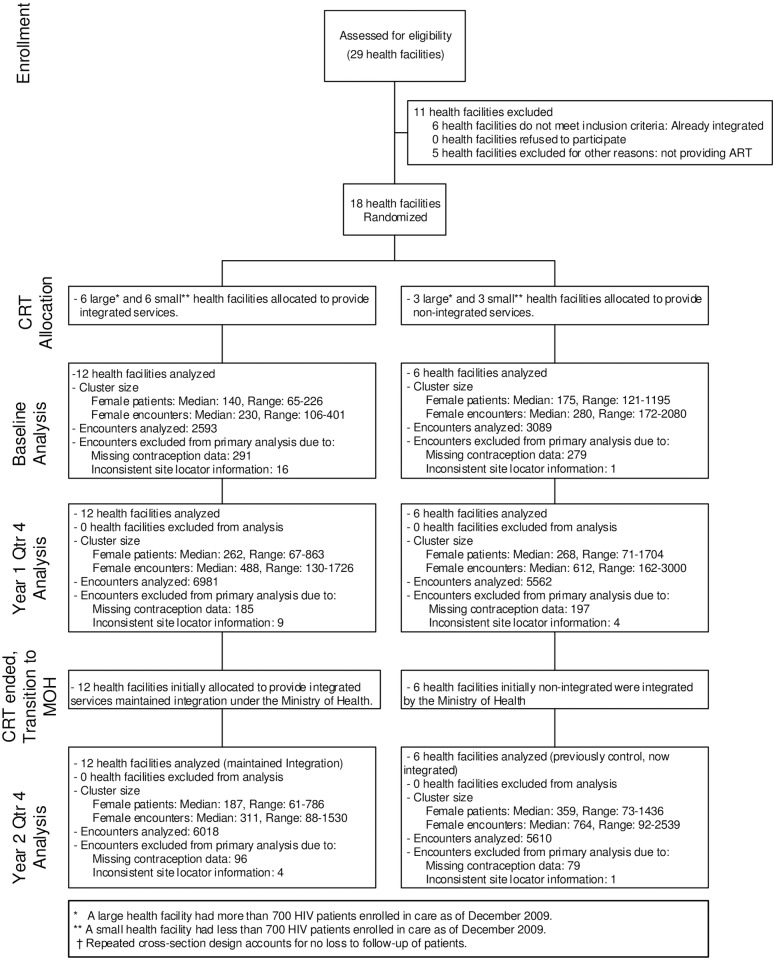
Cohort analysis following cluster randomized trial, when the Kenya Ministry of Health led integration of the remaining control (delayed integration) sites and oversaw integrated services at the original intervention (early integration) sites.
Eighteen health facilities in Kenya.
Women aged 18-45 receiving care: 5682 encounters at baseline, and 11628 encounters during the fourth quarter of year 2.
"One-stop shop" approach to integrating FP and HIV services.
Use of more effective contraceptive methods and incident pregnancy across two years of follow-up.
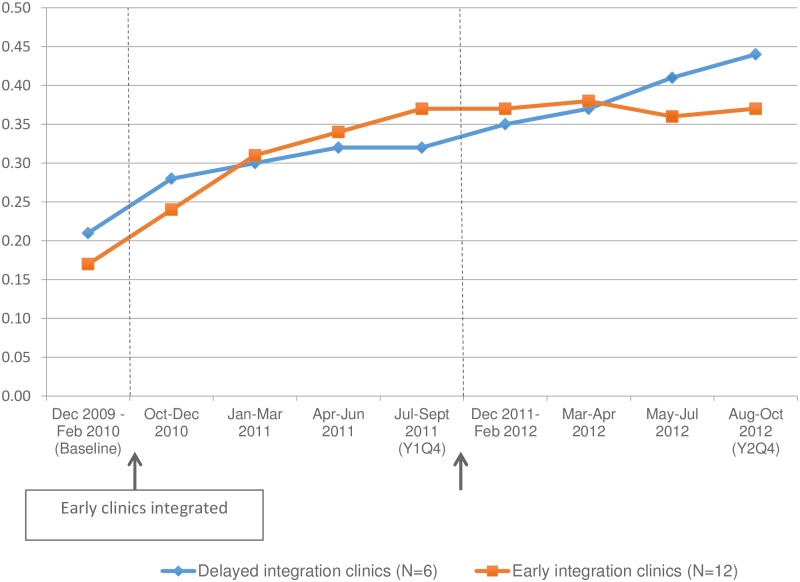
Following integration of FP and HIV services at the six delayed integration clinics, use of more effective contraception increased from 31.7% to 44.2% of encounters (+12.5%; Prevalence ratio (PR) = 1.39 (1.19-1.63). Among the twelve early integration sites, the proportion of encounters at which women used more effective contraceptive methods was sustained from the end of the first to the second year of follow-up (37.5% vs. 37.0%). Pregnancy incidence including all 18 integrated sites in year two declined in comparison to the control arm in year one (rate ratio: 0.72; 95% CI 0.60-0.87).
Integration of FP services into HIV clinics led to a sustained increase in the use of more effective contraceptives and decrease in pregnancy incidence 24 months following implementation of the integrated service model.
ClinicalTrials.gov NCT01001507.
确定计划生育(FP)与艾滋病病毒(HIV)服务整合是否会促使人们更多地使用更有效的避孕方法(即激素避孕法、绝育法和宫内节育器),并降低妊娠率。
在整群随机试验之后进行队列分析,当时肯尼亚卫生部主导了其余对照(延迟整合)地点的整合工作,并在最初的干预(早期整合)地点监督综合服务。
肯尼亚的18家医疗机构。
年龄在18至45岁之间接受护理的女性:基线时5682人次就诊,在第2年第四季度有11628人次就诊。
采用“一站式服务”方式整合FP与HIV服务。
在两年的随访期间使用更有效的避孕方法的情况和意外怀孕情况。
在6家延迟整合诊所将FP与HIV服务整合之后,更有效的避孕方法的使用比例从就诊人次的31.7%增至44.2%(增加了12.5%;患病率比(PR)=1.39(1.19 - 1.63))。在12家早期整合地点,从随访的第一年年底到第二年,女性使用更有效避孕方法的就诊比例保持稳定(37.5%对37.0%)。与第一年的对照组相比,第二年包括所有18个整合地点在内的怀孕发生率有所下降(率比:0.72;95%置信区间0.60 - 0.87)。
将FP服务整合到HIV诊所,在实施综合服务模式24个月后,导致更有效避孕方法的使用持续增加,妊娠发生率降低。
ClinicalTrials.gov NCT01001507。