Kahlon Arunpreet Singh, Pathak Rambha
Department of Community Medicine, MM Institute of Medical Sciences and Research, Mullana, India.
J Pharm Bioallied Sci. 2011 Jul;3(3):324-8. doi: 10.4103/0975-7406.84431.
Till now estimation of blood glucose is the highly effective method for diagnosing diabetes mellitus but it provides a short-term picture of control. More evidence is required to prove that plasma glucose and glycosylated hemoglobin levels together gives a better estimate of glycemic control and compliance with treatment. Indian diabetes risk score (IDRS) is a simplified screening tool for identifying undiagnosed diabetic subjects, requires minimum time, and effort and can help to considerably reduce the costs of screening.
To study patterns of glycemic control using glycosylated hemoglobin in diabetic patients. To find out correlation between levels of plasma glucose and glycosylated hemoglobin in diabetics and to calculate IDRS of the study population.
A cross sectional study was conducted among 300 known diabetic patients attending outpatient department of a rural medical college in Haryana, India. Following standard procedures and protocols FPG and glycosylated hemoglobin were measured to find out a pattern of glycemic control in them after taking their written and informed consent. A correlation between the levels of glycosylated hemoglobin and fasting blood glucose was also calculated. These patients were made to fill a performa and their demographic and clinical risk factors were noted and based on this, their IDRS was calculated. This was done to validate the IDRS in Indian rural population.
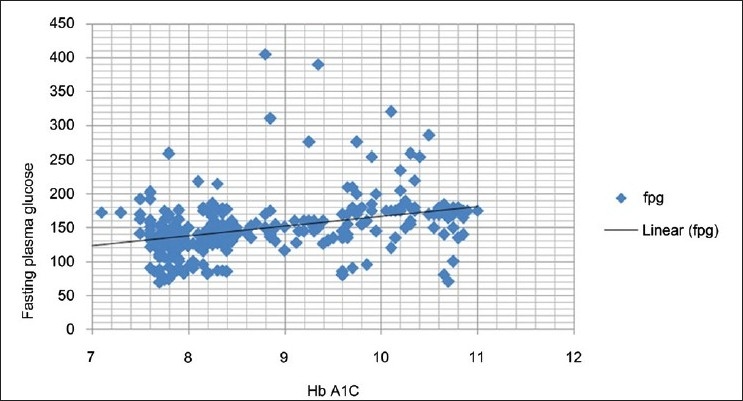
Fifty-two percent of the population had fasting plasma glucose level between 125-150 mg/dl, 21% had this level between 151-175 mg/dl. Thirteen percent of the study subjects had HbA1C between 6.5-7.5, more than half (57.3%) had this value between 7.5-8.5, 12% and 18% had values between 8.5-9.5 and 9.5-10.5, respectively. Twelve percent of the participants had HbA1C level higher than 10.5. Correlation of fasting plasma glucose level and HbA1C was also studied and found that correlation coefficient came out to be .311. This correlation was found to be statistically significant (P = .007). Sixty-five percent of the case had IDRS higher than 60.
Glycaemic control in diabetics can be better assessed with glycosylated hemoglobin and FPG together. A positive correlation between FPG and HbA1c allows for the use of HbA1c along with FPG in diagnosing type 2 DM but the two should not be used interchangeably. IDRS can be used as a screening tool for diabetes.
到目前为止,血糖检测是诊断糖尿病的高效方法,但它只能提供短期的控制情况。需要更多证据来证明血浆葡萄糖和糖化血红蛋白水平共同能更好地评估血糖控制及治疗依从性。印度糖尿病风险评分(IDRS)是一种用于识别未确诊糖尿病患者的简化筛查工具,所需时间和精力最少,有助于大幅降低筛查成本。
研究糖尿病患者糖化血红蛋白的血糖控制模式。找出糖尿病患者血浆葡萄糖水平与糖化血红蛋白水平之间的相关性,并计算研究人群的IDRS。
在印度哈里亚纳邦一所农村医学院门诊部就诊的300名已知糖尿病患者中进行了一项横断面研究。在获得他们的书面知情同意后,按照标准程序和方案测量空腹血糖(FPG)和糖化血红蛋白,以了解他们的血糖控制模式。还计算了糖化血红蛋白水平与空腹血糖水平之间的相关性。让这些患者填写一份表格,记录他们的人口统计学和临床风险因素,并据此计算他们的IDRS。这样做是为了在印度农村人群中验证IDRS。
52%的人群空腹血浆葡萄糖水平在125 - 150毫克/分升之间,21%的人群在此水平在151 - 175毫克/分升之间。13%的研究对象糖化血红蛋白(HbA1C)在6.5 - 7.5之间,超过一半(57.3%)的人在此值在7.5 - 8.5之间,12%和18%的人分别在8.5 - 9.5和9.5 - 10.5之间。12%的参与者糖化血红蛋白水平高于10.5。还研究了空腹血浆葡萄糖水平与HbA1C的相关性,发现相关系数为0.311。这种相关性在统计学上具有显著性(P = 0.007)。65%的病例IDRS高于60。
糖化血红蛋白和FPG一起可以更好地评估糖尿病患者的血糖控制情况。FPG与HbA1c之间呈正相关,这使得HbA1c可与FPG一起用于诊断2型糖尿病,但两者不应互换使用。IDRS可作为糖尿病的筛查工具。