Elkina Yulia, von Haehling Stephan, Anker Stefan D, Springer Jochen
J Cachexia Sarcopenia Muscle. 2011 Sep;2(3):143-151. doi: 10.1007/s13539-011-0035-5. Epub 2011 Jul 26.
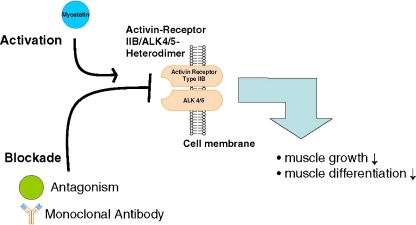
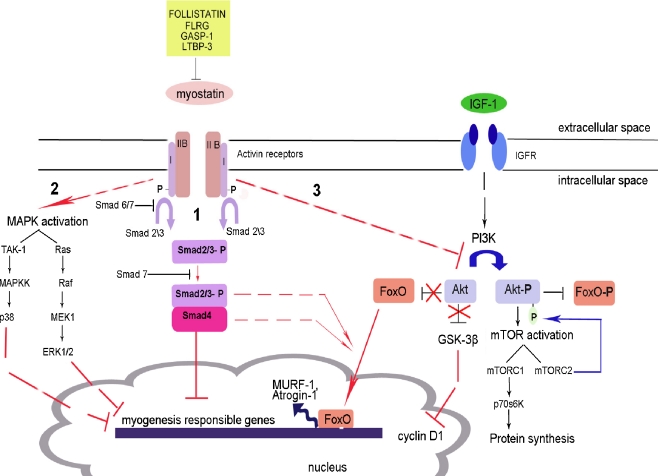
Myostatin is an extracellular cytokine mostly expressed in skeletal muscles and known to play a crucial role in the negative regulation of muscle mass. Upon the binding to activin type IIB receptor, myostatin can initiate several different signalling cascades resulting in the upregulation of the atrogenes and downregulation of the important for myogenesis genes. Muscle size is regulated via a complex interplay of myostatin signalling with the insulin-like growth factor 1/phosphatidylinositol 3-kinase/Akt pathway responsible for increase in protein synthesis in muscle. Therefore, the regulation of muscle weight is a process in which myostatin plays a central role but the mechanism of its action and signalling cascades are not fully understood. Myostatin upregulation was observed in the pathogenesis of muscle wasting during cachexia associated with different diseases (i.e. cancer, heart failure, HIV). Characterisation of myostatin signalling is therefore a perspective direction in the treatment development for cachexia. The current review covers the present knowledge about myostatin signalling pathways leading to muscle wasting and the state of therapy approaches via the regulation of myostatin and/or its downstream targets in cachexia.
肌生成抑制素是一种细胞外细胞因子,主要在骨骼肌中表达,已知在肌肉质量的负调控中起关键作用。与IIB型激活素受体结合后,肌生成抑制素可启动几种不同的信号级联反应,导致萎缩基因上调,而对肌生成重要的基因下调。肌肉大小是通过肌生成抑制素信号与负责增加肌肉蛋白质合成的胰岛素样生长因子1/磷脂酰肌醇3激酶/Akt途径的复杂相互作用来调节的。因此,肌肉重量的调节是一个肌生成抑制素起核心作用的过程,但其作用机制和信号级联反应尚未完全了解。在与不同疾病(如癌症、心力衰竭、艾滋病)相关的恶病质期间的肌肉萎缩发病机制中观察到肌生成抑制素上调。因此,肌生成抑制素信号的表征是恶病质治疗开发的一个有前景的方向。本综述涵盖了目前关于导致肌肉萎缩的肌生成抑制素信号通路的知识,以及通过调节恶病质中的肌生成抑制素和/或其下游靶点的治疗方法的现状。