Immunoproteomics Laboratory, Department of Biomarkers, bioMérieux, Marcy l'étoile, France.
FEBS J. 2011 Dec;278(24):4845-59. doi: 10.1111/j.1742-4658.2011.08385.x. Epub 2011 Nov 3.
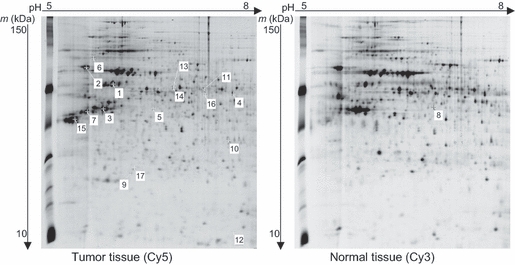
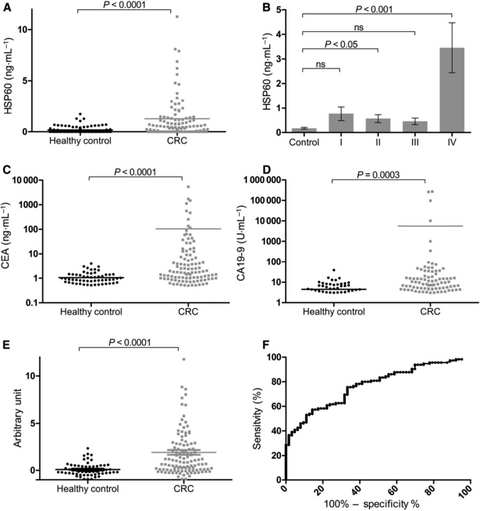
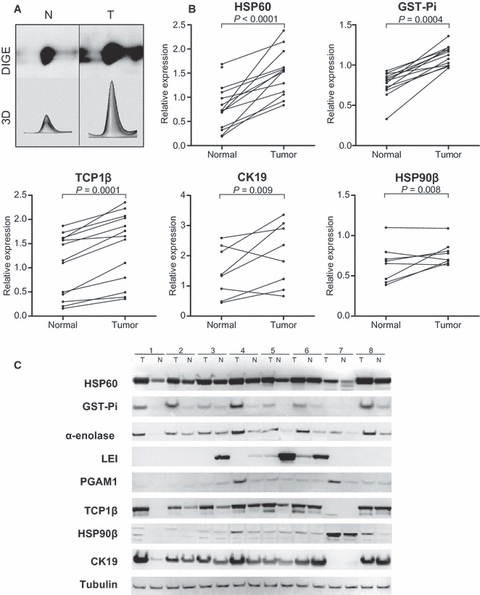
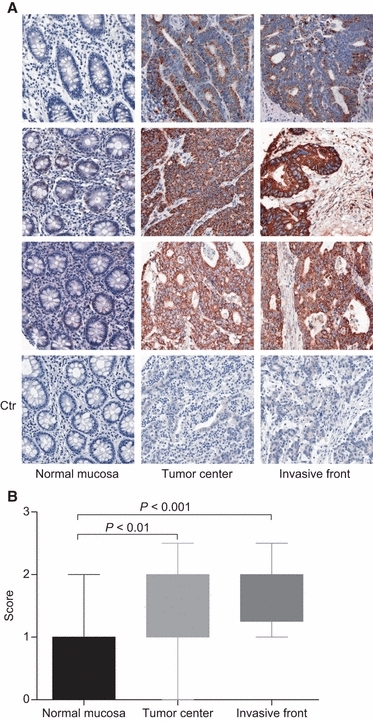
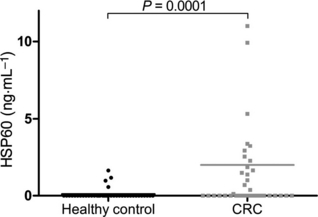
Colorectal cancer (CRC) is a major public health issue worldwide, and novel tumor markers may contribute to its efficient management by helping in early detection, prognosis or surveillance of disease. The aim of our study was to identify new serum biomarkers for CRC, and we followed a phased biomarker discovery and validation process to obtain an accurate preliminary assessment of potential clinical utility. We compared colonic tumors and matched normal tissue from 15 CRC patients, using two-dimensional difference gel electrophoresis (2D-DIGE), and identified 17 proteins that had significant differential expression. These results were further confirmed by western blotting for heat shock protein (HSP) 60, glutathione-S-transferase Pi, α-enolase, T-complex protein 1 subunit β, and leukocyte elastase inhibitor, and by immunohistochemistry for HSP60. Using mAbs raised against HSP60, we developed a reliable (precision of 5-15%) and sensitive (0.3 ng·mL(-1)) immunoassay for the detection of HSP60 in serum. Elevated levels of HSP60 were found in serum from CRC patients in two independent cohorts; the receiver-operating characteristic curve obtained in 112 patients with CRC and 90 healthy controls had an area under the curve (AUC) of 0.70, which was identical to the AUC of carcinoembryonic antigen. Combination of serum markers improved clinical performance: the AUC of a three-marker logistic regression model combining HSP60, carcinoembryonic antigen and carbohydrate antigen 19-9 reached 0.77. Serum HSP60 appeared to be more specific for late-stage CRC; therefore, future studies should evaluate its utility for determining prognosis or monitoring therapy rather than early detection.
结直肠癌(CRC)是全球主要的公共卫生问题,新的肿瘤标志物可能有助于通过帮助早期检测、预后或疾病监测来对其进行有效的管理。我们的研究目的是鉴定 CRC 的新的血清生物标志物,并采用分阶段的生物标志物发现和验证过程来对潜在的临床应用进行准确的初步评估。我们使用二维差异凝胶电泳(2D-DIGE)比较了 15 名 CRC 患者的结肠肿瘤和匹配的正常组织,并鉴定出 17 种具有显著差异表达的蛋白质。通过 Western blot 对热休克蛋白(HSP)60、谷胱甘肽 S-转移酶 Pi、α-烯醇酶、T 复合物蛋白 1 亚基β和白细胞弹性蛋白酶抑制剂进行进一步验证,并通过 HSP60 的免疫组织化学进行验证。使用针对 HSP60 的 mAb,我们开发了一种可靠(精度为 5-15%)和敏感(0.3ng·mL(-1))的 HSP60 血清检测免疫分析方法。在两个独立的 CRC 患者队列中发现 HSP60 在血清中的水平升高;在 112 名 CRC 患者和 90 名健康对照者中获得的接收者操作特性曲线的曲线下面积(AUC)为 0.70,与癌胚抗原的 AUC 相同。血清标志物的组合改善了临床性能:结合 HSP60、癌胚抗原和碳水化合物抗原 19-9 的三标志物逻辑回归模型的 AUC 达到 0.77。血清 HSP60 似乎对晚期 CRC 更具特异性;因此,未来的研究应该评估其在确定预后或监测治疗而不是早期检测中的效用。