Swiss Light Source, Paul Scherrer Institut, 5232 Villigen, Switzerland.
Beilstein J Nanotechnol. 2011;2:47-56. doi: 10.3762/bjnano.2.6. Epub 2011 Jan 21.
Magnetic nanostructures and nanoparticles often show novel magnetic phenomena not known from the respective bulk materials. In the past, several methods to prepare such structures have been developed - ranging from wet chemistry-based to physical-based methods such as self-organization or cluster growth. The preparation method has a significant influence on the resulting properties of the generated nanostructures. Taking chemical approaches, this influence may arise from the chemical environment, reaction kinetics and the preparation route. Taking physical approaches, the thermodynamics and the kinetics of the growth mode or - when depositing preformed clusters/nanoparticles on a surface - the landing kinetics and subsequent relaxation processes have a strong impact and thus need to be considered when attempting to control magnetic and structural properties of supported clusters or nanoparticles.
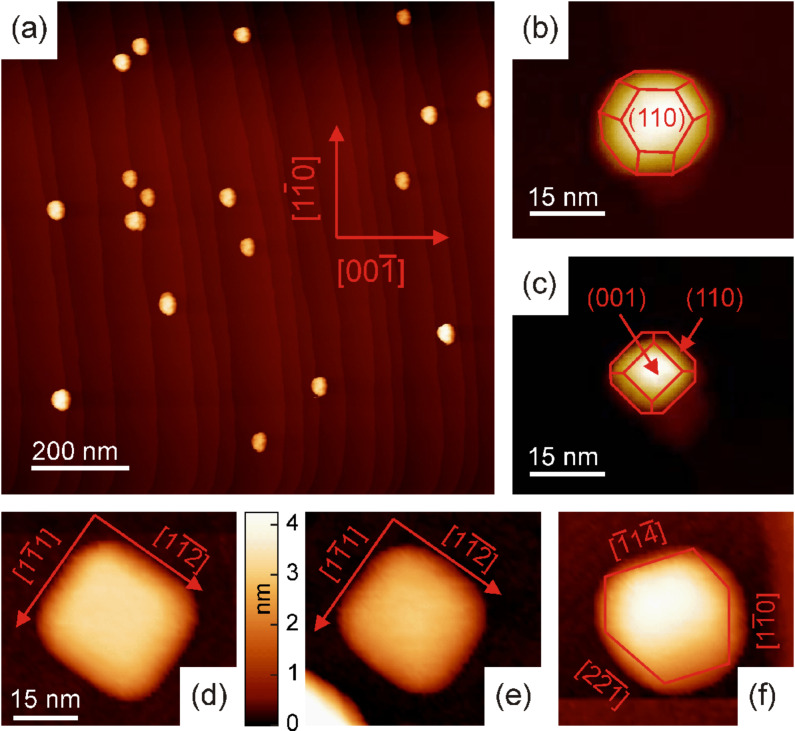
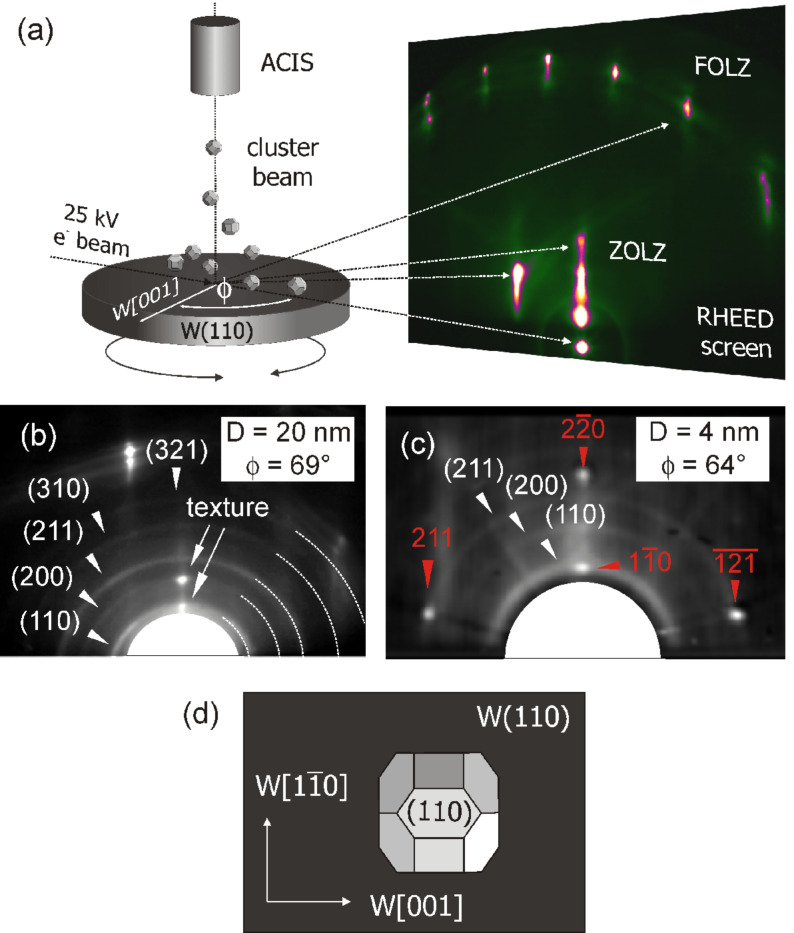
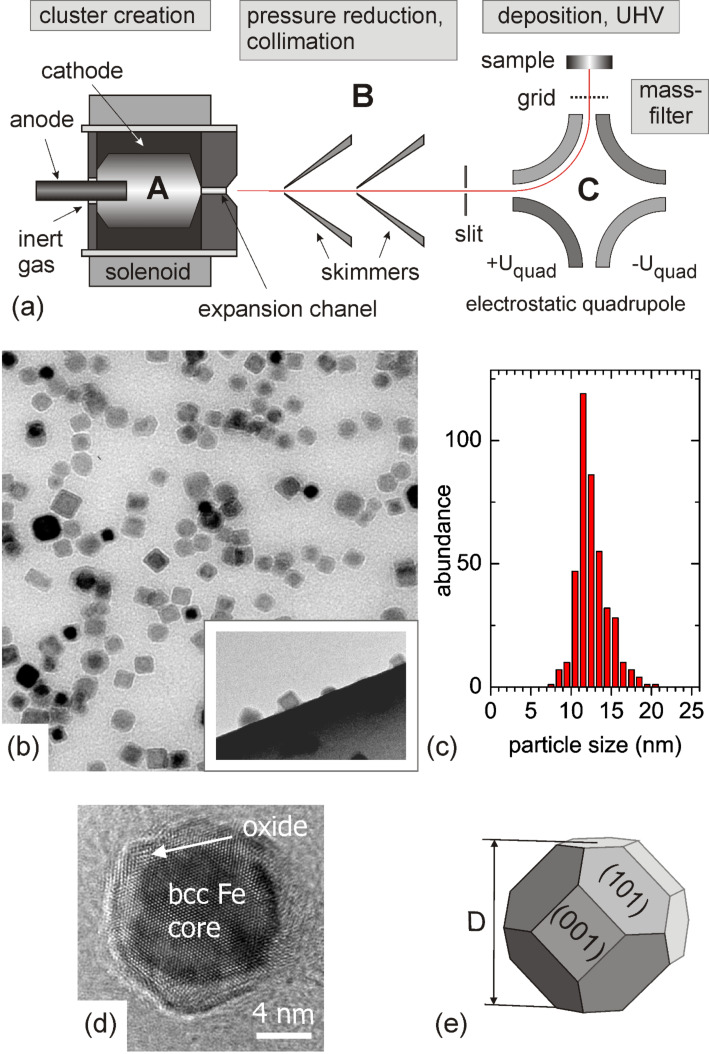
In this contribution we focus on mass-filtered Fe nanoparticles in a size range from 4 nm to 10 nm that are generated in a cluster source and subsequently deposited onto two single crystalline substrates: fcc Ni(111)/W(110) and bcc W(110). We use a combined approach of X-ray magnetic circular dichroism (XMCD), reflection high energy electron diffraction (RHEED) and scanning tunneling microscopy (STM) to shed light on the complex and size-dependent relation between magnetic properties, crystallographic structure, orientation and morphology. In particular XMCD reveals that Fe particles on Ni(111)/W(110) have a significantly lower (higher) magnetic spin (orbital) moment compared to bulk iron. The reduced spin moments are attributed to the random particle orientation being confirmed by RHEED together with a competition of magnetic exchange energy at the interface and magnetic anisotropy energy in the particles. The RHEED data also show that the Fe particles on W(110) - despite of the large lattice mismatch between iron and tungsten - are not strained. Thus, strain is most likely not the origin of the enhanced orbital moments as supposed before. Moreover, RHEED uncovers the existence of a spontaneous process for epitaxial alignment of particles below a critical size of about 4 nm. STM basically confirms the shape conservation of the larger particles but shows first indications for an unexpected reshaping occurring at the onset of self-alignment.
The magnetic and structural properties of nanoparticles are strongly affected by the deposition kinetics even when soft landing conditions are provided. The orientation of the deposited particles and thus their interface with the substrate strongly depend on the particle size with consequences regarding particularly the magnetic behavior. Spontaneous and epitaxial self-alignment can occur below a certain critical size. This may enable the obtainment of samples with controlled, uniform interfaces and crystallographic orientations even in a random deposition process. However, such a reorientation process might be accompanied by a complex reshaping of the particles.
磁性纳米结构和纳米粒子通常表现出不同于相应体材料的新颖磁性现象。过去,已经开发出多种制备这种结构的方法 - 从基于湿化学的方法到基于物理的方法,例如自组织或团簇生长。制备方法对生成的纳米结构的特性有显著影响。对于化学方法,这种影响可能来自化学环境、反应动力学和制备路线。对于物理方法,生长模式的热力学和动力学,或者 - 在将预先形成的团簇/纳米颗粒沉积到表面上时 - 着陆动力学和随后的松弛过程具有很强的影响,因此在试图控制支撑团簇或纳米颗粒的磁性和结构特性时需要考虑这些影响。
在这项研究中,我们专注于在团簇源中生成的尺寸在 4nm 至 10nm 之间的质量过滤的 Fe 纳米颗粒,然后将其沉积到两种单晶衬底上:fcc Ni(111)/W(110)和 bcc W(110)。我们使用 X 射线磁圆二色性(XMCD)、反射高能电子衍射(RHEED)和扫描隧道显微镜(STM)的组合方法来研究磁性、结晶结构、取向和形态之间复杂的、尺寸依赖性的关系。特别是 XMCD 揭示了 Ni(111)/W(110)上的 Fe 颗粒的磁自旋(轨道)矩明显低于(高于)体铁。自旋矩的降低归因于随机的颗粒取向,这一点通过 RHEED 与界面处的磁交换能和颗粒中的磁各向异性能的竞争得到证实。RHEED 数据还表明,尽管铁和钨之间存在较大的晶格失配,但 W(110)上的 Fe 颗粒未发生应变。因此,应变不太可能是之前假设的增强轨道矩的原因。此外,RHEED 揭示了在临界尺寸以下存在自发的颗粒外延排列过程,临界尺寸约为 4nm。STM 基本证实了较大颗粒的形状保持,但首次表明在自对准开始时出现了意想不到的重塑。
即使提供软着陆条件,纳米颗粒的磁性和结构特性也会受到沉积动力学的强烈影响。沉积颗粒的取向,因此它们与衬底的界面强烈依赖于颗粒尺寸,这对特别是磁性行为有影响。在一定的临界尺寸以下可以发生自发和外延的自对准。这可能使即使在随机沉积过程中也能获得具有受控、均匀界面和结晶取向的样品。然而,这种重新取向过程可能伴随着颗粒的复杂重塑。