Department of Cognitive Neurology, Max Planck Institute for Human Cognitive and Brain Sciences, Leipzig, Germany.
PLoS One. 2011;6(9):e24836. doi: 10.1371/journal.pone.0024836. Epub 2011 Sep 29.
Transcranial magnetic stimulation (TMS) has become an important experimental tool for exploring the brain's functional anatomy. As TMS interferes with neural activity, the hypothetical function of the stimulated area can thus be tested. One unresolved methodological issue in TMS experiments is the question of how to adequately calibrate stimulation intensities. The motor threshold (MT) is often taken as a reference for individually adapted stimulation intensities in TMS experiments, even if they do not involve the motor system. The aim of the present study was to evaluate whether it is reasonable to adjust stimulation intensities in each subject to the individual MT if prefrontal regions are stimulated prior to the performance of a cognitive paradigm.
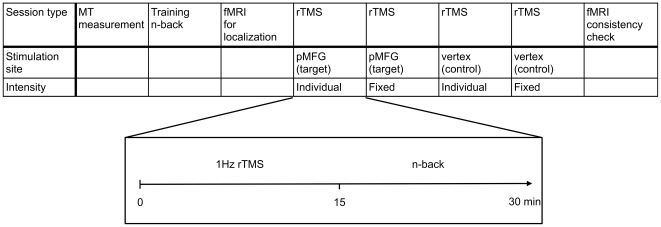
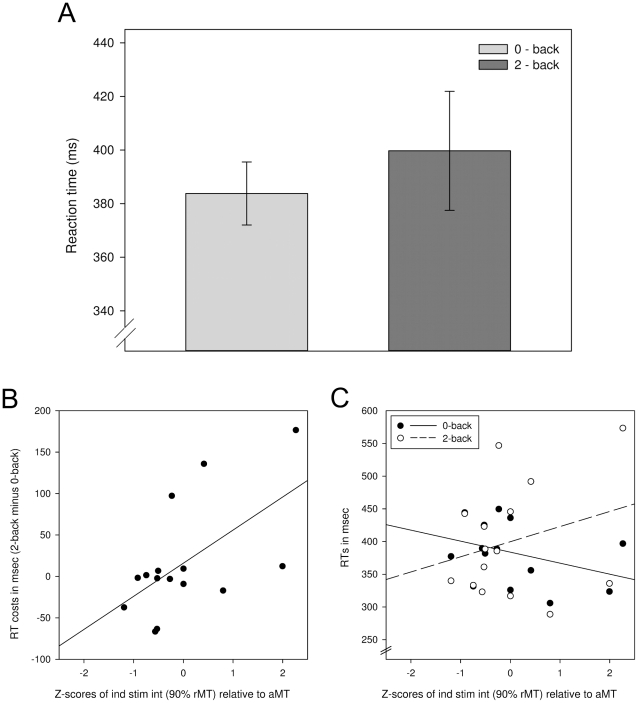
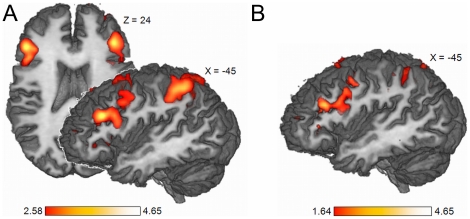
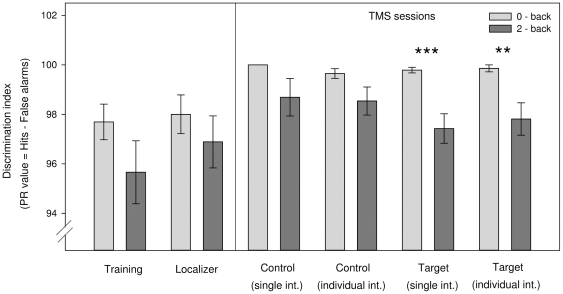
Repetitive TMS (rTMS) was applied prior to a working memory task, either at the 'fixed' intensity of 40% maximum stimulator output (MSO), or individually adapted at 90% of the subject's MT. Stimulation was applied to a target region in the left posterior middle frontal gyrus (pMFG), as indicated by a functional magnetic resonance imaging (fMRI) localizer acquired beforehand, or to a control site (vertex). Results show that MT predicted the effect size after stimulating subjects with the fixed intensity (i.e., subjects with a low MT showed a greater behavioral effect). Nevertheless, the individual adaptation of intensities did not lead to stable effects.
Therefore, we suggest assessing MT and account for it as a measure for general cortical TMS susceptibility, even if TMS is applied outside the motor domain.
经颅磁刺激(TMS)已成为探索大脑功能解剖结构的重要实验工具。由于 TMS 会干扰神经活动,因此可以测试受刺激区域的假设功能。TMS 实验中一个悬而未决的方法问题是如何充分校准刺激强度。运动阈值(MT)通常被用作 TMS 实验中个体适应刺激强度的参考,即使这些实验不涉及运动系统。本研究的目的是评估在执行认知范式之前刺激前额区域时,是否可以合理地将每个受试者的刺激强度调整为个体的 MT。
在工作记忆任务之前,应用重复 TMS(rTMS),要么以 40%最大刺激器输出(MSO)的“固定”强度,要么以 90%受试者 MT 的个体适应性进行。刺激应用于通过先前获得的功能磁共振成像(fMRI)定位器指示的左后中额回(pMFG)的目标区域,或应用于对照部位(顶点)。结果表明,在以固定强度刺激受试者后,MT 预测了效应大小(即,MT 较低的受试者表现出更大的行为效应)。然而,强度的个体适应并没有导致稳定的效果。
因此,我们建议评估 MT 并将其作为一般皮质 TMS 易感性的衡量标准,即使 TMS 应用于运动域之外。