Conservation Biology Unit, Department of Biology, University of Évora, Évora, Portugal.
PLoS One. 2011;6(9):e25383. doi: 10.1371/journal.pone.0025383. Epub 2011 Sep 27.
Road mortality is probably the best-known and visible impact of roads upon wildlife. Although several factors influence road-kill counts, carcass persistence time is considered the most important determinant underlying underestimates of road mortality. The present study aims to describe and model carcass persistence variability on the road for different taxonomic groups under different environmental conditions throughout the year; and also to assess the effect of sampling frequency on the relative variation in road-kill estimates registered within a survey.
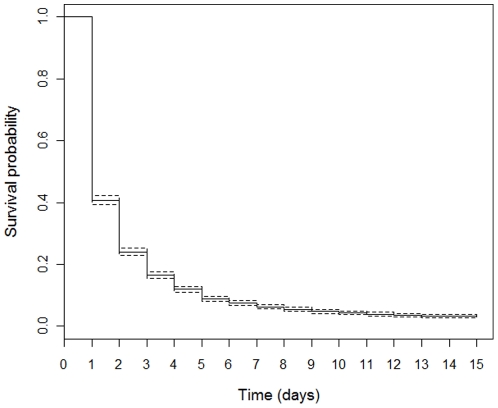
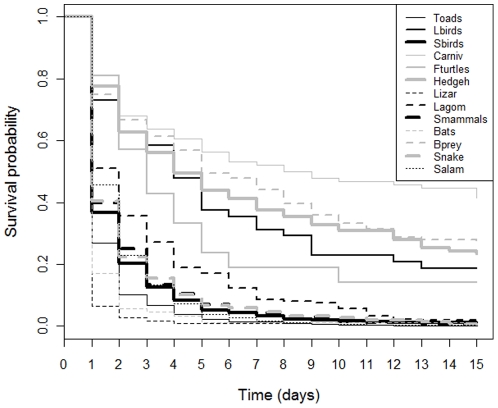
METHODOLOGY/PRINCIPAL FINDINGS: Daily surveys of road-killed vertebrates were conducted over one year along four road sections with different traffic volumes. Survival analysis was then used to i) describe carcass persistence timings for overall and for specific animal groups; ii) assess optimal sampling designs according to research objectives; and iii) model the influence of road, animal and weather factors on carcass persistence probabilities. Most animal carcasses persisted on the road for the first day only, with some groups disappearing at very high rates. The advisable periodicity of road monitoring that minimizes bias in road mortality estimates is daily monitoring for bats (in the morning) and lizards (in the afternoon), daily monitoring for toads, small birds, small mammals, snakes, salamanders, and lagomorphs; 1 day-interval (alternate days) for large birds, birds of prey, hedgehogs, and freshwater turtles; and 2 day-interval for carnivores. Multiple factors influenced the persistence probabilities of vertebrate carcasses on the road. Overall, the persistence was much lower for small animals, on roads with lower traffic volumes, for carcasses located on road lanes, and during humid conditions and high temperatures during the wet season and dry seasons, respectively.
CONCLUSION/SIGNIFICANCE: The guidance given here on monitoring frequencies is particularly relevant to provide conservation and transportation agencies with accurate numbers of road-kills, realistic mitigation measures, and detailed designs for road monitoring programs.
道路死亡率可能是道路对野生动物影响最广为人知和最明显的方面。尽管有几个因素会影响道路死亡数量的统计,但尸体留存时间被认为是导致道路死亡率低估的最重要决定因素。本研究旨在描述和建模全年不同环境条件下不同分类群的动物在道路上的尸体留存时间变化;并评估采样频率对调查中记录的道路死亡估计值相对变化的影响。
方法/主要发现:在一年的时间里,在四条交通量不同的道路段进行了每日的道路死亡脊椎动物调查。然后使用生存分析来:i)描述整体和特定动物群体的尸体留存时间;ii)根据研究目标评估最佳采样设计;iii)模型道路、动物和天气因素对尸体留存概率的影响。大多数动物尸体在第一天就留在了路上,有些群体的消失速度非常快。为了最大限度地减少道路死亡率估计中的偏差,建议采用最小化监测周期,对于蝙蝠(早上)和蜥蜴(下午)采用每日监测,对于蟾蜍、小鸟、小型哺乳动物、蛇、蝾螈和兔形目动物采用每日监测,对于大型鸟类、猛禽、刺猬和淡水龟采用 1 天间隔(隔天)监测,对于食肉动物采用 2 天间隔。多个因素影响了道路上脊椎动物尸体的留存概率。总体而言,对于小型动物、交通量较低的道路、位于道路车道上的尸体,以及在潮湿条件和高温下(分别在雨季和旱季),留存时间要短得多。
结论/意义:这里提供的监测频率指南对于为保护和交通机构提供准确的道路死亡数量、现实的缓解措施以及详细的道路监测计划设计特别重要。