Gwak Ji Hun, Oh Bo-Young, Lee Ryung Ah, Chung Soon Sup, Kim Kwang Ho
Department of Surgery, Ewha Womans University School of Medicine, Seoul, Korea.
J Korean Soc Coloproctol. 2011 Aug;27(4):202-10. doi: 10.3393/jksc.2011.27.4.202. Epub 2011 Aug 31.
The aim of this study is to evaluate long-term survival and prognostic factors for radio-frequency ablation (RFA) in colorectal liver metastases.
We retrospectively reviewed 35 colorectal liver metastases patients who underwent RFA between 2004 and 2008. We analyzed survival after RFA and prognostic factors for survival.
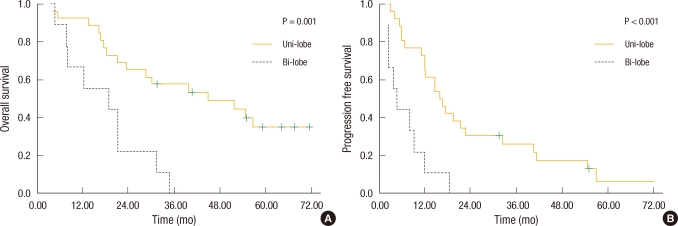
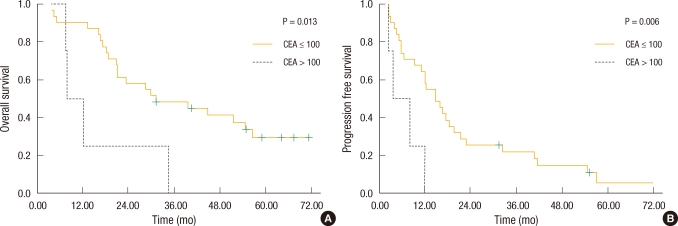
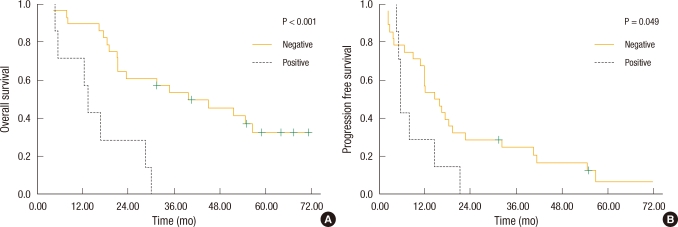
Of the 35 patients, 23 patients were male and 12 were female. Their mean age was 62.40 ± 12.52 years. Mean overall survival was 38.8 ± 4.6 months, and mean progression free survival was 19.9 ± 3.4 months. Three- and 5-year overall survival rates were 42.7 ± 0.1% and 26.0 ± 0.1%, respectively. Three- and 5-year progression-free survival rates were 19.6 ± 0.1% and 4.9 ± 0.04%, respectively. Overall survival and progression-free survival were significantly improved in male and in patients with carcinoembryonic antigen (CEA) ≤ 100 ng/mL, carbohydrate antigen (CA) 19-9 ≤ 100 ng/mL, absence of extrahepatic disease, and a unilobar hepatic lesion. In addition, progression-free survival was improved in patients with a solitary hepatic lesion. On the multivariate analysis, significant survival factors were the absence of extrahepatic disease and the presence of a unilobar hepatic lesion.
RFA for colorectal liver metastases is an effective treatment option in male patients and in patients with CEA or CA19-9 ≤ 100, absence of extrahepatic disease, a solitary hepatic lesion, and a unilobar hepatic lesion.
本研究旨在评估结直肠癌肝转移患者射频消融(RFA)后的长期生存率及预后因素。
我们回顾性分析了2004年至2008年间接受RFA治疗的35例结直肠癌肝转移患者。分析了RFA后的生存率及生存预后因素。
35例患者中,男性23例,女性12例。平均年龄为62.40±12.52岁。平均总生存期为38.8±4.6个月,平均无进展生存期为19.9±3.4个月。3年和5年总生存率分别为42.7±0.1%和26.0±0.1%。3年和5年无进展生存率分别为19.6±0.1%和4.9±0.04%。男性患者以及癌胚抗原(CEA)≤100 ng/mL、糖类抗原(CA)19-9≤100 ng/mL、无肝外疾病且为单叶肝病灶的患者,其总生存期和无进展生存期显著改善。此外,孤立性肝病灶患者的无进展生存期也有所改善。多因素分析显示,显著的生存因素为无肝外疾病和存在单叶肝病灶。
对于男性患者以及CEA或CA19-9≤100、无肝外疾病、有孤立性肝病灶且为单叶肝病灶的结直肠癌肝转移患者,RFA是一种有效的治疗选择。