Exercise Biology Laboratory (BioEx), Health Sciences Institute, Triângulo Mineiro Federal University (UFTM), Uberaba-MG, Brazil.
BMC Musculoskelet Disord. 2011 Oct 7;12:225. doi: 10.1186/1471-2474-12-225.
After menopause, rapid bone mass loss occurs in response to hypoestrogenism. Several studies suggest that muscle mass and bone mineral density (BMD) are positively associated in postmenopausal women. Therefore, it may be assumed that postmenopausal low appendicular muscle mass (aMM) can increase BMD loss in a short period of time.
The purpose of this study was to assess relationship of aMM with femoral neck BMD in postmenopausal women.
Prospective, controlled clinical Trial including 64 women aged 45-70 years, who had not had their last menstruation for at least one year. Subjects were divided into two groups: low aMM (n = 32), and normal aMM (n-32). Femoral neck BMD and muscle mass were measured by DXA at baseline and after twelve months. Pairwise and independent t tests were used for data analysis.
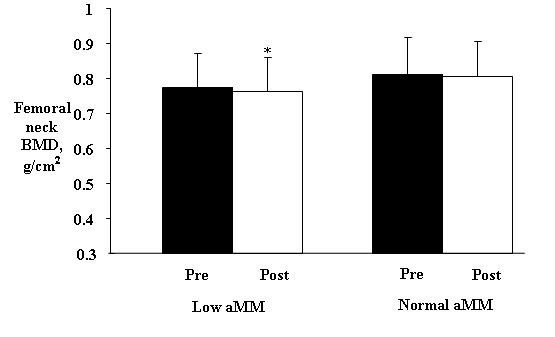
Baseline weight, BMI and muscle mass (total and appendicular) significantly differ between groups (p < 0.05). After twelve months, femoral neck BMD was significantly lower in the group with low aMM, whereas no significant difference was observed in the group with normal aMM (p < 0.05).
In postmenopausal women, low appendicular muscle mass is associated negatively with femoral neck BMD in a short period of time.
绝经后,由于雌激素水平降低,骨量迅速流失。多项研究表明,绝经后妇女的肌肉量和骨密度(BMD)呈正相关。因此,可以假设绝经后四肢肌肉量低(aMM)会在短时间内增加 BMD 的流失。
本研究旨在评估绝经后妇女的 aMM 与股骨颈 BMD 的关系。
这是一项前瞻性、对照临床试验,纳入了 64 名年龄在 45-70 岁、绝经至少 1 年的女性。受试者分为两组:低 aMM(n = 32)和正常 aMM(n = 32)。基线和 12 个月时,通过 DXA 测量股骨颈 BMD 和肌肉量。采用配对和独立 t 检验进行数据分析。
基线时体重、BMI 和肌肉量(总肌肉量和四肢肌肉量)在两组间差异有统计学意义(p < 0.05)。12 个月后,低 aMM 组的股骨颈 BMD 显著降低,而正常 aMM 组则无显著差异(p < 0.05)。
在绝经后妇女中,短期内四肢肌肉量低与股骨颈 BMD 呈负相关。