Toronto General Research Institute, University Health Network, Toronto, Ontario, Canada.
Diabetes. 2011 Dec;60(12):3148-53. doi: 10.2337/db11-0852. Epub 2011 Oct 7.
Metabolism of long-chain fatty acids within the duodenum leads to the activation of duodenal mucosal protein kinase C (PKC)-δ and the cholecystokinin (CCK)-A receptor to lower glucose production through a neuronal network. However, the interfunctional relationship between duodenal PKC-δ and CCK remains elusive. Although long-chain fatty acids activate PKC to stimulate the release of CCK in CCK-secreting cells, CCK has also been found to activate PKC-δ in pancreatic acinar cells. We here evaluate whether activation of duodenal mucosal PKC-δ lies upstream (and/or downstream) of CCK signaling to lower glucose production.
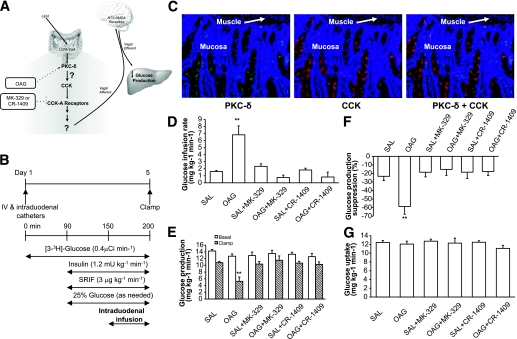
We first determined with immunofluorescence whether PKC-δ and CCK were colocalized within the duodenal mucosa. We then performed gain- and loss-of-function experiments targeting duodenal PKC-δ and the CCK-A receptor and evaluated the impact on changes in glucose kinetics during pancreatic (basal insulin) clamps in rats in vivo.
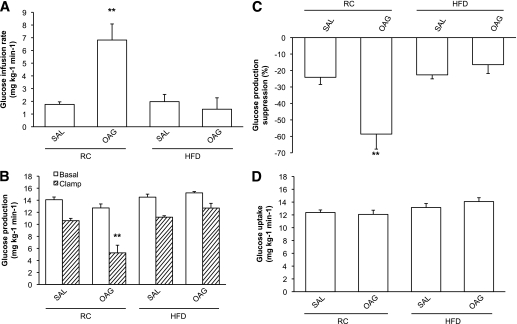
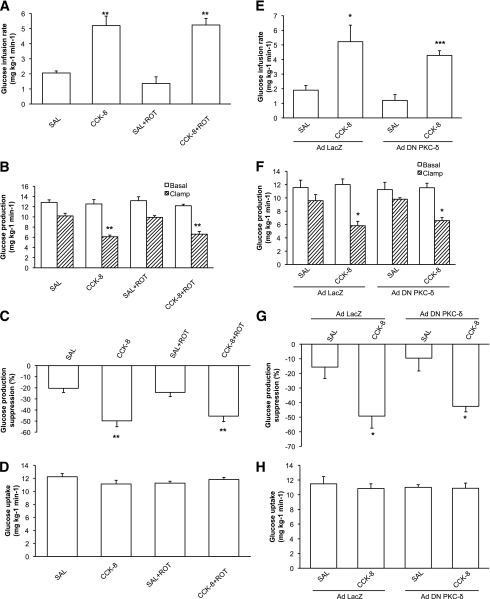
Immunostaining of PKC-δ was found to colocalize with CCK in the duodenal mucosa. Intraduodenal coinfusion of either the CCK-A receptor antagonist MK-329 or CR-1409 with the PKC activator negated the ability of duodenal mucosal PKC-δ activation to lower glucose production during the pancreatic clamps in normal rats. Conversely, molecular and pharmacological inhibition of duodenal PKC-δ did not negate the ability of the duodenal CCK-A receptor agonist CCK-8 to lower glucose production, indicating that activation of duodenal PKC-δ lies upstream (and not downstream) of CCK signaling. Finally, intraduodenal PKC activator infusion failed to lower glucose production in rats with high-fat diet-induced duodenal CCK resistance.
In summary, activation of duodenal PKC-δ leads to the stimulation of CCK release and activation of the CCK-A receptor signaling axis to lower glucose production in normal rats, but fails to bypass duodenal CCK-resistance in high fat-fed rats.
长链脂肪酸在十二指肠内的代谢会激活十二指肠黏膜蛋白激酶 C(PKC)-δ 和胆囊收缩素(CCK)-A 受体,通过神经网络降低葡萄糖生成。然而,十二指肠 PKC-δ 和 CCK 之间的互功能关系仍不清楚。尽管长链脂肪酸激活 PKC 以刺激 CCK 分泌细胞释放 CCK,但也发现 CCK 可以在胰腺腺泡细胞中激活 PKC-δ。我们在此评估十二指肠黏膜 PKC-δ 的激活是否位于 CCK 信号转导的上游(和/或下游)以降低葡萄糖生成。
我们首先通过免疫荧光确定 PKC-δ 和 CCK 是否在十二指肠黏膜中存在共定位。然后,我们进行了针对十二指肠 PKC-δ 和 CCK-A 受体的增益和失能实验,并评估了它们对体内大鼠胰腺(基础胰岛素)钳夹期间葡萄糖动力学变化的影响。
发现 PKC-δ 的免疫染色与十二指肠黏膜中的 CCK 共定位。在正常大鼠的胰腺钳夹期间,十二指肠内共输注 CCK-A 受体拮抗剂 MK-329 或 CR-1409 可消除十二指肠黏膜 PKC-δ 激活降低葡萄糖生成的能力。相反,十二指肠 PKC-δ 的分子和药理学抑制并没有消除十二指肠 CCK-A 受体激动剂 CCK-8 降低葡萄糖生成的能力,这表明十二指肠 PKC-δ 的激活位于 CCK 信号的上游(而不是下游)。最后,在高脂肪饮食诱导的十二指肠 CCK 抵抗大鼠中,十二指肠 PKC 激活剂输注未能降低葡萄糖生成。
总之,在正常大鼠中,激活十二指肠 PKC-δ 会刺激 CCK 释放并激活 CCK-A 受体信号轴以降低葡萄糖生成,但在高脂肪喂养的大鼠中无法绕过十二指肠 CCK 抵抗。