Srinivasan Muthiah, Mascarenhas Jeena, Rajaraman Revathi, Ravindran Meenakshi, Lalitha Prajna, Glidden David V, Ray Kathryn J, Hong Kevin C, Oldenburg Catherine E, Lee Salena M, Zegans Michael E, McLeod Stephen D, Lietman Thomas M, Acharya Nisha R
Departments of Cornea and External Diseases, Aravind Eye Care System, Madurai, India.
Arch Ophthalmol. 2012 Feb;130(2):143-50. doi: 10.1001/archophthalmol.2011.315. Epub 2011 Oct 10.
To determine whether there is a benefit in clinical outcomes with the use of topical corticosteroids as adjunctive therapy in the treatment of bacterial corneal ulcers.
Randomized, placebo-controlled, double-masked, multicenter clinical trial comparing prednisolone sodium phosphate, 1.0%, to placebo as adjunctive therapy for the treatment of bacterial corneal ulcers. Eligible patients had a culture-positive bacterial corneal ulcer and received topical moxifloxacin for at least 48 hours before randomization.
The primary outcome was best spectacle-corrected visual acuity (BSCVA) at 3 months from enrollment. Secondary outcomes included infiltrate/scar size, reepithelialization, and corneal perforation.
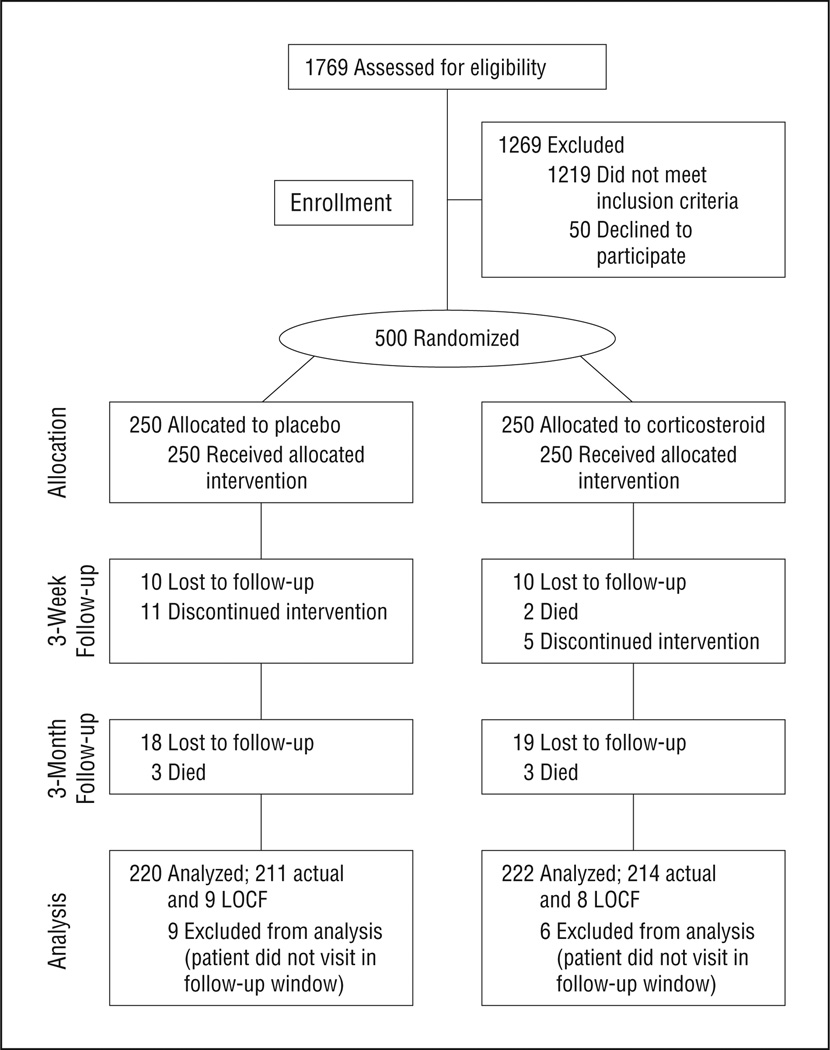
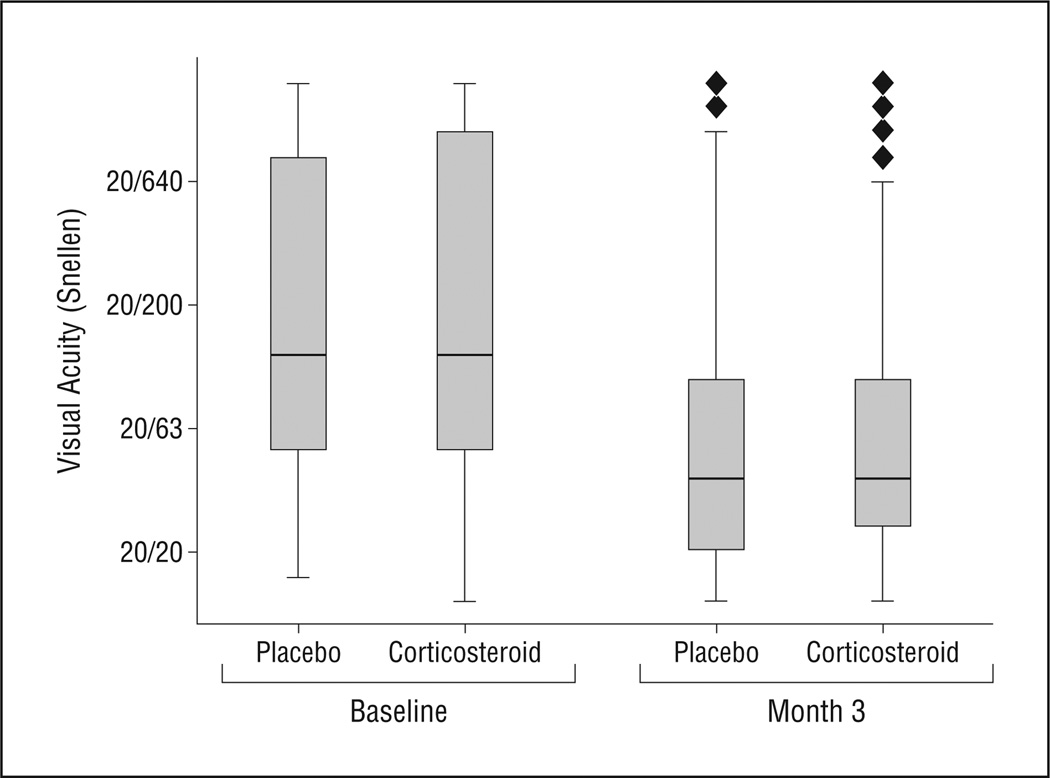
Between September 1, 2006, and February 22, 2010, 1769 patients were screened for the trial and 500 patients were enrolled. No significant difference was observed in the 3-month BSCVA (-0.009 logarithm of the minimum angle of resolution [logMAR]; 95% CI, -0.085 to 0.068; P = .82), infiltrate/scar size (P = .40), time to reepithelialization (P = .44), or corneal perforation (P > .99). A significant effect of corticosteroids was observed in subgroups of baseline BSCVA (P = .03) and ulcer location (P = .04). At 3 months, patients with vision of counting fingers or worse at baseline had 0.17 logMAR better visual acuity with corticosteroids (95% CI, -0.31 to -0.02; P = .03) compared with placebo, and patients with ulcers that were completely central at baseline had 0.20 logMAR better visual acuity with corticosteroids (-0.37 to -0.04; P = .02).
We found no overall difference in 3-month BSCVA and no safety concerns with adjunctive corticosteroid therapy for bacterial corneal ulcers.
Adjunctive topical corticosteroid use does not improve 3-month vision in patients with bacterial corneal ulcers.
clinicaltrials.gov Identifier: NCT00324168.
确定在细菌性角膜溃疡治疗中,使用局部皮质类固醇作为辅助治疗是否对临床结局有益。
一项随机、安慰剂对照、双盲、多中心临床试验,比较1.0%的磷酸泼尼松龙钠与安慰剂作为细菌性角膜溃疡辅助治疗的效果。符合条件的患者患有培养阳性的细菌性角膜溃疡,在随机分组前接受局部莫西沙星治疗至少48小时。
主要结局是入组后3个月的最佳矫正视力(BSCVA)。次要结局包括浸润/瘢痕大小、再上皮化和角膜穿孔。
在2006年9月1日至2010年2月22日期间,1769例患者被筛选进入试验,500例患者入组。在3个月的BSCVA方面未观察到显著差异(最小分辨角对数[logMAR]为-0.009;95%可信区间,-0.085至0.068;P = 0.82),浸润/瘢痕大小(P = 0.40)、再上皮化时间(P = 0.44)或角膜穿孔(P > 0.99)。在基线BSCVA亚组(P = 0.03)和溃疡位置亚组(P = 0.04)中观察到皮质类固醇有显著作用。在3个月时,基线视力为指数或更差的患者使用皮质类固醇后的视力比使用安慰剂的患者好0.17 logMAR(95%可信区间,-0.31至-0.02;P = 0.03),基线溃疡完全位于中央的患者使用皮质类固醇后的视力比使用安慰剂的患者好0.20 logMAR(-0.37至-0.04;P = 0.02)。
我们发现细菌性角膜溃疡辅助皮质类固醇治疗在3个月的BSCVA方面无总体差异,且无安全性问题。
辅助使用局部皮质类固醇不能改善细菌性角膜溃疡患者3个月时的视力。
clinicaltrials.gov标识符:NCT00324168。