Bradley/Hasbro Children's Research Center, Bradley Hospital, East Providence, RI, USA.
J Sleep Res. 2012 Jun;21(3):235-46. doi: 10.1111/j.1365-2869.2011.00962.x. Epub 2011 Oct 11.
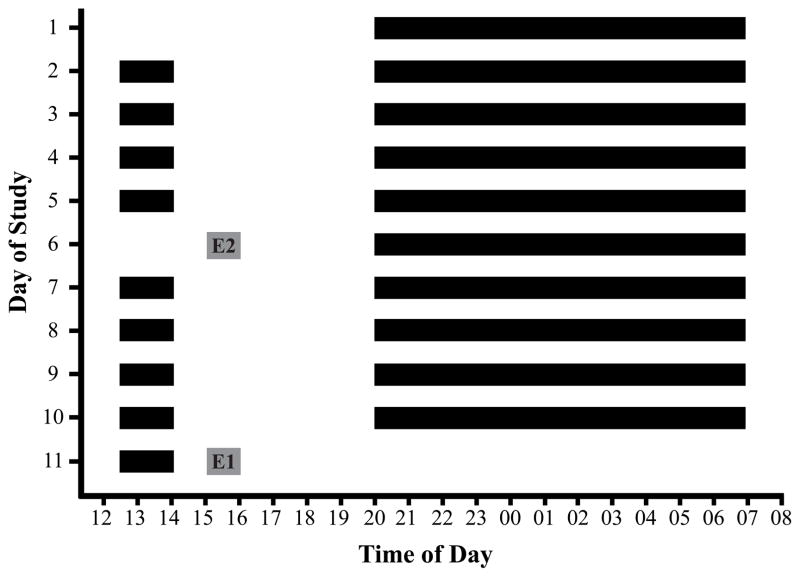
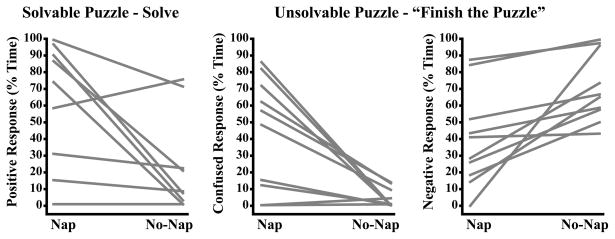
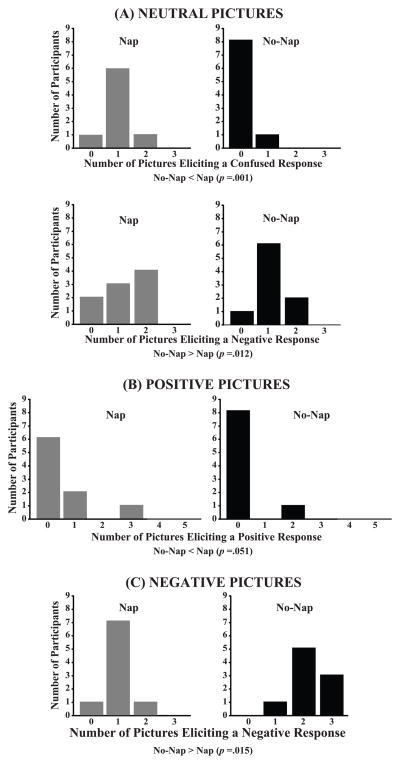
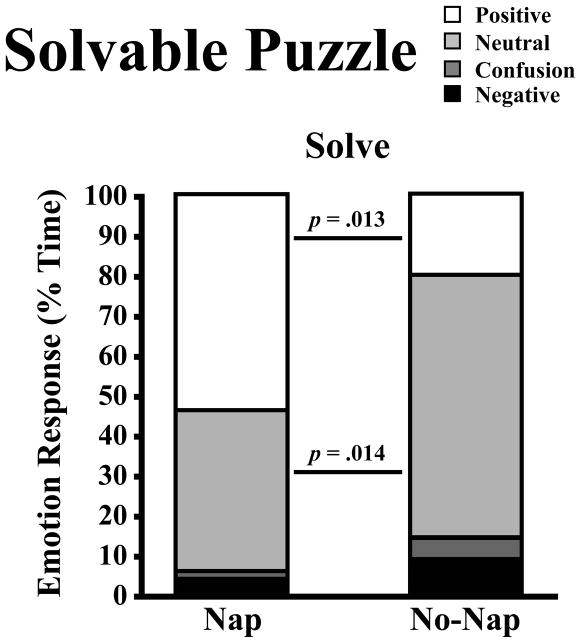
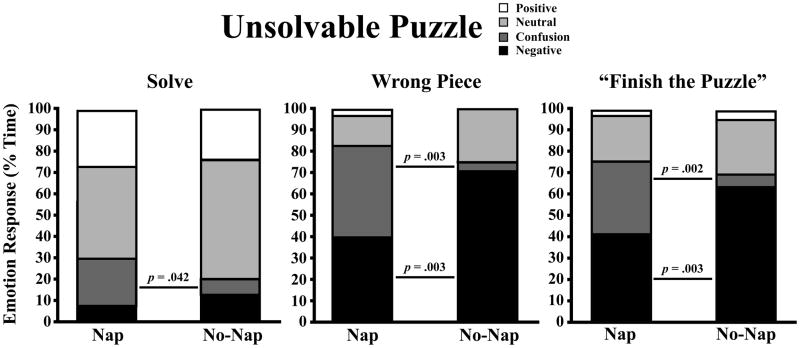
Early childhood is a period of dramatic change in sleep and emotion processing, as well as a time when disturbance in both domains are first detected. Although sleep is recognized as central in emotion processing and psychopathology, the great majority of experimental data have been collected in adults. We examined the effects of acute sleep restriction (nap deprivation) on toddlers' emotion expression. Ten healthy children (seven females; 30-36 months old) followed a strict sleep schedule (≥12.5 h time in bed per 24-h) for 5 days, before each of two randomly assigned afternoon emotion assessments following Nap and No-Nap conditions (resulting in an 11-day protocol). Children viewed emotion-eliciting pictures (five positive, three neutral, three negative) and completed puzzles (one solvable, one unsolvable). Children's faces were video-recorded, and emotion displays were coded. When sleep restricted, children displayed less confusion in response to neutral pictures, more negativity to neutral and negative pictures, and less positivity to positive pictures. Sleep restriction also resulted in a 34% reduction in positive emotion responses (solvable puzzle), as well as a 31% increase in negative emotion responses and a 39% decrease in confused responses (unsolvable puzzle). These findings suggest sleep is a key factor in how young children respond to their world. When sleep restricted, toddlers are neither able to take full advantage of positive experiences nor are they as adaptive in challenging contexts. If insufficient sleep consistently 'taxes' young children's emotion responses, they may not manage emotion regulation challenges effectively, potentially placing them at risk for future emotional/behavioral problems.
婴幼儿期是睡眠和情绪处理发生巨大变化的时期,也是这两个领域的问题首次被发现的时期。尽管睡眠被认为是情绪处理和精神病理学的核心,但绝大多数的实验数据都是在成年人中收集的。我们研究了急性睡眠限制(剥夺小睡)对幼儿情绪表达的影响。十名健康儿童(七名女性;30-36 个月大)遵循严格的睡眠时间表(每 24 小时有 12.5 小时以上的睡眠时间)5 天,然后在两个随机分配的下午情绪评估(在 Nap 和 No-Nap 条件下进行评估)之前进行(导致 11 天的方案)。孩子们观看了引起情绪的图片(五个积极的,三个中性的,三个消极的)并完成了拼图(一个可解决的,一个不可解决的)。孩子们的脸被录像记录下来,情绪表现被编码。当睡眠受到限制时,孩子们对中性图片的困惑减少,对中性和负面图片的负面情绪增加,对正面图片的正面情绪减少。睡眠限制还导致积极情绪反应(可解决的拼图)减少 34%,消极情绪反应增加 31%,困惑反应(不可解决的拼图)减少 39%。这些发现表明睡眠是幼儿对世界做出反应的关键因素。当睡眠受到限制时,幼儿既不能充分利用积极的体验,也不能在具有挑战性的环境中适应。如果睡眠不足持续“加重”幼儿的情绪反应,他们可能无法有效地管理情绪调节挑战,从而使他们面临未来情绪/行为问题的风险。