Department of Proteomics, School of Biotechnology, Royal Institute of Technology, AlbaNova University Center, Stockholm, Sweden.
PLoS One. 2011;6(10):e25791. doi: 10.1371/journal.pone.0025791. Epub 2011 Oct 3.
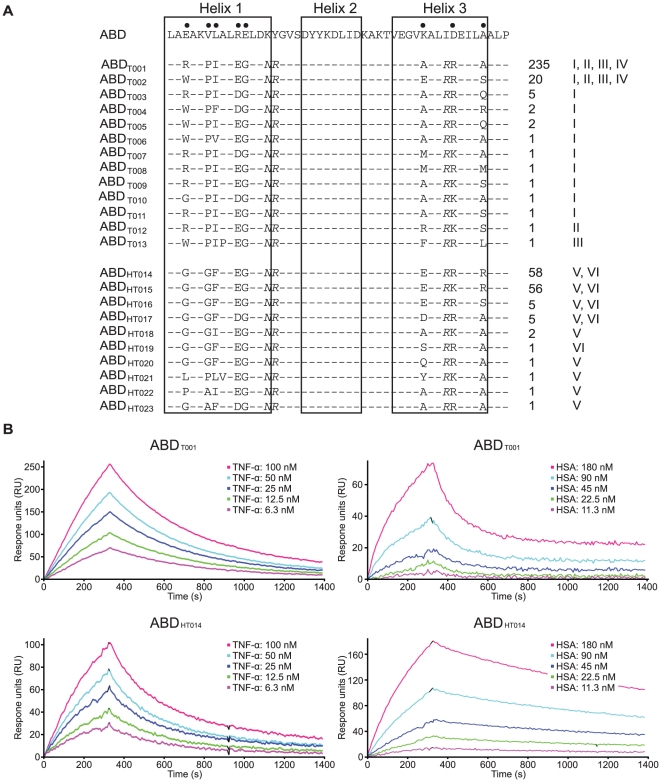
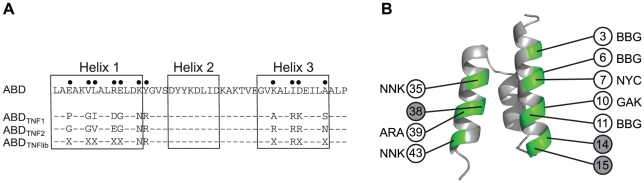
Bispecific antibodies as well as non-immunoglobulin based bispecific affinity proteins are considered to have a very high potential in future biotherapeutic applications. In this study, we report on a novel approach for generation of extremely small bispecific proteins comprised of only a single structural domain. Binding to tumor necrosis factor-α (TNF-α) was engineered into an albumin-binding domain while still retaining the original affinity for albumin, resulting in a bispecific protein composed of merely 46 amino acids. By diversification of the non albumin-binding side of the three-helix bundle domain, followed by display of the resulting library on phage particles, bispecific single-domain proteins were isolated using selections with TNF-α as target. Moreover, based on the obtained sequences from the phage selection, a second-generation library was designed in order to further increase the affinity of the bispecific candidates. Staphylococcal surface display was employed for the affinity maturation, enabling efficient isolation of improved binders as well as multiparameter-based sortings with both TNF-α and albumin as targets in the same selection cycle. Isolated variants were sequenced and the binding to albumin and TNF-α was analyzed. This analysis revealed an affinity for TNF-α below 5 nM for the strongest binders. From the multiparameter sorting that simultaneously targeted TNF-α and albumin, several bispecific candidates were isolated with high affinity to both antigens, suggesting that cell display in combination with fluorescence activated cell sorting is a suitable technology for engineering of bispecificity. To our knowledge, the new binders represent the smallest engineered bispecific proteins reported so far. Possibilities and challenges as well as potential future applications of this novel strategy are discussed.
双特异性抗体以及非免疫球蛋白类双特异性亲和力蛋白被认为在未来的生物治疗应用中有很高的潜力。在这项研究中,我们报告了一种新的方法,用于产生仅由单个结构域组成的极其微小的双特异性蛋白。我们将肿瘤坏死因子-α(TNF-α)的结合部位设计到白蛋白结合域中,同时保留对白蛋白的原始亲和力,从而产生了仅由 46 个氨基酸组成的双特异性蛋白。通过对三螺旋束结构域的非白蛋白结合侧进行多样化,然后在噬菌体颗粒上展示所得文库,使用 TNF-α作为靶标进行选择,分离出双特异性单结构域蛋白。此外,基于噬菌体选择获得的序列,设计了第二代文库,以进一步提高双特异性候选物的亲和力。采用葡萄球菌表面展示进行亲和力成熟,能够有效地分离出改进的结合物,并在同一个选择周期内同时以 TNF-α和白蛋白为靶标进行多参数分选。对分离出的变体进行测序,并分析其与白蛋白和 TNF-α的结合情况。分析结果显示,最强结合物对 TNF-α的亲和力低于 5 nM。通过同时针对 TNF-α和白蛋白的多参数分选,分离出了几个对两种抗原都具有高亲和力的双特异性候选物,这表明细胞展示与荧光激活细胞分选相结合是工程双特异性的一种合适技术。据我们所知,这些新的结合物代表了迄今为止报道的最小的工程化双特异性蛋白。讨论了这种新策略的可能性和挑战以及潜在的未来应用。