Fleetwood Filippa, Andersson Ken G, Ståhl Stefan, Löfblom John
Division of Protein technology, School of Biotechnology, KTH Royal Institute of Technology, Stockholm, Sweden.
Microb Cell Fact. 2014 Dec 30;13:179. doi: 10.1186/s12934-014-0179-z.
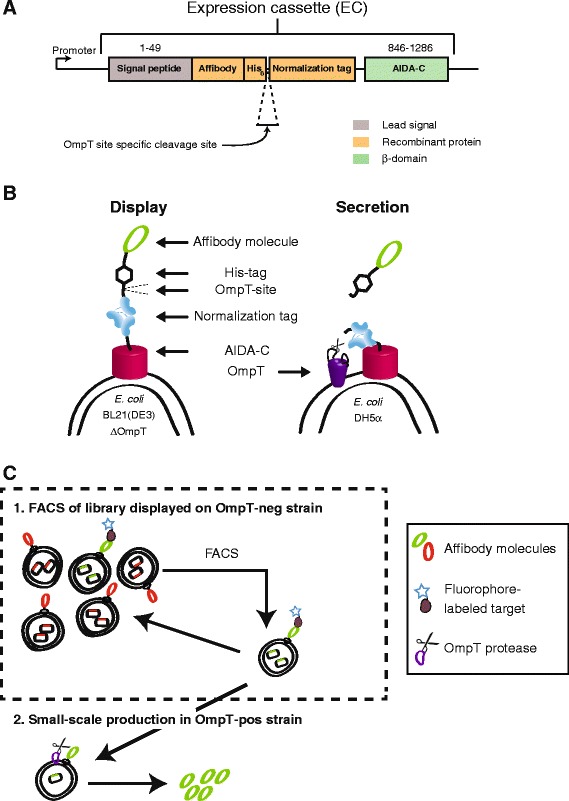
Cell display technologies (e.g. bacterial display) are attractive in directed evolution as they provide the option to use flow-cytometric cell sorting for selection from combinatorial libraries. The aim of this study was to engineer and investigate an expression vector system with dual functionalities: i) recombinant display of Affibody libraries on Escherichia coli for directed evolution and ii) small scale secreted production of candidate affinity proteins, allowing initial downstream characterizations prior to subcloning. Autotransporters form a class of surface proteins in Gram-negative bacteria that have potential for efficient translocation and tethering of recombinant passenger proteins to the outer membrane. We engineered a bacterial display vector based on the E. coli AIDA-I autotransporter for anchoring to the bacterial surface. Potential advantages of employing autotransporters combined with E. coli as host include: high surface expression level, high transformation frequency, alternative promoter systems available, efficient translocation to the outer membrane and tolerance for large multi-domain passenger proteins.
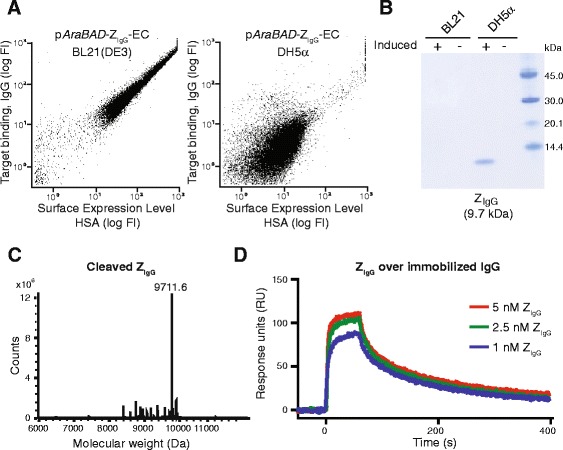
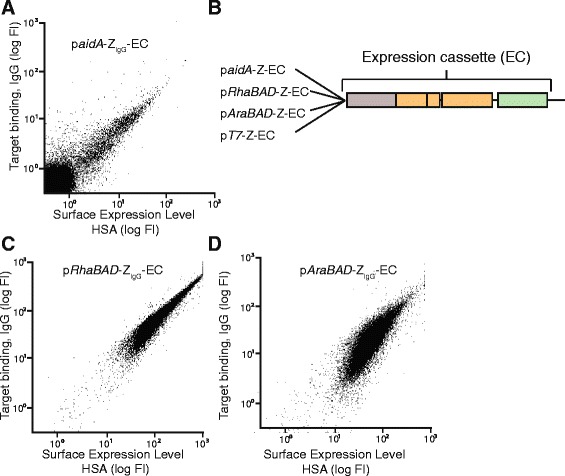
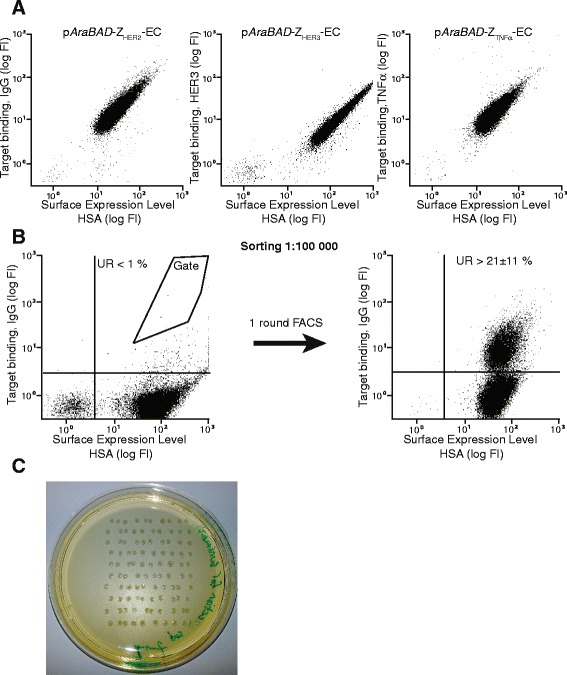
The new vector was designed to comprise an expression cassette encoding for an Affibody molecule, three albumin binding domains for monitoring of surface expression levels, an Outer membrane Protease T (OmpT) recognition site for potential protease-mediated secretion of displayed affinity proteins and a histidine-tag for purification. A panel of vectors with different promoters were generated and evaluated, and suitable cultivation conditions were investigated. The results demonstrated a high surface expression level of the different evaluated Affibody molecules, high correlation between target binding and surface expression level, high signal-to-background ratio, efficient secretion and purification of binders in OmpT-positive hosts as well as tight regulation of surface expression for the titratable promoters. Importantly, a mock selection using FACS from a 1:100,000 background yielded around 20,000-fold enrichment in a single round and high viability of the isolated bacteria after sorting.
The new expression vectors are promising for combinatorial engineering of Affibody molecules and the strategy for small-scale production of soluble recombinant proteins has the potential to increase throughput of the entire discovery process.
细胞展示技术(如细菌展示)在定向进化中具有吸引力,因为它们提供了使用流式细胞术细胞分选从组合文库中进行筛选的选择。本研究的目的是构建并研究一种具有双重功能的表达载体系统:i)在大肠杆菌上重组展示Affibody文库以进行定向进化,ii)小规模分泌产生候选亲和蛋白,以便在亚克隆之前进行初步的下游表征。自转运蛋白是革兰氏阴性细菌中的一类表面蛋白,具有将重组乘客蛋白有效转运并锚定到外膜的潜力。我们基于大肠杆菌AIDA-I自转运蛋白构建了一种细菌展示载体,用于锚定到细菌表面。使用自转运蛋白并结合大肠杆菌作为宿主的潜在优势包括:高表面表达水平、高转化频率、可用的替代启动子系统、有效转运到外膜以及对大型多结构域乘客蛋白的耐受性。
新载体设计为包含一个编码Affibody分子的表达盒、三个用于监测表面表达水平的白蛋白结合结构域、一个外膜蛋白酶T(OmpT)识别位点,用于潜在的蛋白酶介导的展示亲和蛋白的分泌以及一个用于纯化的组氨酸标签。构建并评估了一组具有不同启动子的载体,并研究了合适的培养条件。结果表明,不同评估的Affibody分子具有高表面表达水平,目标结合与表面表达水平之间具有高度相关性,高信噪比,在OmpT阳性宿主中结合物的有效分泌和纯化以及可滴定启动子对表面表达的严格调控。重要的是,使用流式细胞术从1:100,000背景中进行模拟筛选,在一轮中产生了约20,000倍的富集,并且分选后分离出的细菌具有高活力。
新的表达载体对于Affibody分子的组合工程很有前景,并且小规模生产可溶性重组蛋白的策略有可能提高整个发现过程的通量。