Department of Biochemistry and Cambridge Systems Biology Centre, University of Cambridge, Cambridge, United Kingdom.
PLoS Negl Trop Dis. 2011 Oct;5(10):e1320. doi: 10.1371/journal.pntd.0001320. Epub 2011 Oct 4.
The exacting nutritional requirements and complicated life cycles of parasites mean that they are not always amenable to high-throughput drug screening using automated procedures. Therefore, we have engineered the yeast Saccharomyces cerevisiae to act as a surrogate for expressing anti-parasitic targets from a range of biomedically important pathogens, to facilitate the rapid identification of new therapeutic agents.
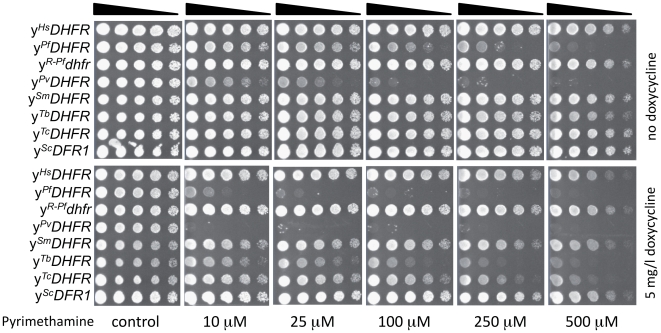
METHODOLOGY/PRINCIPAL FINDINGS: Using pyrimethamine/dihydrofolate reductase (DHFR) as a model parasite drug/drug target system, we explore the potential of engineered yeast strains (expressing DHFR enzymes from Plasmodium falciparum, P. vivax, Homo sapiens, Schistosoma mansoni, Leishmania major, Trypanosoma brucei and T. cruzi) to exhibit appropriate differential sensitivity to pyrimethamine. Here, we demonstrate that yeast strains (lacking the major drug efflux pump, Pdr5p) expressing yeast ((Sc)DFR1), human ((Hs)DHFR), Schistosoma ((Sm)DHFR), and Trypanosoma ((Tb)DHFR and (Tc)DHFR) DHFRs are insensitive to pyrimethamine treatment, whereas yeast strains producing Plasmodium ((Pf)DHFR and (Pv)DHFR) DHFRs are hypersensitive. Reassuringly, yeast strains expressing field-verified, drug-resistant mutants of P. falciparum DHFR ((Pf)dhfr(51I,59R,108N)) are completely insensitive to pyrimethamine, further validating our approach to drug screening. We further show the versatility of the approach by replacing yeast essential genes with other potential drug targets, namely phosphoglycerate kinases (PGKs) and N-myristoyl transferases (NMTs).
CONCLUSIONS/SIGNIFICANCE: We have generated a number of yeast strains that can be successfully harnessed for the rapid and selective identification of urgently needed anti-parasitic agents.
寄生虫对营养的严格要求和复杂的生命周期意味着,它们并不总是适合使用自动化程序进行高通量药物筛选。因此,我们已经设计了酵母酿酒酵母作为一种替代物,用于表达来自一系列重要生物医学病原体的抗寄生虫靶标,以促进新治疗药物的快速鉴定。
方法/主要发现:我们使用氨甲蝶呤/二氢叶酸还原酶(DHFR)作为寄生虫药物/药物靶标系统的模型,探索了表达疟原虫( Pf )、间日疟原虫( Pv )、人类( Hs )、曼氏血吸虫( Sm )、利什曼原虫( Lm )、布氏锥虫( Tb )和克氏锥虫( Tc ) DHFR 酶的工程酵母菌株的潜在应用,以表现出对氨甲蝶呤的适当差异敏感性。在这里,我们证明表达酵母( Sc ) DHFR1、人类( Hs ) DHFR、曼氏血吸虫( Sm )和布氏锥虫( Tb )和克氏锥虫( Tc ) DHFR 的酵母菌株(缺乏主要药物外排泵 Pdr5p )对氨甲蝶呤治疗不敏感,而产生疟原虫( Pf )和间日疟原虫( Pv ) DHFR 的酵母菌株对氨甲蝶呤敏感。令人欣慰的是,表达经过现场验证的抗疟药物耐药突变体 Pf DHFR( Pf dhfr (51I,59R,108N ))的酵母菌株对氨甲蝶呤完全不敏感,进一步验证了我们的药物筛选方法。我们还通过用其他潜在药物靶标(即磷酸甘油酸激酶(PGK )和 N-豆蔻酰转移酶(NMT ))替代酵母必需基因,进一步展示了该方法的多功能性。
结论/意义:我们已经产生了一些酵母菌株,可以成功地用于快速和选择性地鉴定急需的抗寄生虫药物。