Department of Pediatrics, University of Alabama at Birmingham, Birmingham, AL 35233, USA.
N Engl J Med. 2011 Oct 6;365(14):1284-92. doi: 10.1056/NEJMoa1003509.
Poor neurodevelopmental outcomes and recurrences of cutaneous lesions remain unacceptably frequent among survivors of neonatal herpes simplex virus (HSV) disease.
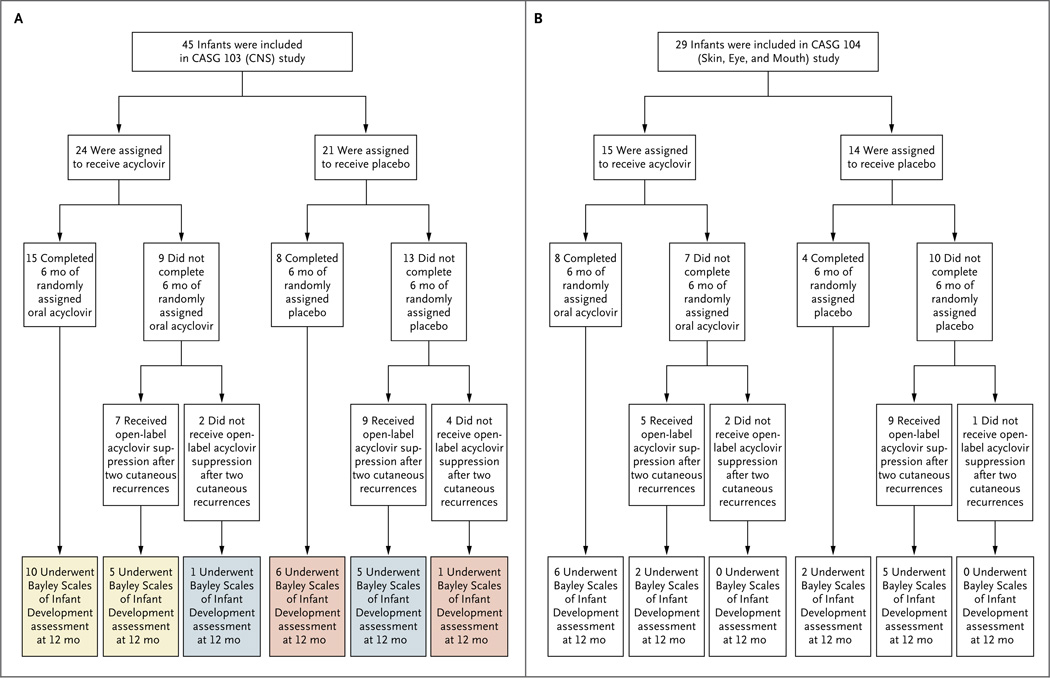
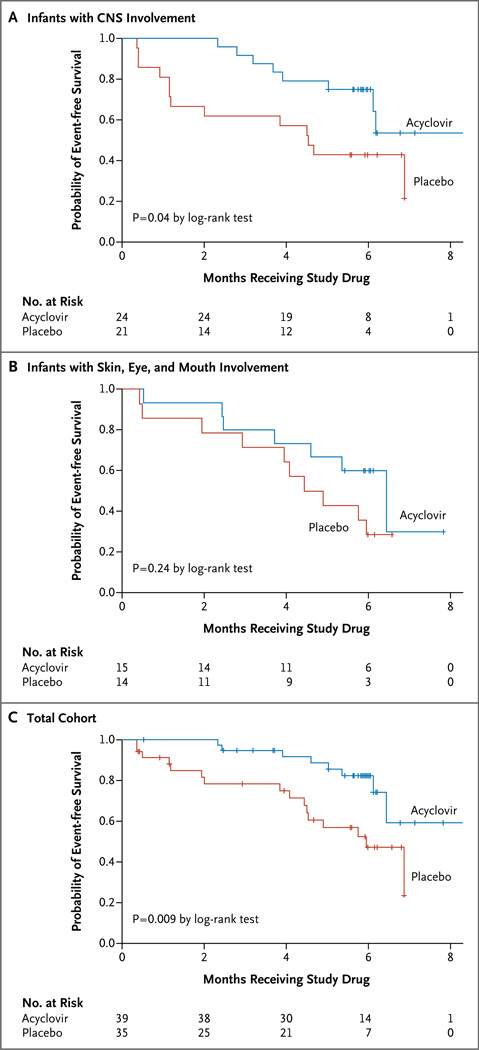
We enrolled neonates with HSV disease in two parallel, identical, double-blind, placebo-controlled studies. Neonates with central nervous system (CNS) involvement were enrolled in one study, and neonates with skin, eye, and mouth involvement only were enrolled in the other. After completing a regimen of 14 to 21 days of parenteral acyclovir, the infants were randomly assigned to immediate acyclovir suppression (300 mg per square meter of body-surface area per dose orally, three times daily for 6 months) or placebo. Cutaneous recurrences were treated with open-label episodic therapy.
A total of 74 neonates were enrolled--45 with CNS involvement and 29 with skin, eye, and mouth disease. The Mental Development Index of the Bayley Scales of Infant Development (in which scores range from 50 to 150, with a mean of 100 and with higher scores indicating better neurodevelopmental outcomes) was assessed in 28 of the 45 infants with CNS involvement (62%) at 12 months of age. After adjustment for covariates, infants with CNS involvement who had been randomly assigned to acyclovir suppression had significantly higher mean Bayley mental-development scores at 12 months than did infants randomly assigned to placebo (88.24 vs. 68.12, P=0.046). Overall, there was a trend toward more neutropenia in the acyclovir group than in the placebo group (P=0.09).
Infants surviving neonatal HSV disease with CNS involvement had improved neurodevelopmental outcomes when they received suppressive therapy with oral acyclovir for 6 months. (Funded by the National Institute of Allergy and Infectious Diseases; CASG 103 and CASG 104 ClinicalTrials.gov numbers, NCT00031460 and NCT00031447, respectively.).
单纯疱疹病毒(HSV)新生儿感染的幸存者神经发育不良和皮肤损伤复发的情况仍然频繁发生,无法接受。
我们纳入了患有 HSV 疾病的新生儿,这些新生儿参与了两项平行、相同、双盲、安慰剂对照研究。一项研究纳入了中枢神经系统(CNS)受累的新生儿,另一项研究纳入了仅皮肤、眼和口腔受累的新生儿。在完成 14 至 21 天的阿昔洛韦静脉治疗后,婴儿被随机分为立即阿昔洛韦抑制组(每平方米体表面积 300 毫克,口服,每日 3 次,持续 6 个月)或安慰剂组。皮肤复发采用开放性间歇治疗。
共有 74 名新生儿入组,其中 45 名患有 CNS 受累,29 名患有皮肤、眼和口腔疾病。在 45 名患有 CNS 受累的婴儿中有 28 名(62%)在 12 个月时接受了贝利婴幼儿发育量表(评分范围为 50 至 150,平均 100,分数越高表示神经发育结果越好)的精神发育指数评估。在调整了协变量后,随机分配到阿昔洛韦抑制组的 CNS 受累婴儿在 12 个月时的平均贝利精神发育评分显著高于随机分配到安慰剂组的婴儿(88.24 对 68.12,P=0.046)。总体而言,阿昔洛韦组的中性粒细胞减少症发生率高于安慰剂组(P=0.09)。
患有 CNS 受累的新生儿单纯疱疹病毒感染存活者,接受口服阿昔洛韦 6 个月的抑制治疗后,神经发育结果得到改善。(由美国国立过敏和传染病研究所资助;CASG 103 和 CASG 104 临床试验.gov 编号,NCT00031460 和 NCT00031447)。