Bioinformatics (HUSAR), Core Facility Genomics and Proteomics, German Cancer Research Center, D-69120 Heidelberg, Germany.
BMC Bioinformatics. 2011;12 Suppl 4(Suppl 4):S2. doi: 10.1186/1471-2105-12-S4-S2. Epub 2011 Jul 5.
Some single nucleotide polymorphisms (SNPs) are known to modify the risk of developing certain diseases or the reaction to drugs. Due to next generation sequencing methods the number of known human SNPs has grown. Not all SNPs lead to a modified protein, which may be the origin of a disease. Therefore, the recognition of functional SNPs is needed. Because most SNP annotation tools look for SNPs which lead to an amino acid exchange or a premature stop, we designed a new tool called AASsites which searches for SNPs which modify splicing.
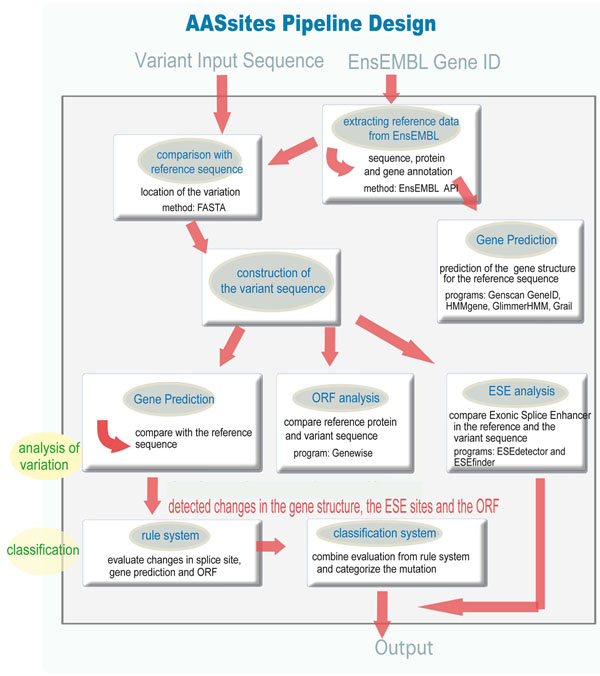
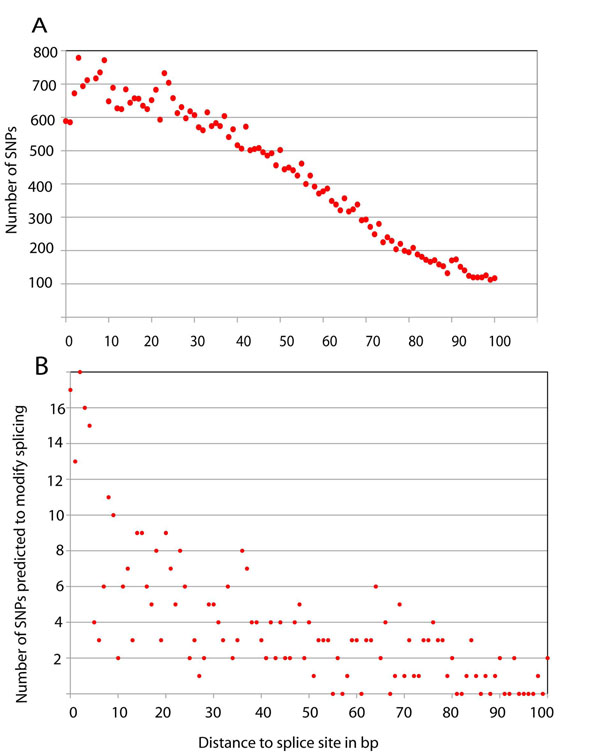
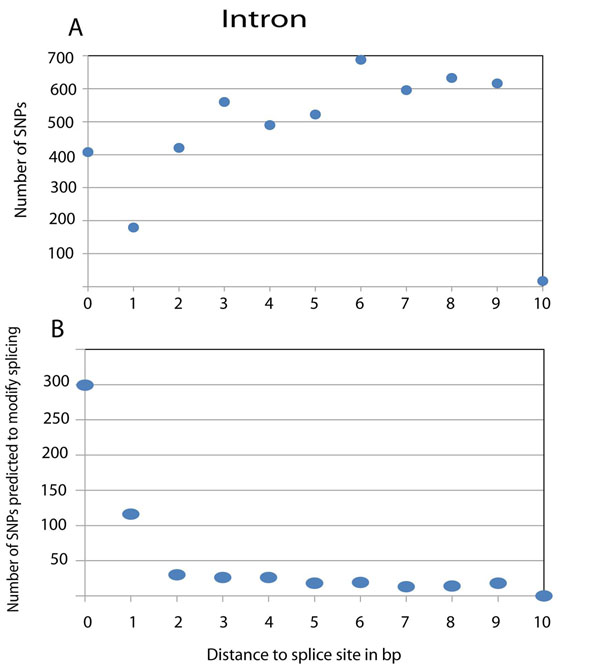
AASsites uses several gene prediction programs and open reading frame prediction to compare the wild type (wt) and the variant gene sequence. The results of the comparison are combined by a handmade rule system to classify a change in splicing as "likely, probable, unlikely". Having received good results from tests with SNPs known for changing the splicing pattern we checked 80,000 SNPs from the human genome which are located near splice sites for their ability to change the splicing pattern of the gene and hereby result in a different protein. We identified 301 "likely" and 985 "probable" classified SNPs with such characteristics. Within this set 33 SNPs are described in the ssSNP Target database to cause modified splicing.
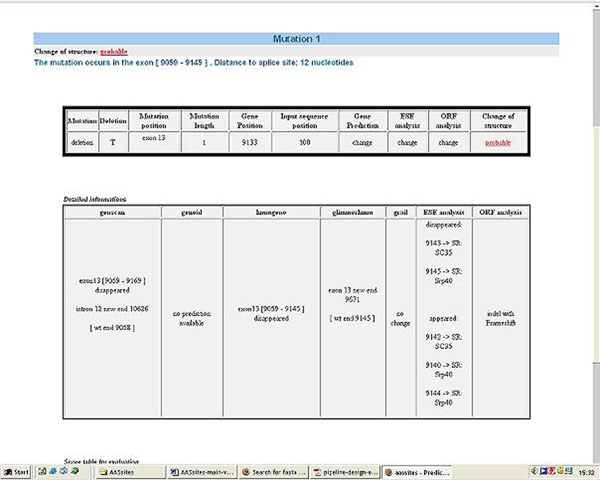
With AASsites single SNPs can be checked for those causing splice modifications. Screening 80,000 known human SNPs we detected about 1,200 SNPs which probably modify splicing. AASsites is available at http://genius.embnet.dkfz-heidelberg.de/menu/biounit/open-husar using any web browser.
一些单核苷酸多态性(SNPs)已知可以改变某些疾病的发病风险或对药物的反应。由于下一代测序方法的出现,已知的人类 SNPs 数量不断增加。并非所有 SNPs 都会导致蛋白质发生改变,而这种改变可能是疾病的起源。因此,需要识别功能性 SNPs。由于大多数 SNP 注释工具都在寻找导致氨基酸替换或过早停止的 SNPs,我们设计了一种名为 AASsites 的新工具,用于搜索改变剪接的 SNPs。
AASsites 使用几种基因预测程序和开放阅读框预测来比较野生型(wt)和变体基因序列。比较的结果通过手工制作的规则系统进行组合,将剪接的变化分类为“可能、很可能、不太可能”。在使用已知改变剪接模式的 SNPs 进行测试后取得了良好的效果,我们检查了人类基因组中 80000 个位于剪接位点附近的 SNPs,以确定它们是否能够改变基因的剪接模式,从而产生不同的蛋白质。我们确定了 301 个“可能”和 985 个“很可能”具有这种特征的分类 SNPs。在这个集合中,33 个 SNPs 被 ssSNP Target 数据库描述为导致剪接改变。
使用 AASsites,可以检查单个 SNPs 是否存在导致剪接修饰的可能性。在筛查 80000 个已知的人类 SNPs 时,我们检测到约 1200 个可能改变剪接的 SNPs。AASsites 可在任何网络浏览器上通过 http://genius.embnet.dkfz-heidelberg.de/menu/biounit/open-husar 进行访问。