• 文献检索
  • 文档翻译
  • 深度研究
  • 学术资讯
  • Suppr Zotero 插件Zotero 插件
  • 邀请有礼
  • 套餐&价格
  • 历史记录
应用&插件
Suppr Zotero 插件Zotero 插件浏览器插件Mac 客户端Windows 客户端微信小程序
定价
高级版会员购买积分包购买API积分包
服务
文献检索文档翻译深度研究API 文档MCP 服务
关于我们
关于 Suppr公司介绍联系我们用户协议隐私条款
关注我们

Suppr 超能文献

核心技术专利:CN118964589B侵权必究
粤ICP备2023148730 号-1Suppr @ 2026

文献检索

告别复杂PubMed语法,用中文像聊天一样搜索,搜遍4000万医学文献。AI智能推荐,让科研检索更轻松。

立即免费搜索

文件翻译

保留排版,准确专业,支持PDF/Word/PPT等文件格式,支持 12+语言互译。

免费翻译文档

深度研究

AI帮你快速写综述,25分钟生成高质量综述,智能提取关键信息,辅助科研写作。

立即免费体验

美国急诊医师学会(ACEP)建议及急诊晕厥患者风险分层评分(OESIL)的应用

Application Of The American College Of Emergency Physicians (ACEP) Recommendations And a Risk Stratification Score (OESIL) For Patients With Syncope Admitted From The Emergency Department.

作者信息

Baranchuk Adrian, McIntyre William, Harper William, Morillo Carlos A

机构信息

Queen's University, Arrhythmia Service, Kingston, ON, Canada.

出版信息

Indian Pacing Electrophysiol J. 2011 Sep;11(5):134-44. Epub 2011 Oct 2.

PMID:21994471
原文链接:https://pmc.ncbi.nlm.nih.gov/articles/PMC3184449/
Abstract

AIMS

The goals of this study were to apply the 2001 ACEP recommendations for admission to hospital after a syncopal event and to validate the OESIL risk stratification score, in patients with syncope admitted to a general internal medicine ward.

METHODS

A retrospective study applied the 2001 ACEP recommendations and OESIL score to all the patients admitted from the emergency department to a general internal medicine ward with a diagnosis of syncope during a 12-month period. The patients were classified as meeting criteria for 2001 ACEP class B or C recommendations and OESIL score 0-1 (low-risk for a major cardiac event) or 2-4 (high-risk for a major cardiac event). The sensitivity and specificity of each group for predicting high-risk patients was calculated.

RESULTS

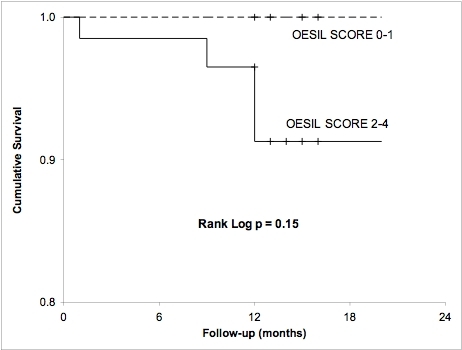
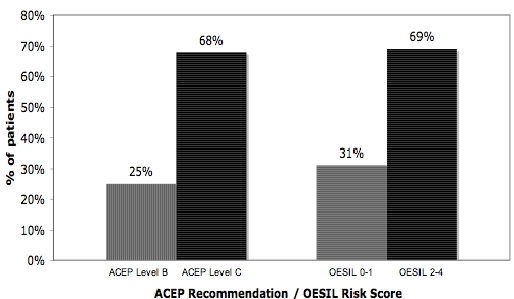
After applying the 2001 ACEP recommendations to our population, 25% (19 patients) were classified as level B, whereas 68% of the patients were classified as Level C. Sensitivity for ACEP level B recommendations was 100% and specificity was 81%. The ACEP level C recommendations also had 100% sensitivity but markedly reduced specificity at 26%. An OESIL score of 0-1 points was calculated for 30.6% of the population, identifying them as low-risk. An OESIL score of 2-4 points was documented in the remaining 69.4% with a mortality risk of 20 % /year.

CONCLUSION

A significant proportion (30%) of patients presenting with syncope to a tertiary care University Hospital emergency department and admitted to an Internal Medicine ward were retrospectively classified as low-risk and could have potentially been managed as outpatients. Implementing current guidelines and clinical pathways for the management of syncope may improve this approach.

摘要

目的

本研究的目标是应用2001年美国急诊医师学会(ACEP)关于晕厥事件后入院的建议,并验证OESIL风险分层评分,研究对象为入住普通内科病房的晕厥患者。

方法

一项回顾性研究将2001年ACEP建议和OESIL评分应用于在12个月期间从急诊科收治到普通内科病房且诊断为晕厥的所有患者。患者被分类为符合2001年ACEP B级或C级建议标准,以及OESIL评分为0 - 1分(重大心脏事件低风险)或2 - 4分(重大心脏事件高风险)。计算每组预测高风险患者的敏感性和特异性。

结果

将2001年ACEP建议应用于我们的研究人群后,25%(19例患者)被分类为B级,而68%的患者被分类为C级。ACEP B级建议的敏感性为100%,特异性为81%。ACEP C级建议的敏感性也为100%,但特异性显著降低,为26%。30.6%的人群OESIL评分为0 - 1分,被确定为低风险。其余69.4%的人群OESIL评分为2 - 4分,年死亡风险为20%。

结论

在一家三级医疗大学医院急诊科就诊并入住内科病房的晕厥患者中,相当比例(30%)的患者经回顾性分类为低风险,可能原本可以作为门诊患者处理。实施当前晕厥管理指南和临床路径可能会改善这种处理方式。
https://cdn.ncbi.nlm.nih.gov/pmc/blobs/ff63/3184449/1925f7602dc7/ipej110134-02.jpg
https://cdn.ncbi.nlm.nih.gov/pmc/blobs/ff63/3184449/f8cc3ee4efd1/ipej110134-01.jpg
https://cdn.ncbi.nlm.nih.gov/pmc/blobs/ff63/3184449/1925f7602dc7/ipej110134-02.jpg
https://cdn.ncbi.nlm.nih.gov/pmc/blobs/ff63/3184449/f8cc3ee4efd1/ipej110134-01.jpg
https://cdn.ncbi.nlm.nih.gov/pmc/blobs/ff63/3184449/1925f7602dc7/ipej110134-02.jpg

相似文献

1
Application Of The American College Of Emergency Physicians (ACEP) Recommendations And a Risk Stratification Score (OESIL) For Patients With Syncope Admitted From The Emergency Department.美国急诊医师学会(ACEP)建议及急诊晕厥患者风险分层评分(OESIL)的应用
Indian Pacing Electrophysiol J. 2011 Sep;11(5):134-44. Epub 2011 Oct 2.
2
Impact of the application of the American College of Emergency Physicians recommendations for the admission of patients with syncope on a retrospectively studied population presenting to the emergency department.美国急诊医师学会关于晕厥患者入院建议的应用对回顾性研究的急诊科就诊人群的影响。
Am Heart J. 2005 May;149(5):826-31. doi: 10.1016/j.ahj.2004.07.024.
3
The Risk stratification Of Syncope in the Emergency department (ROSE) pilot study: a comparison of existing syncope guidelines.急诊科晕厥风险分层(ROSE)试点研究:现有晕厥指南的比较
Emerg Med J. 2007 Apr;24(4):270-5. doi: 10.1136/emj.2006.042739.
4
Relative utility of serum troponin and the OESIL score in syncope.血清肌钙蛋白和OESIL评分在晕厥中的相对效用
Emerg Med Australas. 2005 Feb;17(1):31-8. doi: 10.1111/j.1742-6731.2005.00678.x.
5
[Determination of prognostic value of the OESIL risk score at 6 months in a Colombian cohort with syncope evaluated in the emergency department; first Latin American experience].
Arch Cardiol Mex. 2018 Jul-Sep;88(3):197-203. doi: 10.1016/j.acmx.2017.06.007. Epub 2017 Jul 14.
6
The EGSYS and OESIL risk scores for classification of cardiac etiology of syncope: comparison, revaluation, and clinical implications.用于晕厥心脏病因分类的EGSYS和OESIL风险评分:比较、重新评估及临床意义
Biomed Pap Med Fac Univ Palacky Olomouc Czech Repub. 2010 Jun;154(2):169-73. doi: 10.5507/bp.2010.026.
7
Development and prospective validation of a risk stratification system for patients with syncope in the emergency department: the OESIL risk score.急诊科晕厥患者风险分层系统的开发与前瞻性验证:OESIL风险评分
Eur Heart J. 2003 May;24(9):811-9. doi: 10.1016/s0195-668x(02)00827-8.
8
Comparing an Unstructured Risk Stratification to Published Guidelines in Acute Coronary Syndromes.急性冠状动脉综合征中无结构化风险分层与已发表指南的比较。
West J Emerg Med. 2015 Sep;16(5):683-9. doi: 10.5811/westjem.2015.6.16315. Epub 2015 Oct 20.
9
Application of the recent American practice resources for risk stratification system for patients presenting to a Japanese emergency department because of syncope.将美国近期针对因晕厥前往日本急诊科就诊患者的风险分层系统应用于实际。
Int Heart J. 2007 Jul;48(4):513-22. doi: 10.1536/ihj.48.513.
10
Predictors of hospitalization in patients with syncope assisted in specialized cardiology hospital.晕厥患者住院的预测因素。
Arq Bras Cardiol. 2013 Dec;101(6):480-6. doi: 10.5935/abc.20130206. Epub 2013 Oct 22.

本文引用的文献

1
Knowledge translation of the American College of Emergency Physicians' clinical policy on syncope using computerized clinical decision support.利用计算机化临床决策支持系统对美国急诊医师学会晕厥临床政策进行知识转化。
Int J Emerg Med. 2010 Jun 1;3(2):97-104. doi: 10.1007/s12245-010-0168-x.
2
Epidemiological characteristics and diagnostic approach in patients admitted to the emergency room for transient loss of consciousness: Group for Syncope Study in the Emergency Room (GESINUR) study.因短暂意识丧失而到急诊科就诊患者的流行病学特征和诊断方法:急诊科晕厥研究组(GESINUR)研究。
Europace. 2010 Jun;12(6):869-76. doi: 10.1093/europace/euq018. Epub 2010 Mar 9.
3
Prospective multicentre systematic guideline-based management of patients referred to the Syncope Units of general hospitals.
前瞻性多中心基于指南的综合医院晕厥单元患者管理。
Europace. 2010 Jan;12(1):109-18. doi: 10.1093/europace/eup370.
4
Guidelines for the diagnosis and management of syncope (version 2009).晕厥诊断与处理指南(2009年版)
Eur Heart J. 2009 Nov;30(21):2631-71. doi: 10.1093/eurheartj/ehp298. Epub 2009 Aug 27.
5
Routine electrocardiogram and medical history in syncope: a simple approach can identify most high-risk patients.晕厥患者的常规心电图和病史:一种简单方法可识别大多数高危患者。
Europace. 2009 Nov;11(11):1411-2. doi: 10.1093/europace/eup230. Epub 2009 Aug 25.
6
Clinical policy: critical issues in the evaluation and management of adult patients presenting to the emergency department with syncope.临床政策:急诊科成年晕厥患者评估与管理中的关键问题
Ann Emerg Med. 2007 Apr;49(4):431-44. doi: 10.1016/j.annemergmed.2007.02.001.
7
Diagnostic criteria for vasovagal syncope based on a quantitative history.基于定量病史的血管迷走性晕厥诊断标准。
Eur Heart J. 2006 Feb;27(3):344-50. doi: 10.1093/eurheartj/ehi584. Epub 2005 Oct 13.
8
Impact of the application of the American College of Emergency Physicians recommendations for the admission of patients with syncope on a retrospectively studied population presenting to the emergency department.美国急诊医师学会关于晕厥患者入院建议的应用对回顾性研究的急诊科就诊人群的影响。
Am Heart J. 2005 May;149(5):826-31. doi: 10.1016/j.ahj.2004.07.024.
9
Syncope Evaluation in the Emergency Department Study (SEEDS): a multidisciplinary approach to syncope management.急诊科晕厥评估研究(SEEDS):晕厥管理的多学科方法。
Circulation. 2004 Dec 14;110(24):3636-45. doi: 10.1161/01.CIR.0000149236.92822.07. Epub 2004 Nov 9.
10
Characteristics and admission patterns of patients presenting with syncope to U.S. emergency departments, 1992-2000.1992年至2000年美国急诊科晕厥患者的特征及入院模式。
Acad Emerg Med. 2004 Oct;11(10):1029-34. doi: 10.1197/j.aem.2004.05.032.