Virus Surveillance and Diagnosis Branch, Influenza Division, National Center for Immunization and Respiratory Diseases, Centers for Disease Control and Prevention, 1600 Clifton Rd NE, Mailstop G16, Atlanta, GA 30333, USA.
Atlanta Research and Education Foundation, 1670 Clairmont Rd, 151F, Decatur, GA 30033, USA.
Viruses. 2010 Oct;2(10):2269-2289. doi: 10.3390/v2102269. Epub 2010 Oct 13.
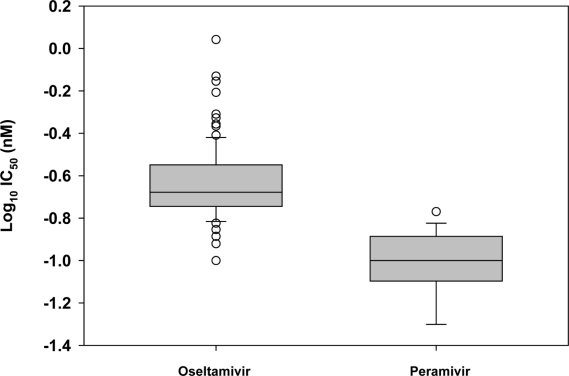
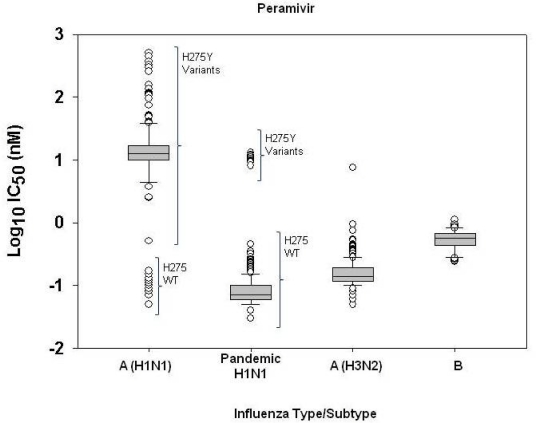
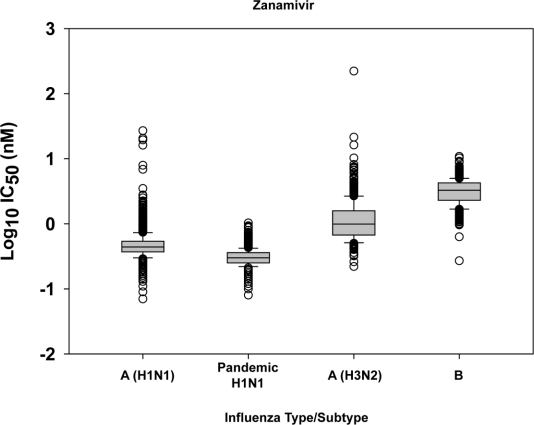
Neuraminidase inhibitors (NAIs) are vital in managing seasonal and pandemic influenza infections. NAI susceptibilities of virus isolates (n = 5540) collected during the 2008-2009 influenza season were assessed in the chemiluminescent neuraminidase inhibition (NI) assay. Box-and-whisker plot analyses of log-transformed IC(50)s were performed for each virus type/subtype and NAI to identify outliers which were characterized based on a statistical cutoff of IC(50) >3 interquartile ranges (IQR) from the 75(th) percentile. Among 1533 seasonal H1N1 viruses tested, 1431 (93.3%) were outliers for oseltamivir; they all harbored the H275Y mutation in the neuraminidase (NA) and were reported as oseltamivir-resistant. Only 15 (0.7%) of pandemic 2009 H1N1 viruses tested (n = 2259) were resistant to oseltamivir. All influenza A(H3N2) (n = 834) and B (n = 914) viruses were sensitive to oseltamivir, except for one A(H3N2) and one B virus, with D151V and D197E (D198E in N2 numbering) mutations in the NA, respectively. All viruses tested were sensitive to zanamivir, except for six seasonal A(H1N1) and several A(H3N2) outliers (n = 22) which exhibited cell culture induced mutations at residue D151 of the NA. A subset of viruses (n = 1058) tested for peramivir were sensitive to the drug, with exception of H275Y variants that exhibited reduced susceptibility to this NAI. This study summarizes baseline susceptibility patterns of seasonal and pandemic influenza viruses, and seeks to contribute towards criteria for defining NAI resistance.
神经氨酸酶抑制剂(NAIs)在管理季节性和大流行性流感感染方面至关重要。在化学发光神经氨酸酶抑制(NI)测定中评估了 2008-2009 流感季节收集的病毒分离物(n = 5540)的 NAI 敏感性。对每种病毒类型/亚型和 NAI 的对数转换 IC 50进行了箱线图分析,以确定离群值,这些离群值基于 IC 50的统计截止值(超过第 75 个百分位数的 3 个四分位距(IQR))来定义。在测试的 1533 种季节性 H1N1 病毒中,有 1431 种(93.3%)对奥司他韦呈离群值;它们都在神经氨酸酶(NA)中携带 H275Y 突变,并被报告为奥司他韦耐药。在测试的 2009 年大流行 H1N1 病毒(n = 2259)中,只有 15 种(0.7%)对奥司他韦耐药。除了一个 A(H3N2)和一个 B 病毒,它们在 NA 中分别具有 D151V 和 D197E(N2 编号中的 D198E)突变外,所有流感 A(H3N2)(n = 834)和 B(n = 914)病毒均对奥司他韦敏感。除了六个季节性 A(H1N1)和几个 A(H3N2)离群值(n = 22)在 NA 中具有 D151 残基的细胞培养诱导突变外,所有测试的病毒均对扎那米韦敏感。测试的喷昔洛韦药物的亚组病毒(n = 1058)对药物敏感,除了 H275Y 变体对这种 NAI 的敏感性降低。这项研究总结了季节性和大流行性流感病毒的基线敏感性模式,并有助于确定 NAI 耐药性的标准。