Department of Microbiology and Immunology, Albert Einstein College of Medicine, Bronx, NY 10461, USA.
Viruses. 2011 May;3(5):423-8. doi: 10.3390/v3050423. Epub 2011 Apr 27.
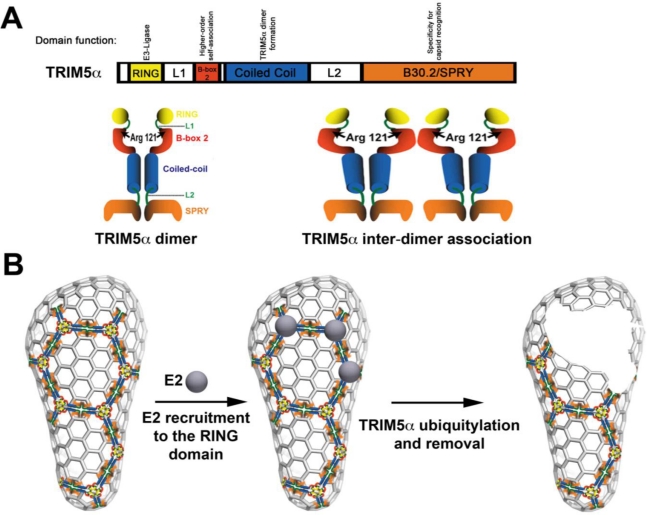
The potent HIV-1 inhibitor TRIM5α blocks HIV-1 infection by accelerating the uncoating of HIV-1. TRIM5α is known to form higher-order self-association complexes that contribute to the avidity of TRIM5α for the HIV-1 capsid, and are essential to inhibit infection; these higher-order self-association complexes are dependent upon an intact B-box 2 domain. Even though the ability to form higher-order self-association complexes resembles the clathrin triskelion that forms a protein array, or cage, around the endocytic vesicle, evidence for the ability of TRIM5α to assemble a similar type of structure surrounding the HIV-1 core has been lacking. Recent work by Ganser-Pornillos, Chandrasekaran and colleagues has now demonstrated the ability of the restriction factor TRIM5α to "cage" or "net" the HIV-1 core by forming an hexagonal array on the surface of the viral capsid. This hexagonal array is strikingly similar in design to the array formed by the clathrin triskelion on the surface of the clathrin-coated endocytic vesicle. This remarkable finding represents an important advance on our understanding of the restriction factor TRIM5α, and suggests that TRIM5α cages the HIV-1 core in order to terminate infection. The present note discusses the implications of this discovery.
强效 HIV-1 抑制剂 TRIM5α 通过加速 HIV-1 的脱壳来阻止 HIV-1 感染。TRIM5α 已知形成更高阶的自组装复合物,有助于 TRIM5α 对 HIV-1 衣壳的亲和力,并且对于抑制感染至关重要;这些高阶自组装复合物依赖于完整的 B-box 2 结构域。尽管形成高阶自组装复合物的能力类似于形成围绕内吞小泡的蛋白质阵列或笼的网格蛋白三聚体,但缺乏 TRIM5α 组装围绕 HIV-1 核心的类似结构的证据。最近,Ganser-Pornillos、Chandrasekaran 和同事的研究表明,限制因子 TRIM5α 通过在病毒衣壳表面形成六方阵列,能够“笼状”或“网捕”HIV-1 核心。这种六方阵列在设计上与网格蛋白三聚体在网格蛋白包被的内吞小泡表面形成的阵列非常相似。这一惊人的发现代表了我们对限制因子 TRIM5α 的理解的重要进展,并表明 TRIM5α 笼子状的 HIV-1 核心以终止感染。本说明讨论了这一发现的意义。