Lauzon Carolyn B, Asman Andrew J, Crainiceanu Ciprian, Caffo Brian C, Landman Bennett A
Department of Electrical Engineering, Vanderbilt University, Nashville, TN, USA.
Med Image Comput Comput Assist Interv. 2011;14(Pt 2):107-15. doi: 10.1007/978-3-642-23629-7_14.
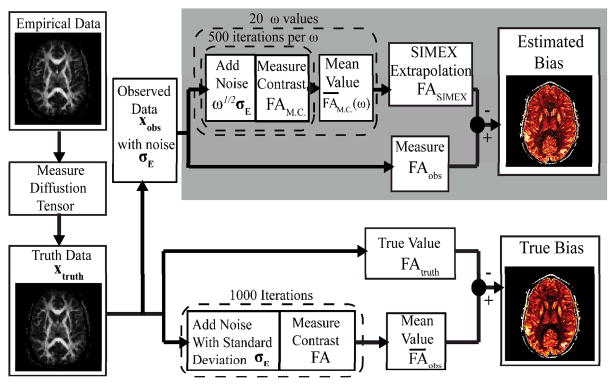
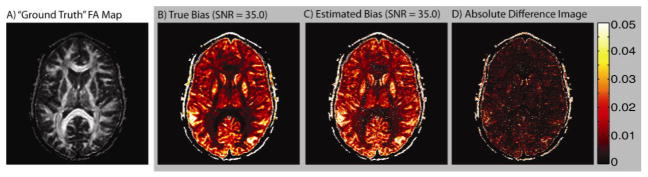
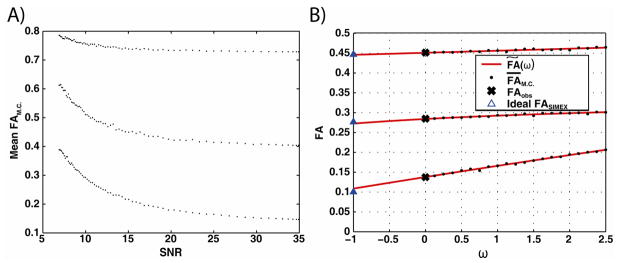
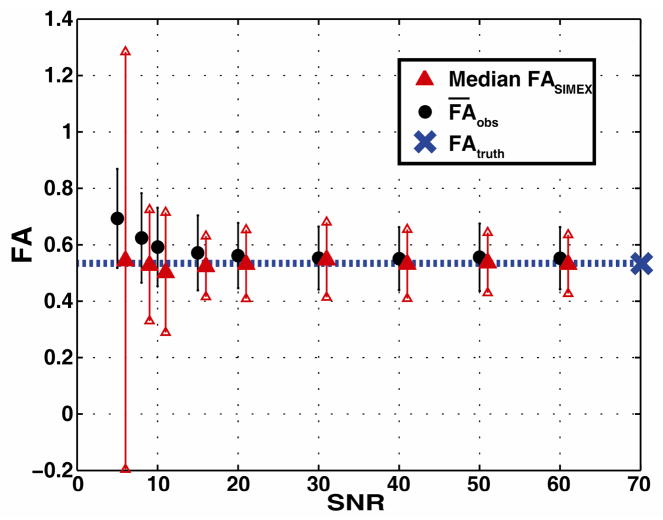
Diffusion Tensor Imaging (DTI) is a Magnetic Resonance Imaging method for measuring water diffusion in vivo. One powerful DTI contrast is fractional anisotropy (FA). FA reflects the strength of water's diffusion directional preference and is a primary metric for neuronal fiber tracking. As with other DTI contrasts, FA measurements are obscured by the well established presence of bias. DTI bias has been challenging to assess because it is a multivariable problem including SNR, six tensor parameters, and the DTI collection and processing method used. SIMEX is a modem statistical technique that estimates bias by tracking measurement error as a function of added noise. Here, we use SIMEX to assess bias in FA measurements and show the method provides; i) accurate FA bias estimates, ii) representation of FA bias that is data set specific and accessible to non-statisticians, and iii) a first time possibility for incorporation of bias into DTI data analysis.
扩散张量成像(DTI)是一种用于测量体内水扩散的磁共振成像方法。一种强大的DTI对比是分数各向异性(FA)。FA反映了水扩散方向偏好的强度,是神经元纤维追踪的主要指标。与其他DTI对比一样,FA测量因已确定存在的偏差而受到干扰。DTI偏差一直难以评估,因为它是一个多变量问题,包括信噪比、六个张量参数以及所使用的DTI采集和处理方法。SIMEX是一种现代统计技术,通过跟踪作为附加噪声函数的测量误差来估计偏差。在这里,我们使用SIMEX来评估FA测量中的偏差,并表明该方法提供了:i)准确的FA偏差估计;ii)特定于数据集且非统计人员可理解的FA偏差表示;iii)首次将偏差纳入DTI数据分析的可能性。