Department of Biostatistics, Vanderbilt University Medical Center, Nashville, Tennessee, USA.
Department of Computer Science, Vanderbilt University, Nashville, Tennessee, USA.
Magn Reson Med. 2018 Oct;80(4):1666-1675. doi: 10.1002/mrm.27115. Epub 2018 Feb 6.
The bias and variance of high angular resolution diffusion imaging methods have not been thoroughly explored in the literature and may benefit from the simulation extrapolation (SIMEX) and bootstrap techniques to estimate bias and variance of high angular resolution diffusion imaging metrics.
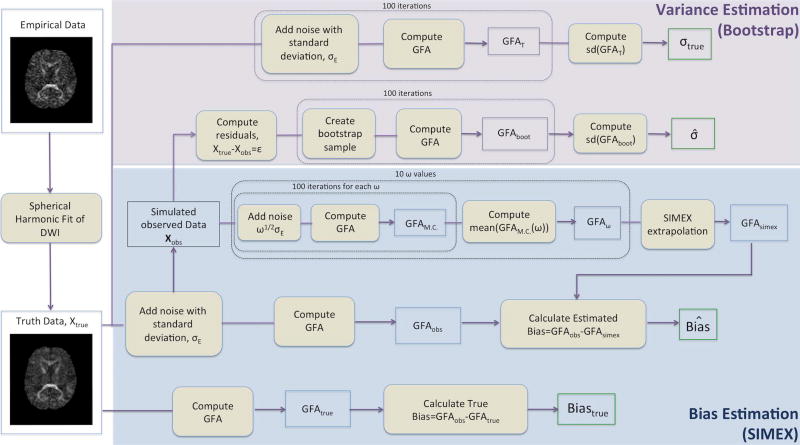
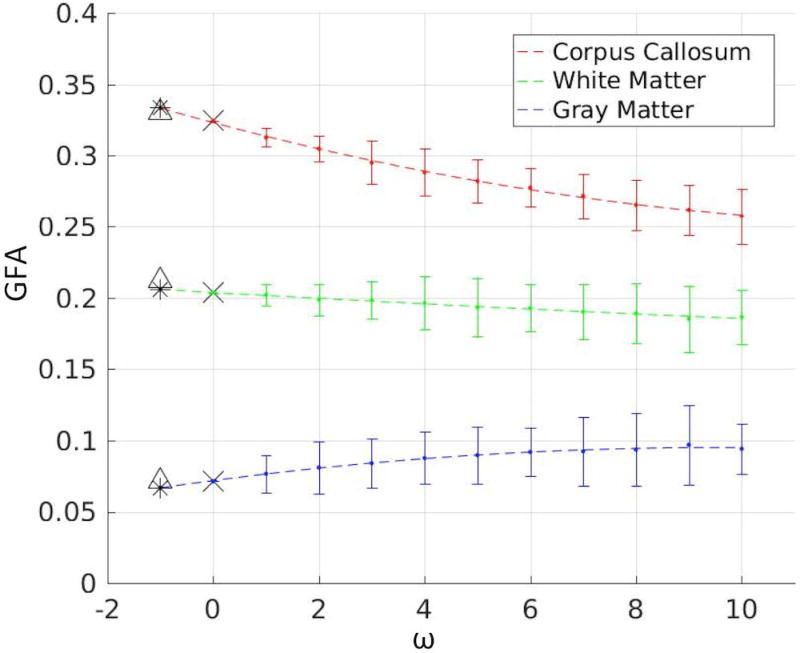
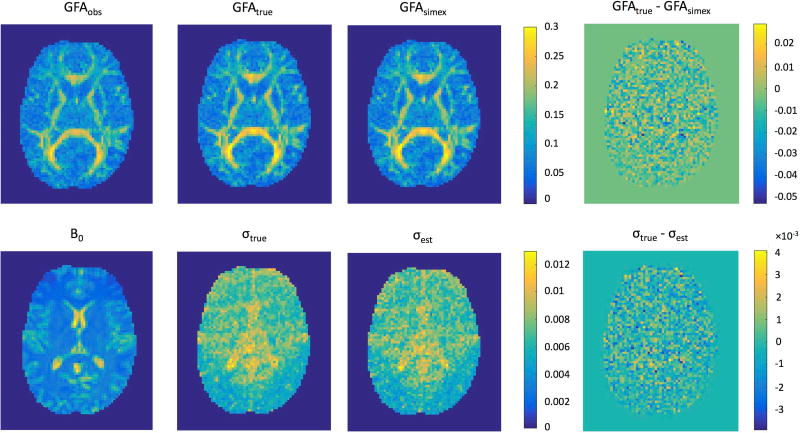
The SIMEX approach is well established in the statistics literature and uses simulation of increasingly noisy data to extrapolate back to a hypothetical case with no noise. The bias of calculated metrics can then be computed by subtracting the SIMEX estimate from the original pointwise measurement. The SIMEX technique has been studied in the context of diffusion imaging to accurately capture the bias in fractional anisotropy measurements in DTI. Herein, we extend the application of SIMEX and bootstrap approaches to characterize bias and variance in metrics obtained from a Q-ball imaging reconstruction of high angular resolution diffusion imaging data.
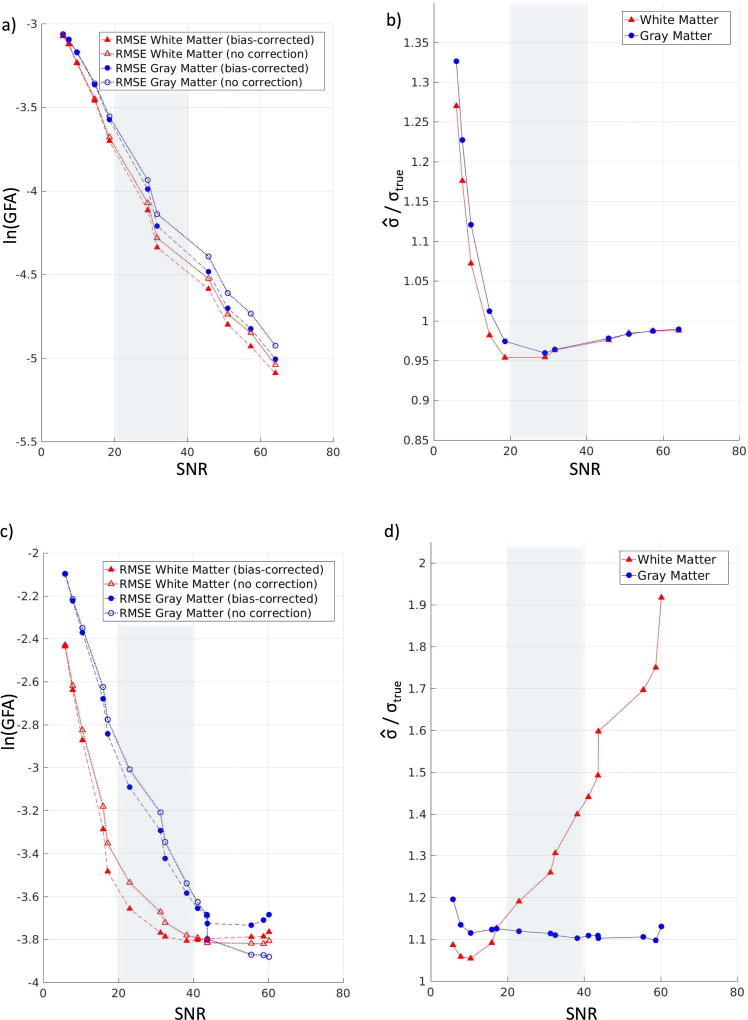
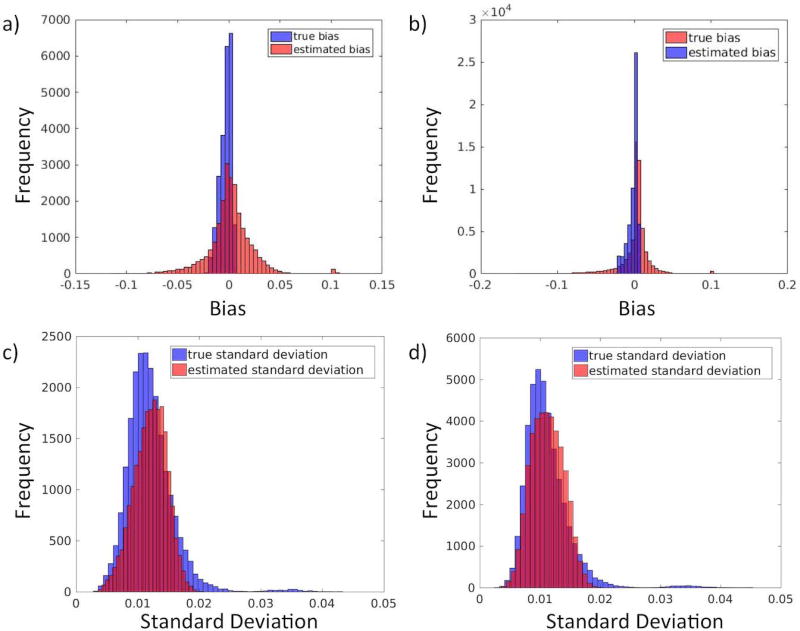
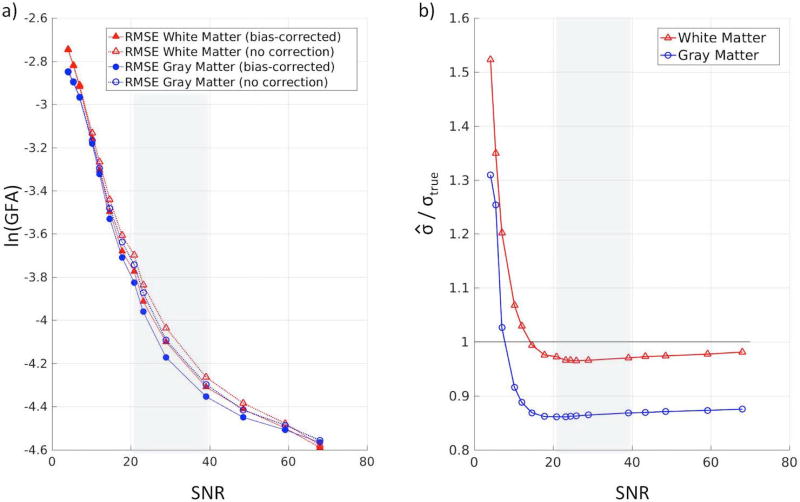
The results demonstrate that SIMEX and bootstrap approaches provide consistent estimates of the bias and variance of generalized fractional anisotropy, respectively. The RMSE for the generalized fractional anisotropy estimates shows a 7% decrease in white matter and an 8% decrease in gray matter when compared with the observed generalized fractional anisotropy estimates. On average, the bootstrap technique results in SD estimates that are approximately 97% of the true variation in white matter, and 86% in gray matter.
Both SIMEX and bootstrap methods are flexible, estimate population characteristics based on single scans, and may be extended for bias and variance estimation on a variety of high angular resolution diffusion imaging metrics.
高角分辨率扩散成像方法的偏差和方差在文献中尚未得到彻底探讨,可能受益于模拟外推(SIMEX)和自举技术来估计高角分辨率扩散成像指标的偏差和方差。
SIMEX 方法在统计学文献中已经得到很好的建立,它使用模拟越来越嘈杂的数据来外推回一个假设的无噪声情况。然后可以通过从原始逐点测量值中减去 SIMEX 估计值来计算计算指标的偏差。SIMEX 技术已在扩散成像的背景下进行了研究,以准确捕获 DTI 中分数各向异性测量值的偏差。在此,我们扩展了 SIMEX 和自举方法的应用,以表征高角分辨率扩散成像数据的 Q 球成像重建中获得的指标的偏差和方差。
结果表明,SIMEX 和自举方法分别为广义分数各向异性的偏差和方差提供了一致的估计。与观察到的广义分数各向异性估计相比,广义分数各向异性估计的 RMSE 在白质中降低了 7%,在灰质中降低了 8%。平均而言,自举技术的 SD 估计值在白质中约为真实变异性的 97%,在灰质中约为 86%。
SIMEX 和自举方法都很灵活,基于单次扫描估计总体特征,并且可以扩展用于各种高角分辨率扩散成像指标的偏差和方差估计。