Lehrstuhl für Technische Mikrobiologie, Technische Universität München, 85350 Freising, Germany.
Microb Cell Fact. 2011 Aug 30;10 Suppl 1(Suppl 1):S6. doi: 10.1186/1475-2859-10-S1-S6.
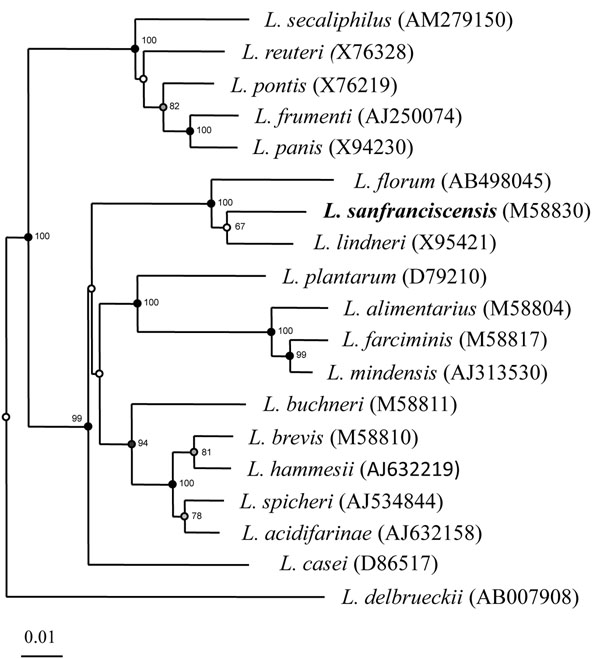
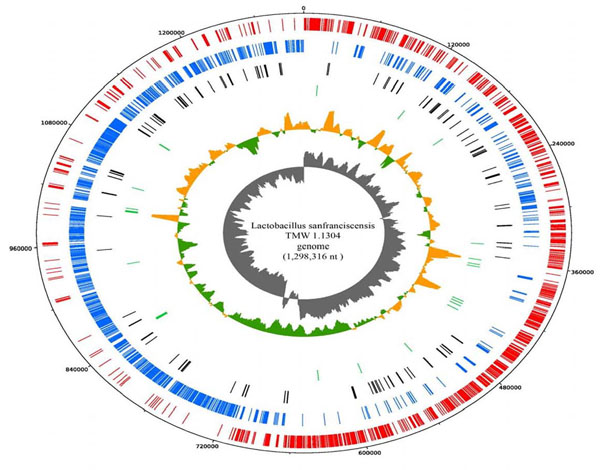
Sourdough has played a significant role in human nutrition and culture for thousands of years and is still of eminent importance for human diet and the bakery industry. Lactobacillus sanfranciscensis is the predominant key bacterium in traditionally fermented sourdoughs.The genome of L. sanfranciscensis TMW 1.1304 isolated from an industrial sourdough fermentation was sequenced with a combined Sanger/454-pyrosequencing approach followed by gap closing by walking on fosmids. The sequencing data revealed a circular chromosomal sequence of 1,298,316 bp and two additional plasmids, pLS1 and pLS2, with sizes of 58,739 bp and 18,715 bp, which are predicted to encode 1,437, 63 and 19 orfs, respectively. The overall GC content of the chromosome is 34.71%. Several specific features appear to contribute to the ability of L. sanfranciscensis to outcompete other bacteria in the fermentation. L. sanfranciscensis contains the smallest genome within the lactobacilli and the highest density of ribosomal RNA operons per Mbp genome among all known genomes of free-living bacteria, which is important for the rapid growth characteristics of the organism. A high frequency of gene inactivation and elimination indicates a process of reductive evolution. The biosynthetic capacity for amino acids scarcely availably in cereals and exopolysaccharides reveal the molecular basis for an autochtonous sourdough organism with potential for further exploitation in functional foods. The presence of two CRISPR/cas loci versus a high number of transposable elements suggests recalcitrance to gene intrusion and high intrinsic genome plasticity.
传统发酵酸面团中占主导地位的关键细菌是旧金山乳杆菌。从工业酸面团发酵中分离出的旧金山乳杆菌 TMW 1.1304 的基因组采用组合 Sanger/454 焦磷酸测序方法进行测序,然后通过 fosmid 行走进行缺口闭合。测序数据显示,该细菌的染色体序列呈圆形,大小为 1,298,316 bp,另有两个质粒,pLS1 和 pLS2,大小分别为 58,739 bp 和 18,715 bp,分别预测编码 1,437、63 和 19 个或基因。染色体的总 GC 含量为 34.71%。几个特定的特征似乎有助于旧金山乳杆菌在发酵过程中胜过其他细菌。旧金山乳杆菌在乳杆菌属中拥有最小的基因组,并且在所有已知的自由生活细菌的基因组中,核糖体 RNA 操纵子的密度最高,这对于该生物体的快速生长特性非常重要。高频率的基因失活和消除表明了一种还原进化的过程。对谷物中几乎不可用的氨基酸和胞外多糖的生物合成能力揭示了一种具有自主酸面团生物的分子基础,具有在功能性食品中进一步开发的潜力。两个 CRISPR/cas 位点的存在与大量转座元件相比,表明了对基因入侵的抵抗力和内在基因组高可塑性。