Section of Brain Electrophysiology and Imaging, Laboratory of Clinical and Translational Studies, National Institute on Alcohol Abuse and Alcoholism, National Institutes of Health, 10 Center Drive, Bethesda, MD 20892, USA.
Addict Biol. 2012 Mar;17(2):465-78. doi: 10.1111/j.1369-1600.2011.00383.x. Epub 2011 Oct 13.
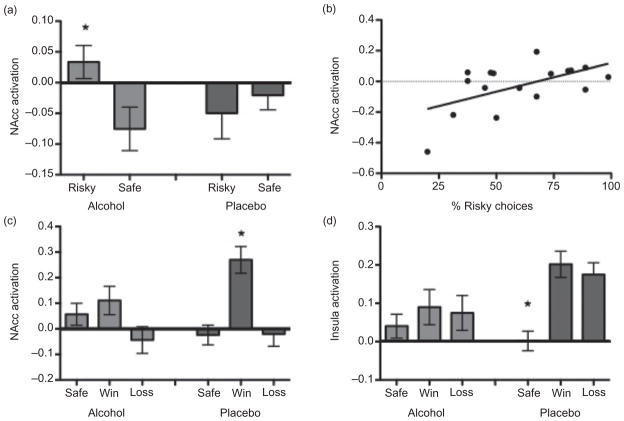
Alcohol is thought to contribute to an increase in risk-taking behavior, but the neural correlates underlying this effect are not well understood. In this study, participants were given intravenous alcohol or placebo while undergoing functional magnetic resonance imaging (fMRI) and playing a risk-taking game. The game allowed us to examine the neural response to choosing a safe or risky option, anticipating outcome and receiving feedback. We found that alcohol increased risk-taking behavior, particularly among participants who experienced more stimulating effects of alcohol. fMRI scans demonstrated that alcohol increased activation in the striatum to risky compared with safe choices and dampened the neural response to notification of both winning and losing throughout the caudate, thalamus and insula. This study suggests that alcohol may increase risk-taking behavior by both activating brain regions involved in reward when a decision is made, and dampening the response to negative and positive feedback.
酒精被认为会导致冒险行为增加,但这种影响的神经相关性尚不清楚。在这项研究中,参与者在接受功能磁共振成像 (fMRI) 检查的同时接受静脉注射酒精或安慰剂,并玩风险选择游戏。该游戏使我们能够检查选择安全或冒险选项、预测结果和接收反馈时的神经反应。我们发现酒精会增加冒险行为,特别是在那些经历更多酒精刺激作用的参与者中。fMRI 扫描显示,与安全选择相比,酒精会增加纹状体对冒险选择的激活,并且会减弱对尾状核、丘脑和脑岛中赢和输的通知的神经反应。这项研究表明,酒精可能会通过激活与决策时奖励相关的大脑区域,以及减弱对正负反馈的反应,从而增加冒险行为。