ENEA (Italian National Agency for New Technologies, Energy and Sustainable Development) Casaccia Research Center-Technical Unit for Sustainable Development and Innovation of Agro-Industrial System, Via Anguillarese 301, 00123 S, Maria di Galeria, Rome, Italy.
BMC Microbiol. 2011 Oct 13;11:228. doi: 10.1186/1471-2180-11-228.
A close association between maize roots and Burkholderia cepacia complex (BCC) bacteria has been observed in different locations globally. In this study we investigated by MultiLocus Restriction Typing (MLRT) the genetic diversity and relationships among Burkholderia cenocepacia IIIB and BCC6 populations associated with roots of maize plants cultivated in geographically distant countries (Italy and Mexico), in order to provide new insights into their population structure, evolution and ecology.
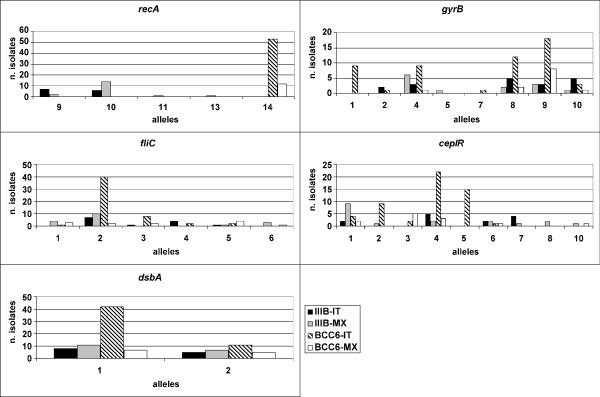
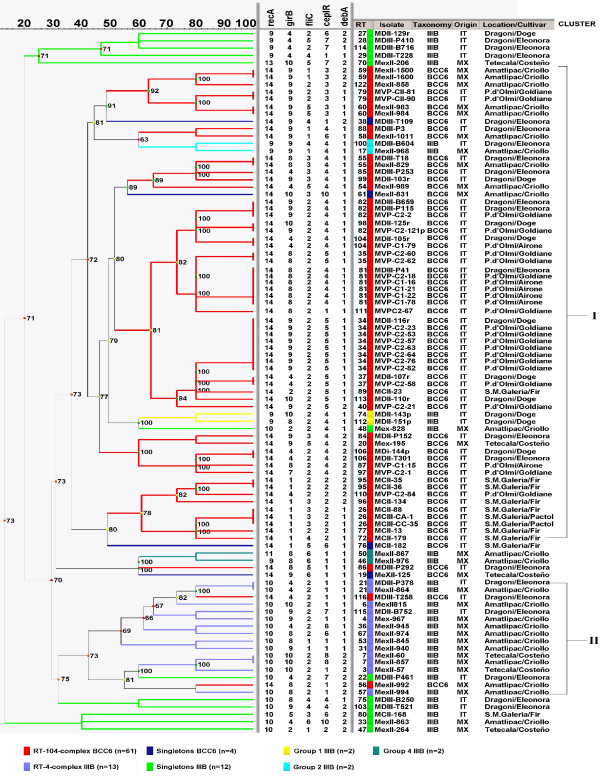
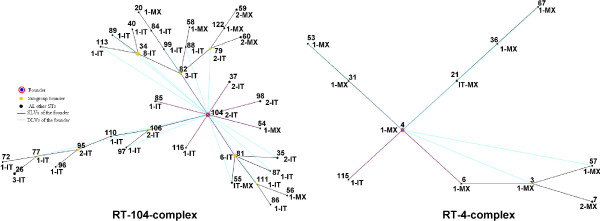
The 31 B. cenocepacia IIIB and 65 BCC6 isolates gave rise to 29 and 39 different restriction types (RTs), respectively. Two pairs of isolates of B. cenocepacia IIIB and BCC6, recovered from both Italian and Mexican maize rhizospheres, were found to share the same RT. The eBURST (Based Upon Related Sequence Types) analysis of MLRT data grouped all the B. cenocepacia IIIB isolates into four clonal complexes, with the RT-4-complex including the 42% of them, while the majority of the BCC6 isolates (94%) were grouped into the RT-104-complex. These two main clonal complexes included RTs shared by both Italian and Mexican maize rhizospheres and a clear relationship between grouping and maize variety was also found. Grouping established by eBURST correlated well with the assessment using unweighted-pair group method with arithmetic mean (UPGMA). The standardized index of association values obtained in both B. cenocepacia IIIB and BCC6 suggests an epidemic population structure in which occasional clones emerge and spread.
Taken together our data demonstrate a wide dispersal of certain B. cenocepacia IIIB and BCC6 isolates in Mexican and Italian maize rhizospheres. Despite the clear relationship found between the geographic origin of isolates and grouping, identical RTs and closely related isolates were observed in geographically distant regions. Ecological factors and selective pressure may preferably promote some genotypes within each local microbial population, favouring the spread of a single clone above the rest of the recombinant population.
在全球不同地区的玉米根中都观察到了与伯克霍尔德氏菌复合群(BCC)细菌的密切关联。在这项研究中,我们通过多位点限制分型(MLRT)研究了与种植在地理上相距遥远的国家(意大利和墨西哥)的玉米根相关的伯克霍尔德氏菌中III 型和 BCC6 群体的遗传多样性和关系,以提供对其种群结构、进化和生态的新见解。
31 株伯克霍尔德氏菌中 III 型和 65 株 BCC6 分离株分别产生了 29 和 39 种不同的限制类型(RT)。从意大利和墨西哥玉米根际中分离出的两对伯克霍尔德氏菌中 III 型和 BCC6 分离株被发现具有相同的 RT。MLRT 数据的 eBURST(基于相关序列类型)分析将所有伯克霍尔德氏菌中 III 型分离株分为四个克隆复合体,其中 RT-4 复合体包括其中的 42%,而大多数 BCC6 分离株(94%)分为 RT-104 复合体。这两个主要的克隆复合体包括意大利和墨西哥玉米根际共享的 RT 和明显的与玉米品种的关系也被发现。eBURST 建立的分组与使用非加权对组平均法(UPGMA)的评估相关性良好。在伯克霍尔德氏菌中 III 型和 BCC6 中获得的标准化关联值指数表明存在一种流行的种群结构,其中偶尔会出现克隆并传播。
总的来说,我们的数据表明,某些伯克霍尔德氏菌中 III 型和 BCC6 分离株在墨西哥和意大利玉米根际中广泛传播。尽管分离株的地理来源和分组之间存在明显的关系,但在地理上相距遥远的地区观察到了相同的 RT 和密切相关的分离株。生态因素和选择压力可能更有利于每个当地微生物种群中的某些基因型,从而促进单一克隆在重组种群中的传播。