Cardiovascular Research Laboratory, Research Centre, Hospital de Clinicas de Porto Alegre, Rua Ramiro Barcelos 2350, Porto Alegre, Brazil.
Crit Care. 2011;15(5):230. doi: 10.1186/cc10334. Epub 2011 Sep 14.
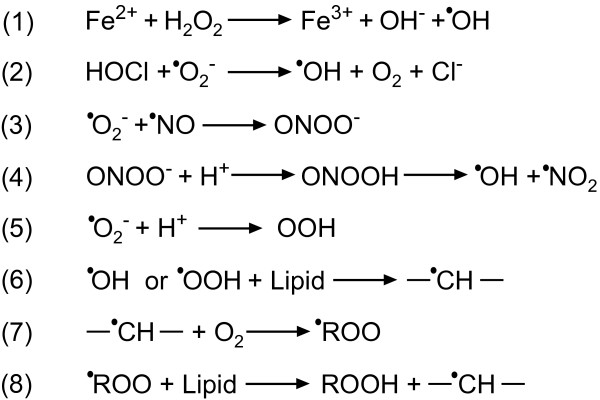
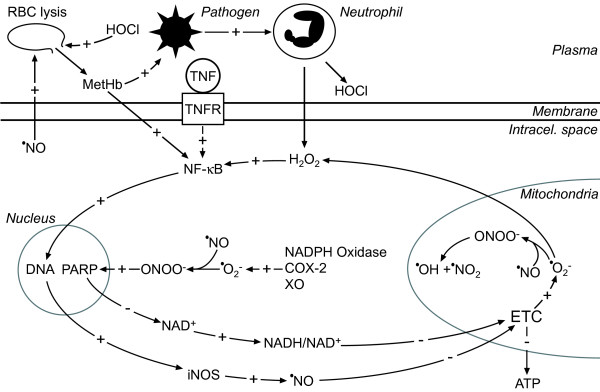
The pathogenesis of sepsis and its progression to multiple organ dysfunction syndrome and septic shock have been the subject of investigations for nearly half a century. Controversies still exist with regard to understanding the molecular pathophysiology of sepsis in relation to the complex roles played by reactive oxygen species, nitric oxide, complements and cytokines. In the present review we categorise the key turning points in sepsis development and outline the most probable sequence of events leading to cellular dysfunction and organ failure under septic conditions. We have applied an integrative approach in order to fuse current state-of-the-art knowledge about redox processes involving hydrogen peroxide, nitric oxide, superoxide, peroxynitrite and hydroxyl radical, which lead to mitochondrial respiratory dysfunction. Finally, from this point of view, the potential of redox therapy targeting sepsis is discussed.
脓毒症的发病机制及其进展为多器官功能障碍综合征和感染性休克,一直是近半个世纪研究的课题。对于脓毒症的分子病理生理学的理解,与活性氧、一氧化氮、补体和细胞因子所起的复杂作用有关,这方面仍然存在争议。在本综述中,我们对脓毒症发展的关键转折点进行分类,并概述在感染条件下导致细胞功能障碍和器官衰竭的最可能的事件顺序。我们采用了一种综合的方法,将涉及过氧化氢、一氧化氮、超氧化物、过氧亚硝酸盐和羟自由基的最新知识融合在一起,这些物质会导致线粒体呼吸功能障碍。最后,从这个角度来看,讨论了针对脓毒症的氧化还原治疗的潜力。