Department of Systems Biology, Division of Cancer Medicine, The University of Texas MD Anderson Cancer Center, Houston, TX 77030, USA.
Gut. 2012 Sep;61(9):1291-8. doi: 10.1136/gutjnl-2011-300812. Epub 2011 Oct 13.
Despite continual efforts to develop prognostic and predictive models of colorectal cancer by using clinicopathological and genetic parameters, a clinical test that can discriminate between patients with good or poor outcome after treatment has not been established. Thus, the authors aim to uncover subtypes of colorectal cancer that have distinct biological characteristics associated with prognosis and identify potential biomarkers that best reflect the biological and clinical characteristics of subtypes.
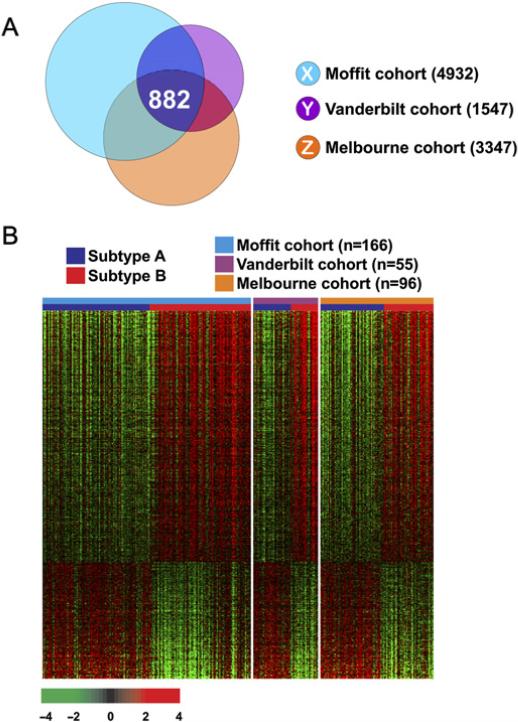
Unsupervised hierarchical clustering analysis was applied to gene expression data from 177 patients with colorectal cancer to determine a prognostic gene expression signature. Validation of the signature was sought in two independent patient groups. The association between the signature and prognosis of patients was assessed by Kaplan-Meier plots, log-rank tests and the Cox model.
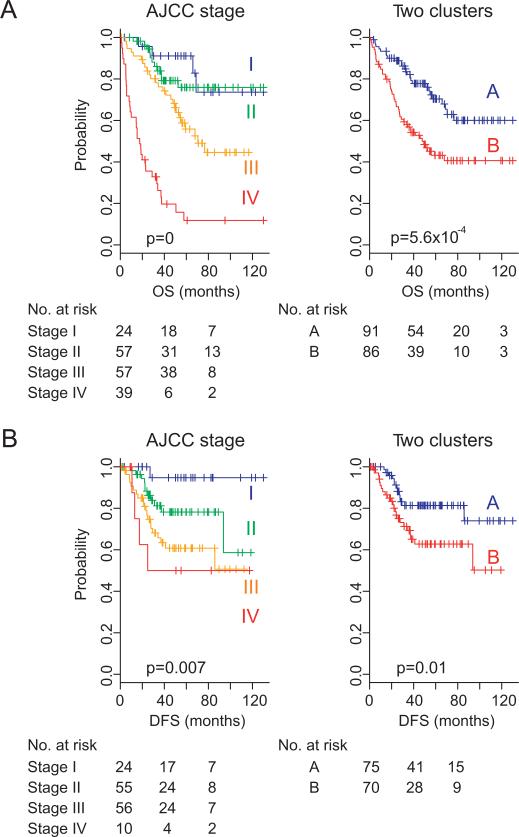
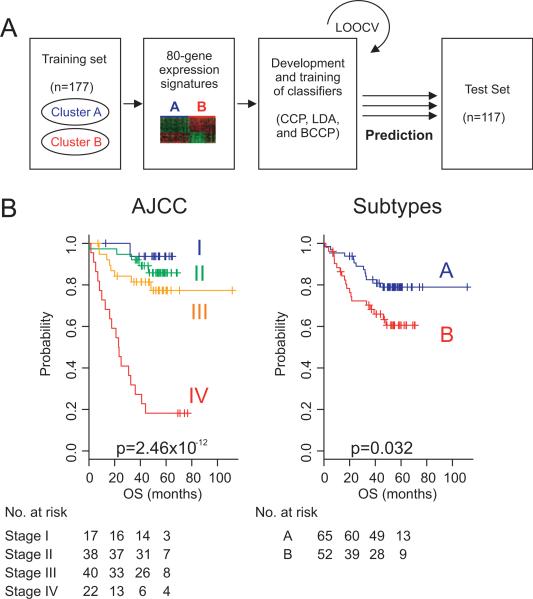
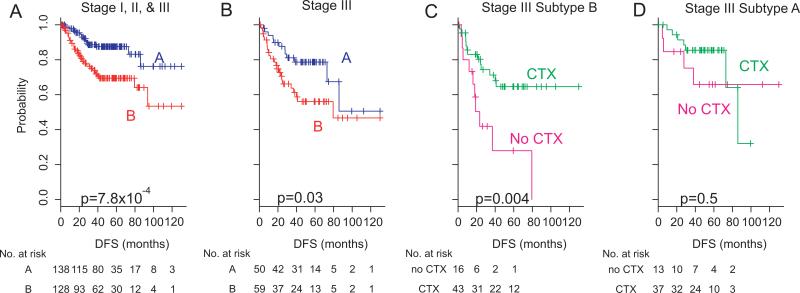
The authors identified a gene signature that was associated with overall survival and disease-free survival in 177 patients and validated in two independent cohorts of 213 patients. In multivariate analysis, the signature was an independent risk factor (HR 3.08; 95% CI 1.33 to 7.14; p=0.008 for overall survival). Subset analysis of patients with AJCC (American Joint Committee on Cancer) stage III cancer revealed that the signature can also identify the patients who have better outcome with adjuvant chemotherapy (CTX). Adjuvant chemotherapy significantly affected disease-free survival in patients in subtype B (3-year rate, 71.2% (CTX) vs 41.9% (no CTX); p=0.004). However, such benefit of adjuvant chemotherapy was not significant for patients in subtype A.
The gene signature is an independent predictor of response to chemotherapy and clinical outcome in patients with colorectal cancer.
尽管通过临床病理和遗传参数不断努力来开发结直肠癌的预后和预测模型,但尚未建立能够区分治疗后预后良好或不良的患者的临床检测方法。因此,作者旨在发现具有不同预后相关生物学特征的结直肠癌亚型,并确定能最佳反映亚型生物学和临床特征的潜在生物标志物。
对 177 例结直肠癌患者的基因表达数据进行无监督层次聚类分析,以确定预后基因表达特征。在两个独立的患者组中寻求该特征的验证。通过 Kaplan-Meier 图、对数秩检验和 Cox 模型评估该特征与患者预后的相关性。
作者确定了一个与 177 例患者的总生存期和无病生存期相关的基因特征,并在另外两个 213 例患者的独立队列中进行了验证。在多变量分析中,该特征是独立的风险因素(HR 3.08;95%CI 1.33 至 7.14;p=0.008 用于总生存期)。AJCC(美国癌症联合委员会)III 期癌症患者的亚组分析显示,该特征还可以识别出辅助化疗(CTX)后具有更好预后的患者。辅助化疗显著影响了亚型 B 患者的无病生存期(3 年生存率,71.2%(CTX)比 41.9%(无 CTX);p=0.004)。然而,对于亚型 A 的患者,辅助化疗的这种获益并不显著。
该基因特征是结直肠癌患者对化疗反应和临床结局的独立预测因子。