Centre for BioNano Interactions, School of Chemistry and Chemical Biology, University College Dublin, Belfield, Dublin, Ireland.
PLoS One. 2011;6(10):e25556. doi: 10.1371/journal.pone.0025556. Epub 2011 Oct 6.
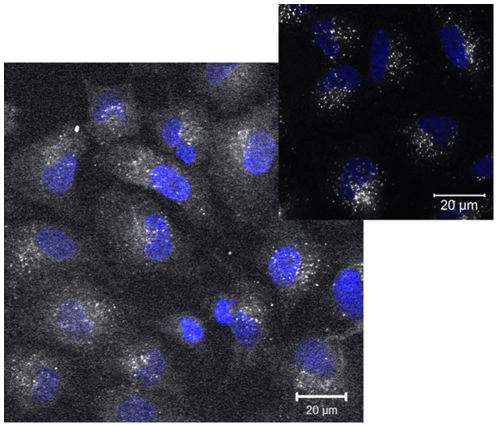
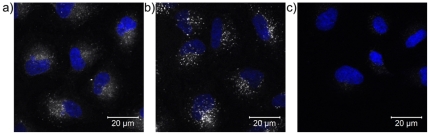
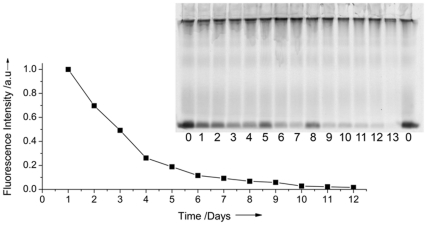
Cells act as extremely efficient filters for elution of unbound fluorescent tags or impurities associated with nanoparticles, including those that cannot be removed by extensive cleaning. This has consequences for quantification of nanoparticle uptake and sub-cellular localization in vitro and in vivo as a result of the presence of significant amount of labile dye even following extensive cleaning by dialysis. Polyacrylamide gel electrophoresis (PAGE) can be used to monitor the elution of unbound fluorescent probes from nanoparticles, either commercially available or synthesized in-house, and to ensure their complete purification for biological studies, including cellular uptake and sub-cellular localisation. Very different fluorescence distribution within cells is observed after short dialysis times versus following extensive dialysis against a solvent in which the free dye is more soluble, due to the contribution from free dye. In the absence of an understanding of the presence of residual free dye in (most) labeled nanoparticle solutions, the total fluorescence intensity in cells following exposure to nanoparticle solutions could be mis-ascribed to the presence of nanoparticles through the cell, rather than correctly assigned to either a combination of free-dye and nanoparticle-bound dye, or even entirely to free dye depending on the exposure conditions (i.e. aggregation of the particles etc). Where all of the dye is nanoparticle-bound, the particles are highly localized in sub-cellular organelles, likely lysosomes, whereas in a system containing significant amounts of free dye, the fluorescence is distributed through the cell due to the free diffusion of the molecule dye across all cellular barriers and into the cytoplasm.
细胞作为高效的过滤器,可以洗脱与纳米粒子相关的未结合的荧光标记物或杂质,包括那些即使经过广泛的清洗也无法去除的杂质。这对于纳米粒子摄取和亚细胞定位的定量分析有影响,无论是在体外还是体内,因为即使经过广泛的透析清洗,仍然存在大量不稳定的染料。聚丙烯酰胺凝胶电泳 (PAGE) 可用于监测商业上可获得的或内部合成的纳米粒子中未结合的荧光探针的洗脱情况,并确保其完全纯化,用于生物学研究,包括细胞摄取和亚细胞定位。由于游离染料的贡献,与经过大量透析相比,短时间透析后,细胞内观察到的荧光分布非常不同。由于(大多数)标记的纳米粒子溶液中存在残留游离染料,如果不了解这一点,那么暴露于纳米粒子溶液后的细胞内总荧光强度可能会被错误地归因于纳米粒子的存在,而不是正确地归因于游离染料和纳米粒子结合的染料的组合,甚至完全归因于游离染料,具体取决于暴露条件(例如粒子聚集等)。如果所有的染料都与纳米粒子结合,那么粒子就会高度局限于亚细胞细胞器中,可能是溶酶体中;而在含有大量游离染料的系统中,由于分子染料可以自由扩散穿过所有细胞屏障并进入细胞质,因此荧光会分布在整个细胞中。