College of Natural Conservation, Beijing Forestry University, Beijing, China.
PLoS One. 2011;6(10):e25629. doi: 10.1371/journal.pone.0025629. Epub 2011 Oct 5.
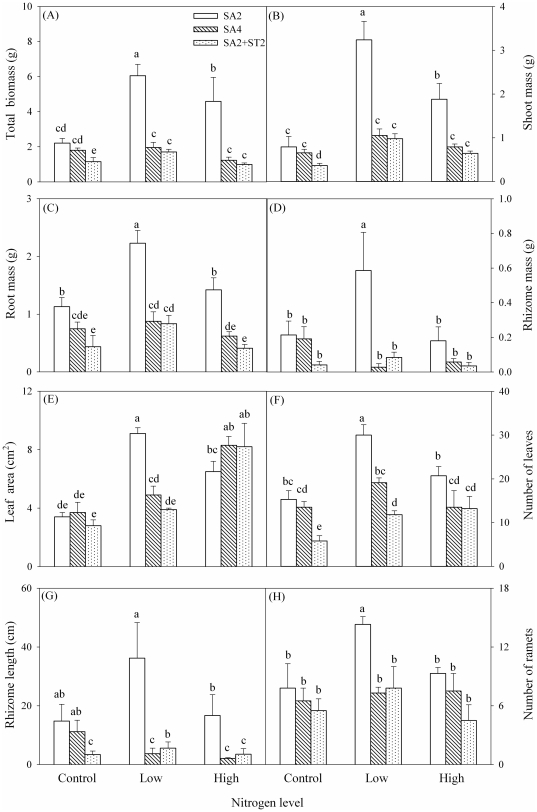
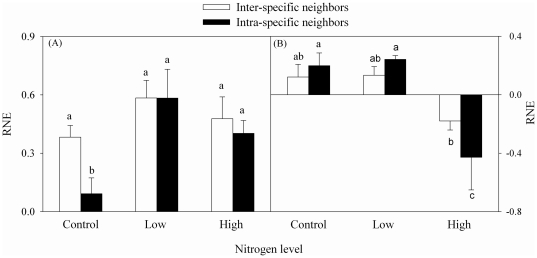
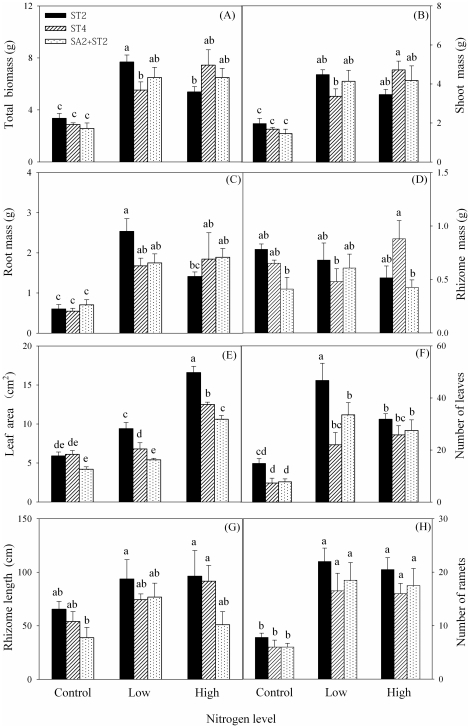
The exotic species Spartina anglica, introduced from Europe in 1963, has been experiencing a decline in the past decade in coastal China, but the reasons for the decline are still not clear. It is hypothesized that competition with the native species Scirpus triqueter may have played an important role in the decline due to niche overlap in the field. We measured biomass, leaf number and area, asexual reproduction and relative neighborhood effect (RNE) of the two species in both monoculture and mixture under three nitrogen levels (control, low and high). S. anglica showed significantly lower biomass accumulation, leaf number and asexual reproduction in mixture than in monoculture. The inter- and intra-specific RNE of S. anglica were all positive, and the inter-specific RNE was significantly higher than the intra-specific RNE in the control. For S. triqueter, inter- and intra-specific RNE were negative at the high nitrogen level but positive in the control and at the low nitrogen level. This indicates that S. triqueter exerted an asymmetric competitive advantage over S. anglica in the control and low nitrogen conditions; however, S. anglica facilitated growth of S. triqueter in high nitrogen conditions. Nitrogen level changed the interactions between the two species because S. triqueter better tolerated low nitrogen. Since S. anglica is increasingly confined to upper, more nitrogen-limited marsh areas in coastal China, increased competition from S. triqueter may help explain its decline.
外来物种英国米草于 1963 年从欧洲引入,过去十年在中国沿海地区数量不断减少,但减少的原因仍不清楚。由于在野外生态位重叠,与本地物种互花米草的竞争可能在减少中起了重要作用。我们在三种氮水平(对照、低氮和高氮)下,在单一种群和混种群落中测量了这两个物种的生物量、叶片数量和面积、无性繁殖和相对邻接效应(RNE)。与单一种群相比,混种群落中的英国米草生物量积累、叶片数量和无性繁殖均显著降低。英国米草的种间和种内 RNE 均为正,且对照中种间 RNE 显著高于种内 RNE。对于互花米草,高氮水平下种间和种内 RNE 为负,而对照和低氮水平下为正。这表明,在对照和低氮条件下,互花米草对英国米草具有不对称的竞争优势;然而,在高氮条件下,英国米草促进了互花米草的生长。氮水平改变了两个物种之间的相互作用,因为互花米草能更好地耐受低氮。由于英国米草越来越局限于沿海中国高氮限制的上层沼泽地区,来自互花米草的竞争增加可能有助于解释其减少的原因。