Department of Anaesthesia and Intensive Care, Evangelical Hospital Vienna, Hans-Sachs-Gasse 10-12, 1180-Vienna, Austria.
Crit Care. 2011;15(5):R239. doi: 10.1186/cc10488. Epub 2011 Oct 14.
Haemostatic therapy in surgical and/or massive trauma patients typically involves transfusion of fresh frozen plasma (FFP). Purified human fibrinogen concentrate may offer an alternative to FFP in some instances. In this systematic review, we investigated the current evidence for the use of FFP and fibrinogen concentrate in the perioperative or massive trauma setting.
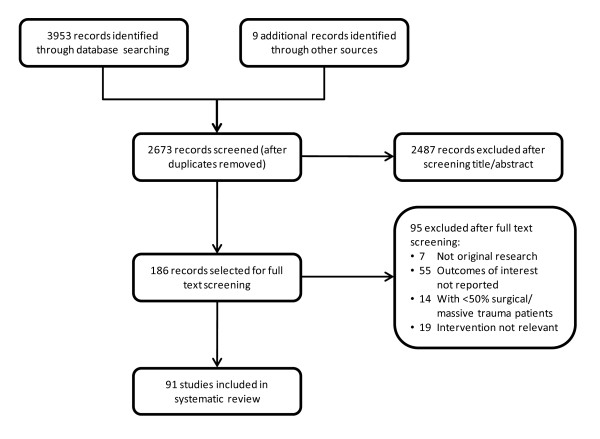
Studies reporting the outcome (blood loss, transfusion requirement, length of stay, survival and plasma fibrinogen level) of FFP or fibrinogen concentrate administration to patients in a perioperative or massive trauma setting were identified in electronic databases (1995 to 2010). Studies were included regardless of type, patient age, sample size or duration of patient follow-up. Studies of patients with congenital clotting factor deficiencies or other haematological disorders were excluded. Studies were assessed for eligibility, and data were extracted and tabulated.
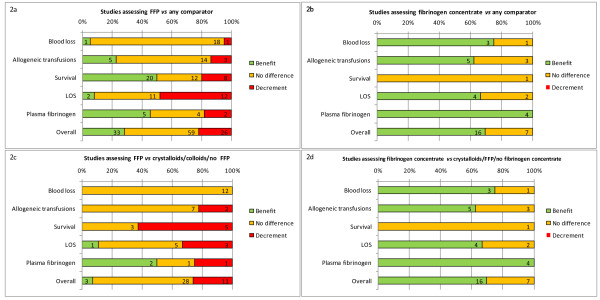
Ninety-one eligible studies (70 FFP and 21 fibrinogen concentrate) reported outcomes of interest. Few were high-quality prospective studies. Evidence for the efficacy of FFP was inconsistent across all assessed outcomes. Overall, FFP showed a positive effect for 28% of outcomes and a negative effect for 22% of outcomes. There was limited evidence that FFP reduced mortality: 50% of outcomes associated FFP with reduced mortality (typically trauma and/or massive bleeding), and 20% were associated with increased mortality (typically surgical and/or nonmassive bleeding). Five studies reported the outcome of fibrinogen concentrate versus a comparator. The evidence was consistently positive (70% of all outcomes), with no negative effects reported (0% of all outcomes). Fibrinogen concentrate was compared directly with FFP in three high-quality studies and was found to be superior for > 50% of outcomes in terms of reducing blood loss, allogeneic transfusion requirements, length of intensive care unit and hospital stay and increasing plasma fibrinogen levels. We found no fibrinogen concentrate comparator studies in patients with haemorrhage due to massive trauma, although efficacy across all assessed outcomes was reported in a number of noncomparator trauma studies.
The weight of evidence does not appear to support the clinical effectiveness of FFP for surgical and/or massive trauma patients and suggests it can be detrimental. Perioperatively, fibrinogen concentrate was generally associated with improved outcome measures, although more high-quality, prospective studies are required before any definitive conclusions can be drawn.
在外科和/或大量创伤患者中,止血治疗通常涉及输注新鲜冷冻血浆(FFP)。在某些情况下,纯化的人纤维蛋白原浓缩物可能是 FFP 的替代物。在这项系统评价中,我们调查了围手术期或大量创伤环境中使用 FFP 和纤维蛋白原浓缩物的现有证据。
在电子数据库中(1995 年至 2010 年)确定了报告围手术期或大量创伤环境中患者 FFP 或纤维蛋白原浓缩物给药结果(失血量、输血需求、住院时间、存活率和血浆纤维蛋白原水平)的研究。无论研究类型、患者年龄、样本量或患者随访时间如何,均纳入研究。排除患有先天性凝血因子缺乏症或其他血液疾病的患者的研究。评估研究的合格性,并提取和制表数据。
91 项合格研究(70 项 FFP 和 21 项纤维蛋白原浓缩物)报告了感兴趣的结果。很少有高质量的前瞻性研究。FFP 的疗效证据在所有评估结果上不一致。总体而言,FFP 对 28%的结果有积极影响,对 22%的结果有消极影响。有有限的证据表明 FFP 降低了死亡率:50%的结果与 FFP 降低死亡率相关(通常是创伤和/或大量出血),20%的结果与死亡率增加相关(通常是外科和/或非大量出血)。五项研究报告了纤维蛋白原浓缩物与比较剂的结果。证据始终是积极的(所有结果的 70%),没有报告任何负面影响(所有结果的 0%)。在三项高质量研究中,纤维蛋白原浓缩物与 FFP 直接比较,发现其在减少失血量、异体输血需求、重症监护病房和住院时间以及提高血浆纤维蛋白原水平方面超过 50%的结果具有优势。我们在大量创伤引起的出血患者中没有发现纤维蛋白原浓缩物的比较剂研究,尽管在许多非比较剂创伤研究中报告了所有评估结果的疗效。
证据的权重似乎不支持 FFP 用于外科和/或大量创伤患者的临床有效性,并表明它可能有害。围手术期,纤维蛋白原浓缩物通常与改善的结果测量相关,尽管需要更多高质量的前瞻性研究才能得出任何明确的结论。