Department of Biochemistry and Molecular Cell Biology, Center for Experimental Medicine, University Medical Center Hamburg-Eppendorf, Hamburg, Germany.
BMC Med Educ. 2011 Oct 14;11:83. doi: 10.1186/1472-6920-11-83.
Knowledge in natural sciences generally predicts study performance in the first two years of the medical curriculum. In order to reduce delay and dropout in the preclinical years, Hamburg Medical School decided to develop a natural science test (HAM-Nat) for student selection. In the present study, two different approaches to scale construction are presented: a unidimensional scale and a scale composed of three subject specific dimensions. Their psychometric properties and relations to academic success are compared.
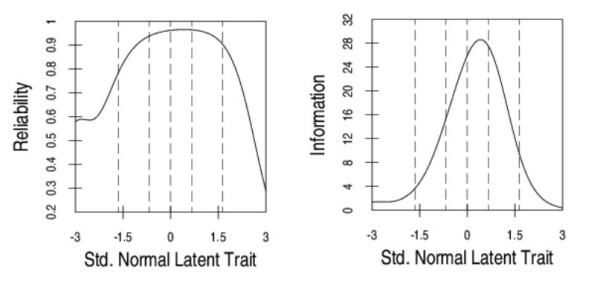
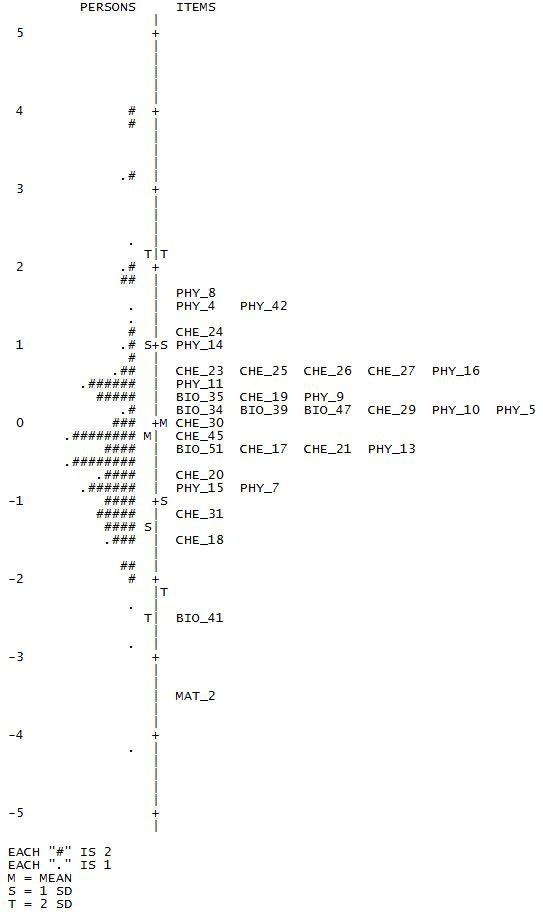
334 first year medical students of the 2006 cohort responded to 52 multiple choice items from biology, physics, and chemistry. For the construction of scales we generated two random subsamples, one for development and one for validation. In the development sample, unidimensional item sets were extracted from the item pool by means of weighted least squares (WLS) factor analysis, and subsequently fitted to the Rasch model. In the validation sample, the scales were subjected to confirmatory factor analysis and, again, Rasch modelling. The outcome measure was academic success after two years.
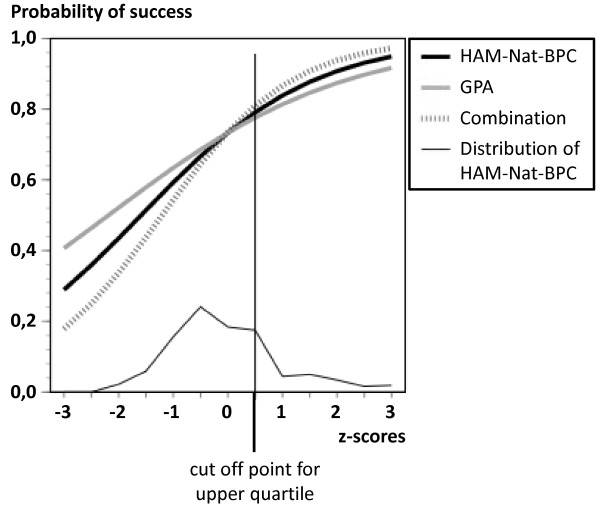
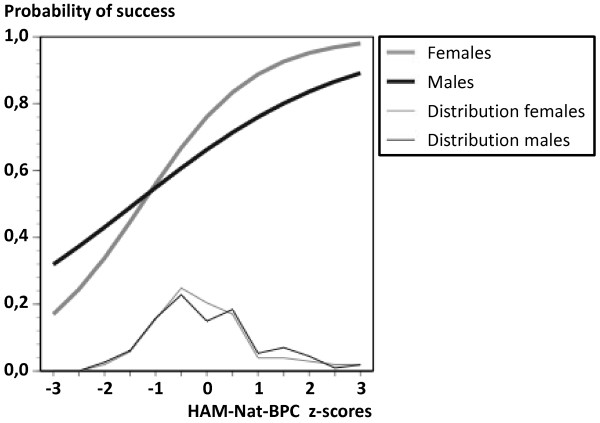
Although the correlational structure within the item set is weak, a unidimensional scale could be fitted to the Rasch model. However, psychometric properties of this scale deteriorated in the validation sample. A model with three highly correlated subject specific factors performed better. All summary scales predicted academic success with an odds ratio of about 2.0. Prediction was independent of high school grades and there was a slight tendency for prediction to be better in females than in males.
A model separating biology, physics, and chemistry into different Rasch scales seems to be more suitable for item bank development than a unidimensional model, even when these scales are highly correlated and enter into a global score. When such a combination scale is used to select the upper quartile of applicants, the proportion of successful completion of the curriculum after two years is expected to rise substantially.
自然科学知识通常可以预测医学生在医学课程头两年的学习成绩。为了减少前临床阶段的延迟和辍学,汉堡医科大学决定开发一种自然科学测试(HAM-Nat)用于学生选拔。在本研究中,呈现了两种不同的量表构建方法:一种是单维量表,另一种是由三个学科特定维度组成的量表。比较了它们的心理测量学特性及其与学业成功的关系。
2006 年队列的 334 名一年级医学生对生物学、物理学和化学的 52 个多项选择题做出了回应。为了构建量表,我们从项目池中生成了两个随机子样本,一个用于开发,另一个用于验证。在开发样本中,通过加权最小二乘法(WLS)因子分析从项目池中提取出单维项目集,然后将其拟合到 Rasch 模型中。在验证样本中,对量表进行了验证性因素分析,然后再次进行了 Rasch 建模。因变量是两年后的学业成功。
尽管项目集内的相关性结构较弱,但可以将一个单维量表拟合到 Rasch 模型中。然而,该量表在验证样本中的心理测量学特性恶化了。一个具有三个高度相关的学科特定因子的模型表现更好。所有综合量表的预测成功率为 2.0 左右。预测与高中成绩无关,而且女性的预测效果略优于男性。
将生物学、物理学和化学分开成不同的 Rasch 量表的模型似乎比单维模型更适合项目库开发,即使这些量表高度相关并进入一个总体得分。当使用这种组合量表选择申请人的前四分之一时,预计在两年后完成课程的成功率会大幅提高。