Holmes B, Costas M, Sloss L L
National Collection of Type Cultures, Central Public Health Laboratory, London, England.
Epidemiol Infect. 1990 Aug;105(1):107-17. doi: 10.1017/s0950268800047701.
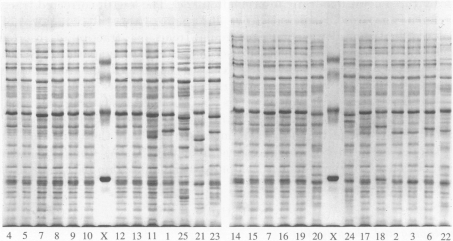
Twenty-five cultures comprising 18 clinical isolates of Serratia marcescens from two hospitals, the type strain of S. marcescens, two reference strains of S. marinorubra, the type or a reference strain of three other Serratia species and a reference strain of undetermined species, were characterized by one-dimensional sodium dodecyl sulphate-polyacrylamide gel electrophoresis (SDS-PAGE) of whole-cell proteins. The protein patterns were highly reproducible and were used as the basis of a numerical analysis which divided the clinical isolates into eight protein types. Comparison with O-serotyping indicated that the level of discrimination by SDS-PAGE was similar. As with O-serotyping, a secondary scheme, such as phage typing, is necessary to differentiate strains of the same protein type. We conclude that high-resolution SDS-PAGE of proteins provides an effective adjunct to other methods for typing isolates of S. marcescens.
对25种培养物进行了全细胞蛋白的一维十二烷基硫酸钠-聚丙烯酰胺凝胶电泳(SDS-PAGE)分析,这些培养物包括来自两家医院的18株粘质沙雷氏菌临床分离株、粘质沙雷氏菌的模式菌株、两株海红沙雷氏菌参考菌株、其他三种沙雷氏菌的模式或参考菌株以及一株未确定种的参考菌株。蛋白质图谱具有高度可重复性,并作为数值分析的基础,该分析将临床分离株分为八种蛋白类型。与O-血清分型的比较表明,SDS-PAGE的鉴别水平相似。与O-血清分型一样,需要二级分型方案,如噬菌体分型,以区分相同蛋白类型的菌株。我们得出结论,蛋白质的高分辨率SDS-PAGE为其他分型粘质沙雷氏菌分离株的方法提供了有效的辅助手段。