Max-Planck Institut für Evolutionsbiologie, August-Thienemannstrasse 2, 24306 Plön, Germany.
BMC Evol Biol. 2011 Oct 18;11:306. doi: 10.1186/1471-2148-11-306.
Insights into the micro-evolutionary patterns of morphological traits require an assessment of the natural variation of the trait within and between populations and closely related species. The mouse mandible is a particularly suitable morphological trait for such an analysis, since it has long been used as a model to study the quantitative genetics of shape. In addition, many distinct populations, sub-species and closely related species are known for the house mouse. However, morphological comparisons among wild caught animals require an assessment in how far environmental and technical factors could interfere with the shape change measurements.
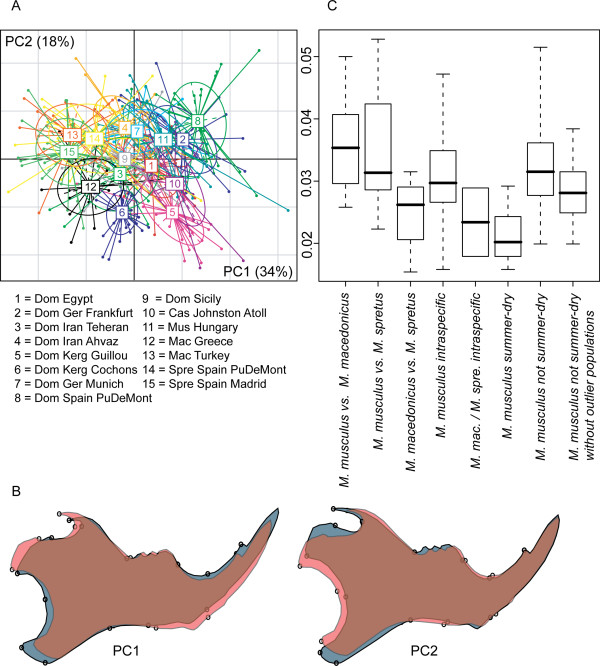
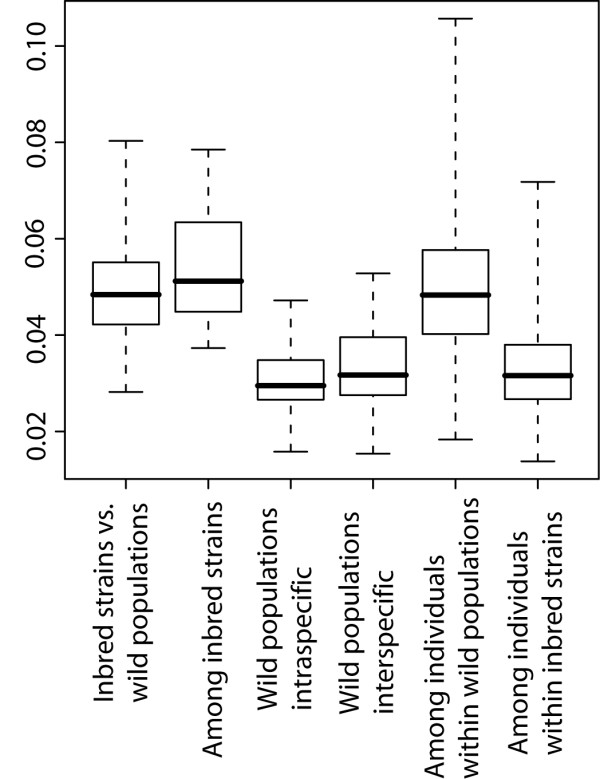
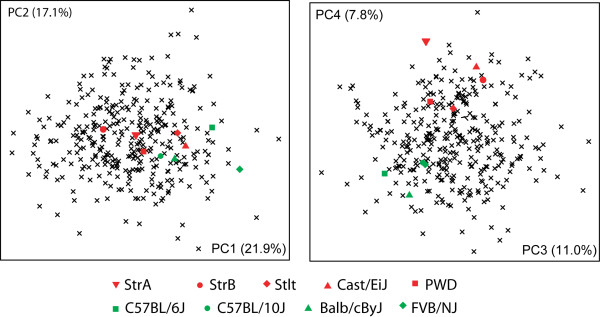
Using geometric morphometrics, we have surveyed mandible shapes in 15 natural populations of the genus Mus, with a focus on the subspecies Mus musculus domesticus. In parallel we have carefully assessed possibly confounding technical and biological factors. We find that there are distinct differences on average between populations, subspecies and species, but these differences are smaller than differences between individuals within populations. Populations from summer-dry regions, although more ancestral, are less distinct from each other than are populations from the more recently colonized northern areas. Populations with especially distinct shapes occur in an area of sympatry of M. m. domesticus and M. spretus and on recently colonized sub-antarctic islands. We have also studied a number of inbred strains to assess in how far their mandible shapes resemble those from the wild. We find that they fall indeed into the shape space of natural variation between individuals in populations.
Although mandible shapes in natural populations can be influenced by environmental variables, these influences are insufficient to explain the average extent of shape differences between populations, such that evolutionary processes must be invoked to explain this level of diversity. We discuss that adaptive evolution may contribute to shape changes between populations, in particular in newly colonized areas. A comparison between inbred strains and wild mice suggests that the laboratory environment has no major systematic effect on the mandible shape and that such strains can be used as representatives of the natural shape differences between individuals.
深入了解形态特征的微观进化模式,需要评估该特征在种群内和种群间以及近缘物种中的自然变异。鼠类下颌骨是进行这种分析的特别合适的形态特征,因为它长期以来一直被用作研究形状的数量遗传学模型。此外,有许多不同的种群、亚种和近缘物种被用于家鼠。然而,对野生捕获动物进行形态比较,需要评估环境和技术因素在多大程度上会干扰形状变化的测量。
我们利用几何形态测量学,对 15 个属 Mus 的自然种群的下颌骨形状进行了调查,重点是亚种 Mus musculus domesticus。同时,我们还仔细评估了可能存在的混淆技术和生物学因素。我们发现,种群、亚种和物种之间平均存在明显差异,但这些差异小于种群内个体之间的差异。来自夏季干旱地区的种群,尽管更为原始,但彼此之间的差异不如最近被殖民的北方地区的种群之间的差异大。具有特别独特形状的种群出现在 M. m. domesticus 和 M. spretus 的同域地区,以及最近被殖民的亚南极岛屿上。我们还研究了一些近交系,以评估它们的下颌骨形状与野生种群的相似程度。我们发现,它们确实落入了种群内个体之间的自然变异的形状空间。
尽管自然种群中的下颌骨形状可能受到环境变量的影响,但这些影响不足以解释种群之间形状差异的平均程度,因此必须援引进化过程来解释这种多样性水平。我们讨论了适应性进化可能有助于种群之间的形状变化,特别是在新殖民地区。近交系和野生鼠之间的比较表明,实验室环境对下颌骨形状没有重大系统影响,并且这些系可以用作个体之间自然形状差异的代表。