Department of Ophthalmology, S. S. Medical College, Rewa, MP, India.
Indian J Ophthalmol. 2011 Nov-Dec;59(6):509-12. doi: 10.4103/0301-4738.86327.
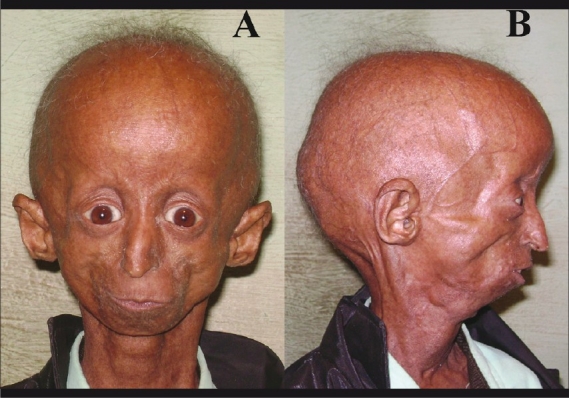
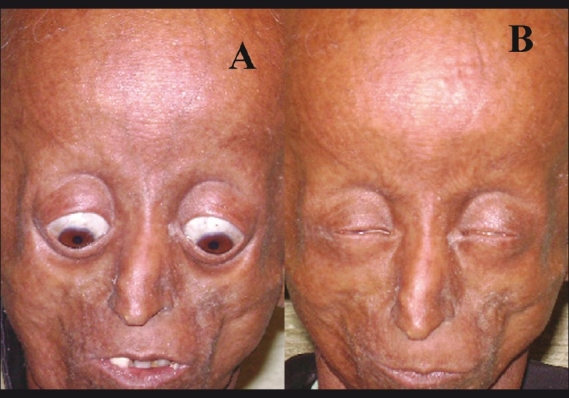
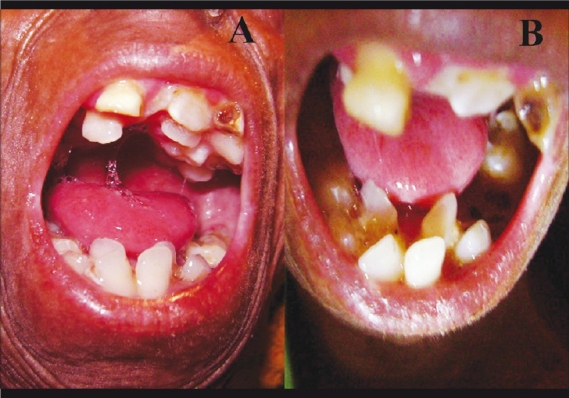
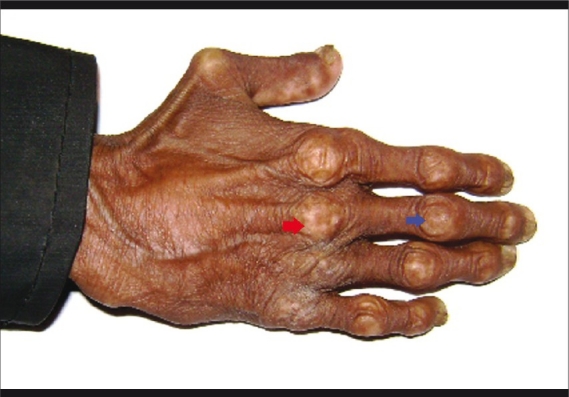
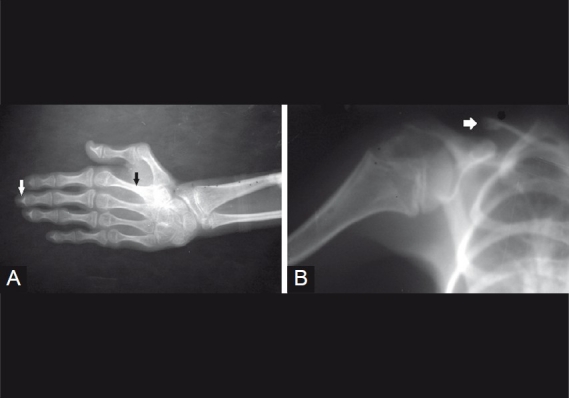
The Hutchinson-Gilford progeria (HGP) syndrome is an extremely rare genetic condition characterized by an appearance of accelerated aging in children. The word progeria is derived from the Greek word progeros meaning 'prematurely old'. It is caused by de novo dominant mutation in the LMNA gene (gene map locus 1q21.2) and characterized by growth retardation and accelerated degenerative changes of the skin, musculoskeletal and cardiovascular systems. The most common ocular manifestations are prominent eyes, loss of eyebrows and eyelashes, and lagophthalmos. In the present case some additional ocular features such as horizontal narrowing of palpebral fissure, superior sulcus deformity, upper lid retraction, upper lid lag in down gaze, poor pupillary dilatation, were noted. In this case report, a 15-year-old Indian boy with some additional ocular manifestations of the HGP syndrome is described.
哈钦森-吉尔福德早衰症(HGP)综合征是一种极其罕见的遗传性疾病,其特征是儿童出现加速衰老的表现。早衰症一词源自希腊语 progeros,意思是“过早衰老”。它是由 LMNA 基因(基因图谱位置 1q21.2)的新生显性突变引起的,其特征是生长迟缓以及皮肤、肌肉骨骼和心血管系统的退行性变化加速。最常见的眼部表现为眼球突出、眉毛和睫毛缺失以及睑裂闭合不全。在本病例中,还观察到一些其他眼部特征,如睑裂水平变窄、上睑沟畸形、上睑退缩、下视时下睑迟落、瞳孔扩张不良。在本病例报告中,描述了一名 15 岁印度男孩患有 HGP 综合征的一些其他眼部表现。