UCL Institute of Cognitive Neuroscience, 17 Queen Square, London WC1N 3AR, UK.
Proc Biol Sci. 2012 Apr 7;279(1732):1327-34. doi: 10.1098/rspb.2011.1959. Epub 2011 Oct 19.
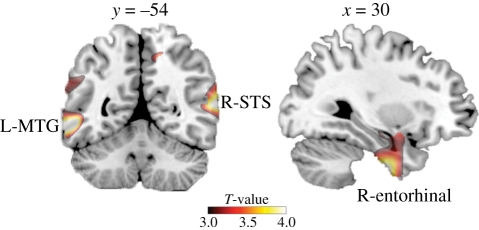
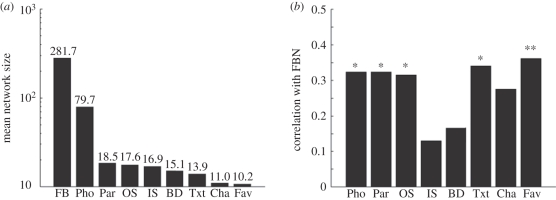
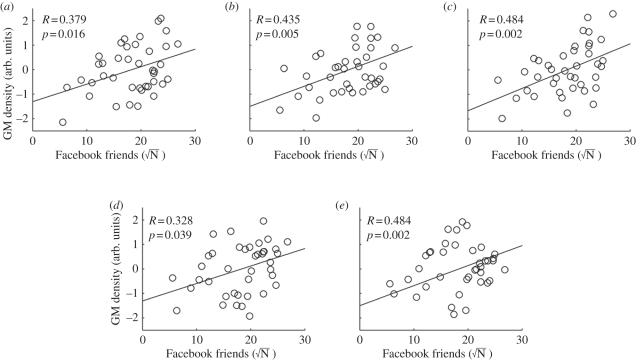
The increasing ubiquity of web-based social networking services is a striking feature of modern human society. The degree to which individuals participate in these networks varies substantially for reasons that are unclear. Here, we show a biological basis for such variability by demonstrating that quantitative variation in the number of friends an individual declares on a web-based social networking service reliably predicted grey matter density in the right superior temporal sulcus, left middle temporal gyrus and entorhinal cortex. Such regions have been previously implicated in social perception and associative memory, respectively. We further show that variability in the size of such online friendship networks was significantly correlated with the size of more intimate real-world social groups. However, the brain regions we identified were specifically associated with online social network size, whereas the grey matter density of the amygdala was correlated both with online and real-world social network sizes. Taken together, our findings demonstrate that the size of an individual's online social network is closely linked to focal brain structure implicated in social cognition.
基于网络的社交网络服务的普及程度日益提高,这是现代人类社会的一个显著特征。由于目前尚不清楚原因,个人参与这些网络的程度存在很大差异。在这里,我们通过证明个体在基于网络的社交网络服务上宣称的朋友数量的定量变化可靠地预测了右侧上颞回、左侧中颞回和内嗅皮层的灰质密度,从而证明了这种可变性存在生物学基础。这些区域之前分别与社会知觉和联想记忆有关。我们进一步表明,这种在线友谊网络大小的可变性与更亲密的现实世界社交群体的大小显著相关。然而,我们确定的大脑区域与在线社交网络大小密切相关,而杏仁核的灰质密度与在线和现实世界社交网络大小都相关。总之,我们的研究结果表明,个体的在线社交网络规模与社会认知中涉及的焦点大脑结构密切相关。