Department of Entomology and Plant Pathology, University of Tennessee, Knoxville, TN 37996, USA.
Mol Plant Pathol. 2012 May;13(4):329-37. doi: 10.1111/j.1364-3703.2011.00754.x. Epub 2011 Oct 20.
Phytophthora capsici is a highly dynamic and destructive pathogen of vegetables. It attacks all cucurbits, pepper, tomato and eggplant, and, more recently, snap and lima beans. The disease incidence and severity have increased significantly in recent decades and the molecular resources to study this pathogen are growing and now include a reference genome. At the population level, the epidemiology varies according to the geographical location, with populations in South America dominated by clonal reproduction, and populations in the USA and South Africa composed of many unique genotypes in which sexual reproduction is common. Just as the impact of crop loss as a result of P. capsici has increased in recent decades, there has been a similar increase in the development of new tools and resources to study this devastating pathogen. Phytophthora capsici presents an attractive model for understanding broad-host-range oomycetes, the impact of sexual recombination in field populations and the basic mechanisms of Phytophthora virulence.
Kingdom Chromista; Phylum Oomycota; Class Oomycetes; Order Peronosporales; Family Peronosporaceae; Genus Phytophthora; Species capsici.
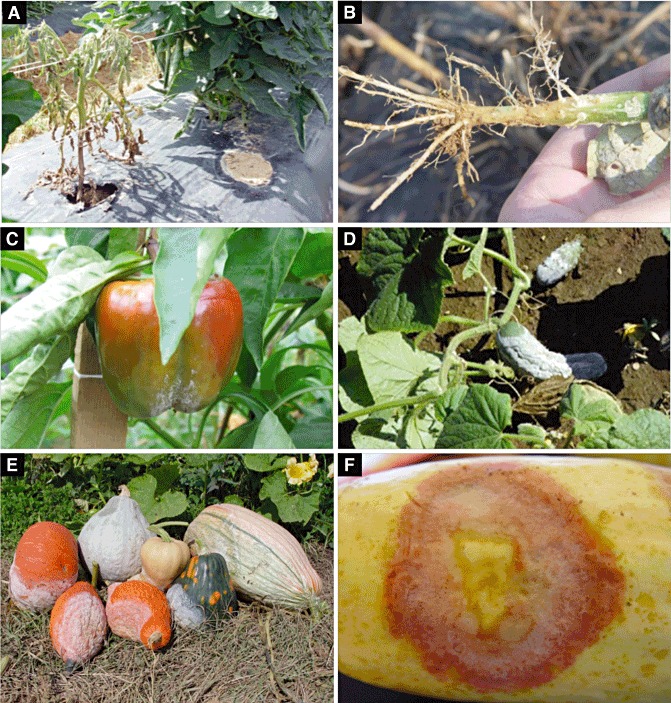
Symptoms vary considerably according to the host, plant part infected and environmental conditions. For example, in dry areas (e.g. southwestern USA and southern France), infection on tomato and bell or chilli pepper is generally on the roots and crown, and the infected plants have a distinctive black/brown lesion visible at the soil line (Fig. 1). In areas in which rainfall is more common (e.g. eastern USA), all parts of the plant are infected, including the roots, crown, foliage and fruit (Fig. 1). Root infections cause damping off in seedlings, whereas, in older plants, it is common to see stunted growth, wilting and, eventually, death. For tomatoes, it is common to see significant adventitious root growth just above an infected tap root, and the stunted plants, although severely compromised, may not die. For many cucurbit fruit, the expanding lesions produce fresh sporangia over days (or even weeks depending on the size of the fruit) and the fruit often look as if they have been dipped in white powdered confectioner's sugar (Fig. 1). Generally, hyphae do not emerge from infected plants or fruit (common with Pythium infections) and all that is visible on the surface of an infected plant is sporangia.
Phytophthora capsici presents an oomycete worst-case scenario to growers as it has a broad host range, often produces long-lived dormant sexual spores, has extensive genotypic diversity and has an explosive asexual disease cycle. It is becoming increasingly apparent that novel control strategies are needed to safeguard food production from P. capsici and other oomycetes. Considering that P. capsici is easy to grow, mate and manipulate in the laboratory and infects many plant species, this pathogen is a robust model for investigations, particularly those related to sexual reproduction, host range and virulence.
Phytophthora capsici genome database: http://genome.jgi-psf.org/Phyca11/Phyca11.home.html. Molecular tools to identify Phytophthora isolates: http://phytophthora-id.org.
辣椒疫霉是一种高度活跃且具有破坏性的蔬菜病原体。它会攻击所有的葫芦科作物、辣椒、番茄和茄子,最近还会攻击甜豆和利马豆。在过去几十年中,病害的发病率和严重程度显著增加,而用于研究这种病原体的分子资源也在不断增加,现在包括一个参考基因组。在种群水平上,根据地理位置,流行病学情况有所不同,南美洲的种群以无性繁殖为主,而美国和南非的种群则由许多独特的基因型组成,其中有性繁殖很常见。就像由于辣椒疫霉导致的作物损失在最近几十年中增加一样,用于研究这种破坏性病原体的新工具和资源也在类似地增加。辣椒疫霉为理解广宿主范围的卵菌、有性重组在田间种群中的作用以及植物疫霉致病的基本机制提供了一个有吸引力的模型。
界Chromista;门Oomycota;纲 Oomycetes;目 Peronosporales;科 Peronosporaceae;属 Phytophthora;种 capsici。
根据宿主、感染的植物部位和环境条件的不同,症状差异很大。例如,在干燥地区(例如美国西南部和法国南部),番茄和甜椒或辣椒的根和冠部通常会受到感染,受感染的植物在土壤线处有明显的黑色/棕色病变(图 1)。在降雨更为常见的地区(例如美国东部),植株的所有部位都会受到感染,包括根、冠、叶片和果实(图 1)。根部感染会导致幼苗猝倒,而在较老的植株中,常见的是植株生长矮小、萎蔫,最终死亡。对于番茄,通常会看到感染的主根上方有大量的不定根生长,尽管植株受到严重损害,但可能不会死亡。对于许多葫芦科果实,不断扩展的病变会在数天内(或根据果实的大小甚至数周)产生新鲜的游动孢子,果实看起来就像是被浸过白色糖粉一样(图 1)。通常,在受感染的植物或果实上不会有菌丝体出现(与腐霉菌感染不同),在受感染的植物表面只能看到游动孢子。
辣椒疫霉对种植者来说是一种最坏的卵菌情况,因为它具有广泛的宿主范围,通常会产生长期休眠的有性孢子,具有广泛的基因型多样性,并且具有爆炸性的无性疾病循环。越来越明显的是,需要新的控制策略来保护粮食生产免受辣椒疫霉和其他卵菌的侵害。考虑到辣椒疫霉易于在实验室中生长、交配和操作,并且感染许多植物物种,因此该病原体是用于研究,特别是与有性繁殖、宿主范围和毒力相关研究的可靠模型。
辣椒疫霉基因组数据库:http://genome.jgi-psf.org/Phyca11/Phyca11.home.html。用于鉴定 Phytophthora 分离株的分子工具:http://phytophthora-id.org。
