Institute of Laboratory Animals, Graduate School of Medicine, Kyoto University, Yoshidakonoe-cho, Sakyo-ku, Kyoto 606-8501, Japan.
BMC Genet. 2011 Oct 21;12:91. doi: 10.1186/1471-2156-12-91.
Hypohidrotic ectodermal dysplasia (HED) is a congenital disorder characterized by sparse hair, oligodontia, and inability to sweat. It is caused by mutations in any of three Eda pathway genes: ectodysplasin (Eda), Eda receptor (Edar), and Edar-associated death domain (Edaradd), which encode ligand, receptor, and intracellular adaptor molecule, respectively. The Eda signaling pathway activates NF-κB, which is central to ectodermal differentiation. Although the causative genes and the molecular pathway affecting HED have been identified, no curative treatment for HED has been established. Previously, we found a rat spontaneous mutation that caused defects in hair follicles and named it sparse-and-wavy (swh). Here, we have established the swh rat as the first rat model of HED and successfully identified the swh mutation.
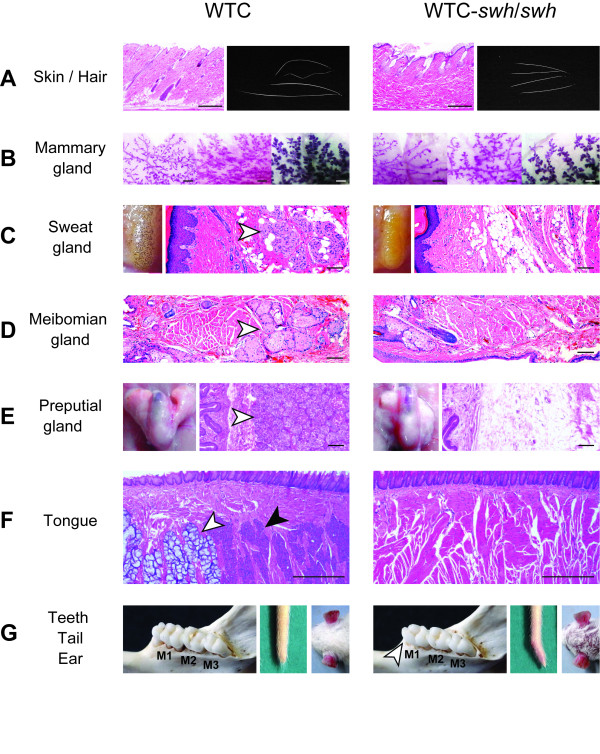
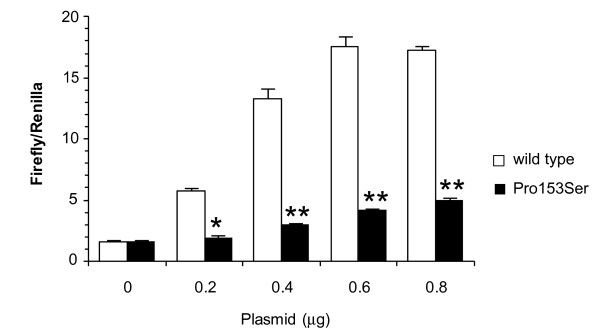
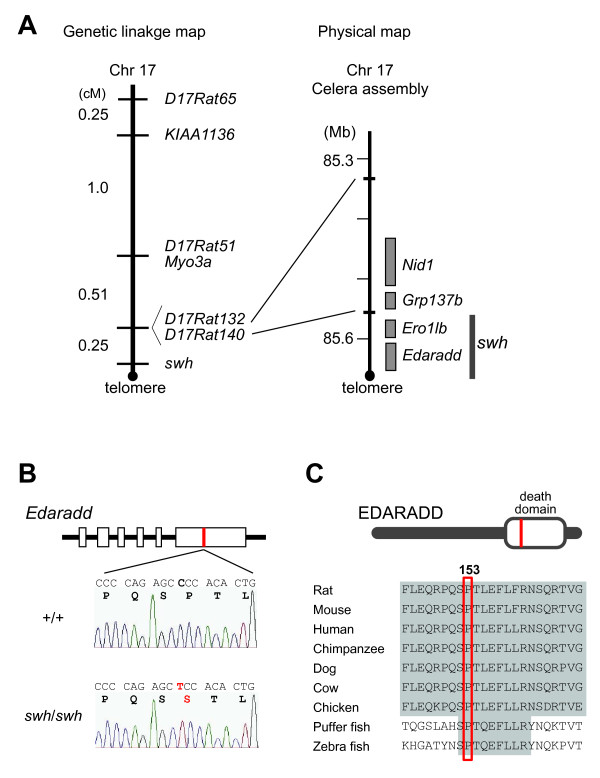
The swh/swh rat showed sparse hair, abnormal morphology of teeth, and absence of sweat glands. The ectoderm-derived glands, meibomian, preputial, and tongue glands, were absent. We mapped the swh mutation to the most telomeric part of rat Chr 7 and found a Pro153Ser missense mutation in the Edaradd gene. This mutation was located in the death domain of EDARADD, which is crucial for signal transduction and resulted in failure to activate NF-κB.
These findings suggest that swh is a loss-of-function mutation in the rat Edaradd and indicate that the swh/swh rat would be an excellent animal model of HED that could be used to investigate the pathological basis of the disease and the development of new therapies.
少汗型外胚层发育不全(HED)是一种先天性疾病,其特征为毛发稀疏、牙齿缺失和无汗。它是由三个 Eda 通路基因中的任何一个突变引起的:ectodysplasin(Eda)、Eda 受体(Edar)和 Edar 相关死亡结构域(Edaradd),它们分别编码配体、受体和细胞内衔接分子。Eda 信号通路激活 NF-κB,这对于外胚层分化至关重要。尽管已经确定了导致 HED 的致病基因和分子途径,但尚未建立针对 HED 的治愈方法。先前,我们发现了一种导致毛囊缺陷的大鼠自发性突变,并将其命名为稀疏卷曲(swh)。在这里,我们将 swh 大鼠建立为 HED 的首个大鼠模型,并成功鉴定了 swh 突变。
swh/swh 大鼠表现出毛发稀疏、牙齿形态异常和无汗。外胚层衍生的腺体,如睑板腺、包皮腺和舌腺,均缺失。我们将 swh 突变定位到大鼠 Chr 7 的最端粒部分,并在 Edaradd 基因中发现了一个 Pro153Ser 错义突变。该突变位于 EDARADD 的死亡结构域,对于信号转导至关重要,导致 NF-κB 无法激活。
这些发现表明 swh 是大鼠 Edaradd 的功能丧失突变,并表明 swh/swh 大鼠将成为 HED 的优秀动物模型,可用于研究疾病的病理基础和新疗法的开发。