Center for Vascular and Inflammatory Diseases, and Department of Microbiology and Immunology, University of Maryland School of Medicine, 800 W, Baltimore St, Baltimore, MD 21201, USA.
BMC Immunol. 2011 Oct 20;12:60. doi: 10.1186/1471-2172-12-60.
CD4+ T helper type 2 (TH2) cells, their cytokines IL-4, IL-5 and IL-13 and the transcription factor STAT6 are known to regulate various features of asthma including lung inflammation, mucus production and airway hyperreactivity and also drive alternative activation of macrophages (AAM). However, the precise roles played by the IL-4/IL-13 receptors and STAT6 in inducing AAM protein expression and modulating specific features of airway inflammation are still unclear. Since TH2 differentiation and activation plays a pivotal role in this disease, we explored the possibility of developing an asthma model in mice using T cells that were differentiated in vivo.
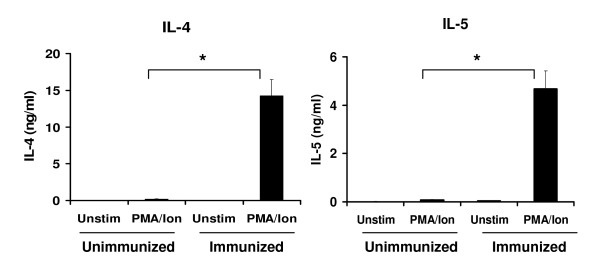
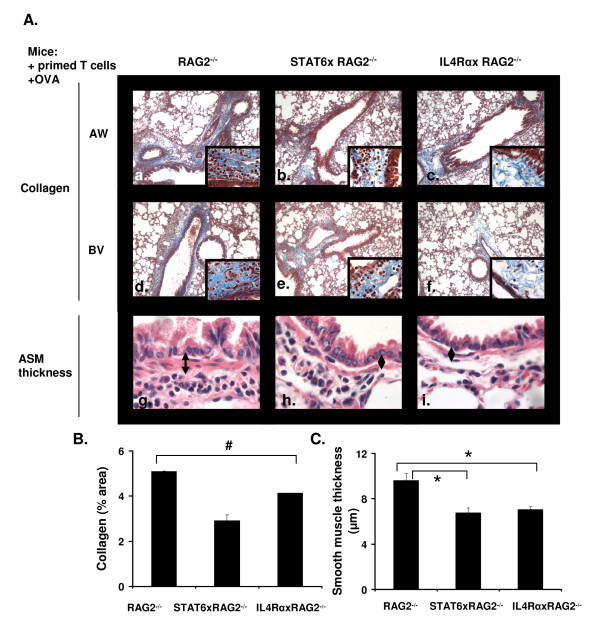
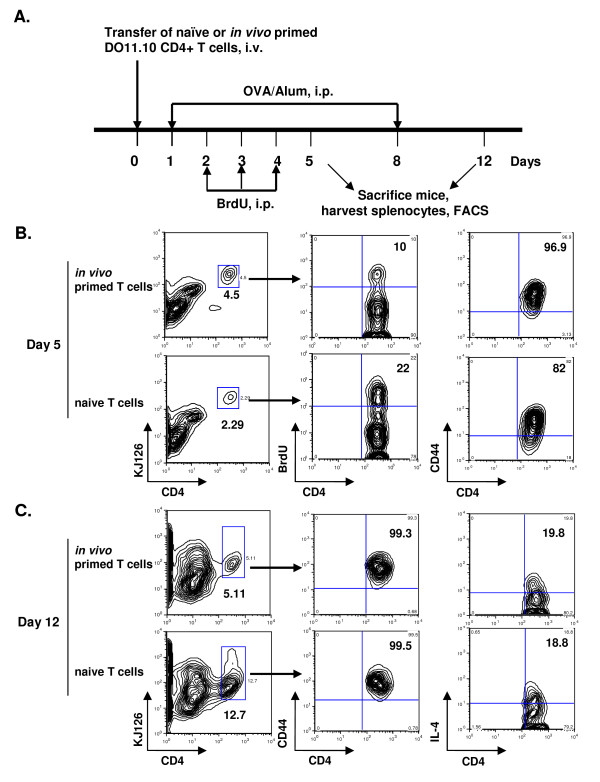
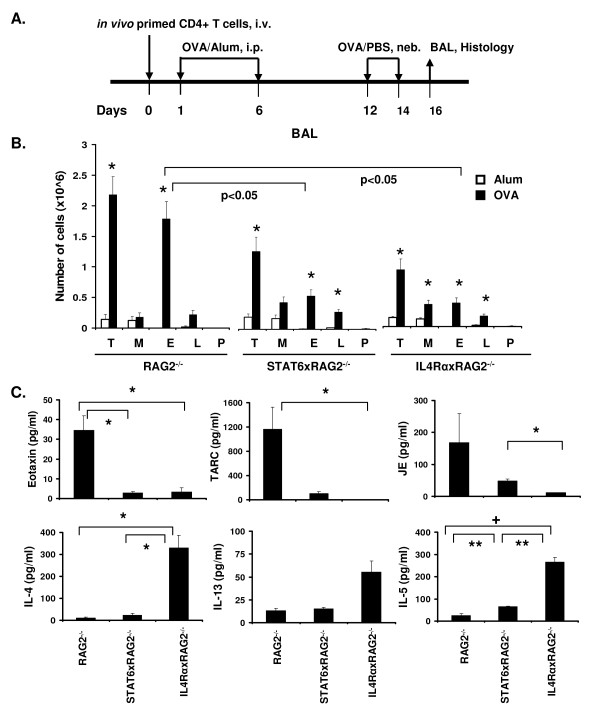
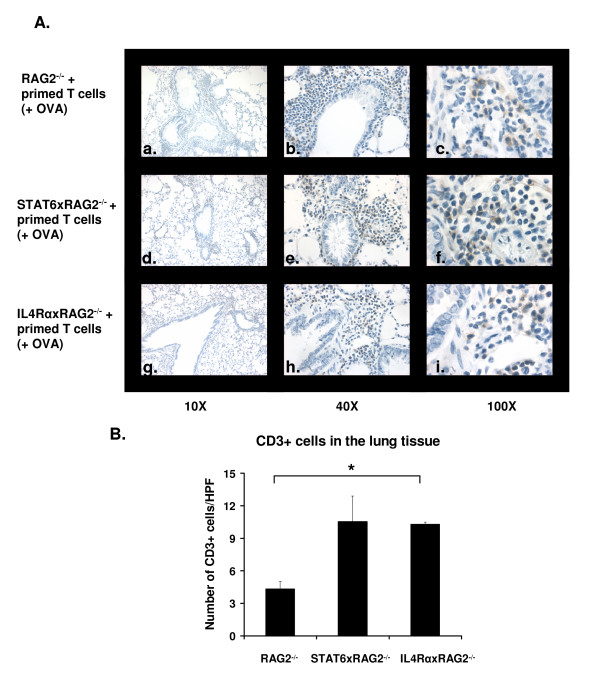
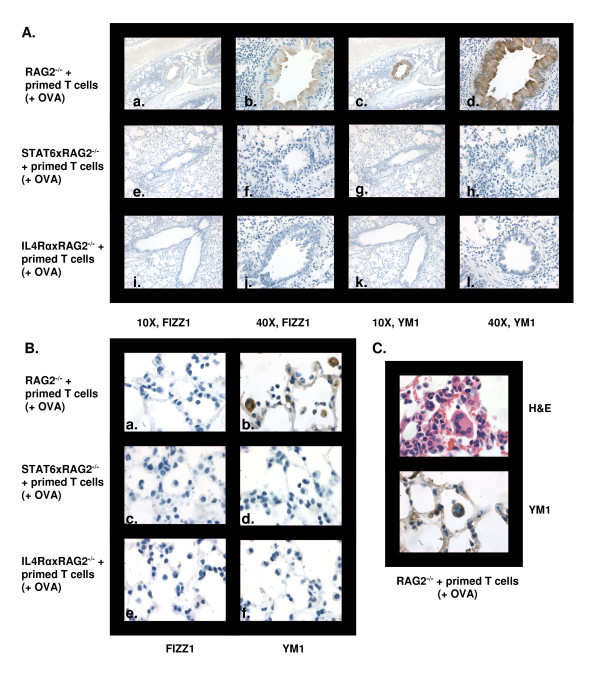
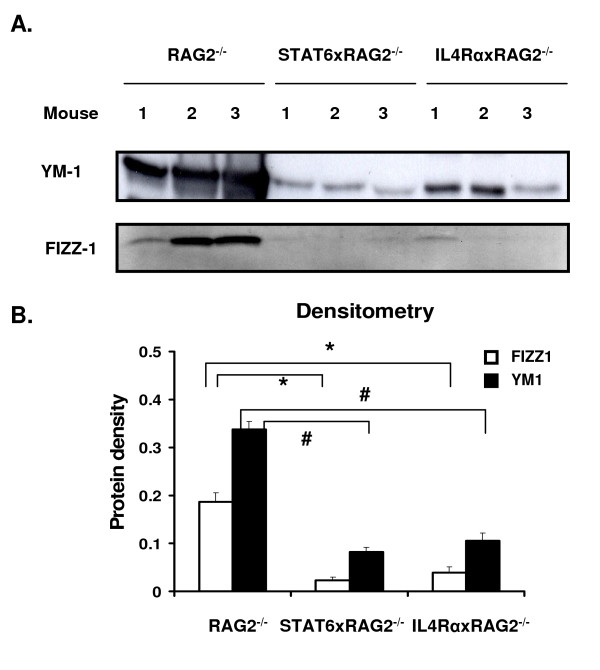
In this study, we monitored the activation and proliferation status of adoptively transferred allergen-specific naïve or in vivo primed CD4+ T cells. We found that both the naïve and in vivo primed T cells expressed similar levels of CD44 and IL-4. However, in vivo primed T cells underwent reduced proliferation in a lymphopenic environment when compared to naïve T cells. We then used these in vivo generated effector T cells in an asthma model. Although there was reduced inflammation in mice lacking IL-4Rα or STAT6, significant amounts of eosinophils were still present in the BAL and lung tissue. Moreover, specific AAM proteins YM1 and FIZZ1 were expressed by epithelial cells, while macrophages expressed only YM1 in RAG2-/- mice. We further show that FIZZ1 and YM1 protein expression in the lung was completely dependent on signaling through the IL-4Rα and STAT6. Consistent with the enhanced inflammation and AAM protein expression, there was a significant increase in collagen deposition and smooth muscle thickening in RAG2-/- mice compared to mice deficient in IL-4Rα or STAT6.
These results establish that transfer of in vivo primed CD4+ T cells can induce allergic lung inflammation. Furthermore, while IL-4/IL-13 signaling through IL-4Rα and STAT6 is essential for AAM protein expression, lung inflammation and eosinophilia are only partially dependent on this pathway. Further studies are required to identify other proteins and signaling pathways involved in airway inflammation.
CD4+T 辅助型 2(TH2)细胞、其细胞因子白细胞介素 4(IL-4)、白细胞介素 5(IL-5)和白细胞介素 13(IL-13)以及转录因子 STAT6 已知可调节哮喘的各种特征,包括肺部炎症、黏液产生和气道高反应性,并且还可驱动巨噬细胞的替代激活(AAM)。然而,IL-4/IL-13 受体和 STAT6 在诱导 AAM 蛋白表达和调节气道炎症的特定特征方面的确切作用仍不清楚。由于 TH2 分化和激活在这种疾病中起着关键作用,我们探索了使用体内分化的 T 细胞在小鼠中建立哮喘模型的可能性。
在这项研究中,我们监测了过继转移的过敏原特异性幼稚或体内致敏 CD4+T 细胞的激活和增殖状态。我们发现,幼稚和体内致敏的 T 细胞均表达相似水平的 CD44 和 IL-4。然而,与幼稚 T 细胞相比,体内致敏的 T 细胞在淋巴减少环境中增殖减少。然后,我们在哮喘模型中使用这些体内生成的效应 T 细胞。尽管缺乏 IL-4Rα 或 STAT6 的小鼠炎症减少,但 BAL 和肺组织中仍存在大量嗜酸性粒细胞。此外,上皮细胞表达特定的 AAM 蛋白 YM1 和 FIZZ1,而巨噬细胞在 RAG2-/- 小鼠中仅表达 YM1。我们进一步表明,肺中的 FIZZ1 和 YM1 蛋白表达完全依赖于通过 IL-4Rα 和 STAT6 的信号传导。与增强的炎症和 AAM 蛋白表达一致,与缺乏 IL-4Rα 或 STAT6 的小鼠相比,RAG2-/- 小鼠中的胶原沉积和平滑肌增厚显著增加。
这些结果表明,体内致敏的 CD4+T 细胞的转移可以诱导过敏性肺炎症。此外,尽管通过 IL-4Rα 和 STAT6 的 IL-4/IL-13 信号传导对于 AAM 蛋白表达是必需的,但肺炎症和嗜酸性粒细胞增多仅部分依赖于该途径。需要进一步的研究来确定参与气道炎症的其他蛋白和信号通路。