From the Department of Obstetrics and Gynecology, Education Discovery Institute, Georgia Health Sciences University, Augusta, Georgia; the Department of Emergency Medicine, Department of Family Medicine, University of Michigan, Ann Arbor, Michigan; the Department of Community-Public Health, School of Nursing, Johns Hopkins University, Baltimore, Maryland; and the Departments of Psychiatry and Family Medicine, University of Michigan, Ann Arbor, Michigan.
Obstet Gynecol. 2011 Nov;118(5):1056-1063. doi: 10.1097/AOG.0b013e31823294da.
To estimate the rates of pregnancy-associated homicide and suicide in a multistate sample from the National Violent Death Reporting System, to compare these rates with other causes of maternal mortality, and to describe victims' demographic characteristics.
We analyzed data from female victims of reproductive age from 2003 to 2007. We identified pregnancy-associated violent deaths as deaths attributable to homicide or suicide during pregnancy or within the first year postpartum, and we calculated the rates of pregnancy-associated homicide and suicide as the number of deaths per 100,000 live births in the sample population. We used descriptive statistics to report victims' demographic characteristics and prevalence of intimate-partner violence.
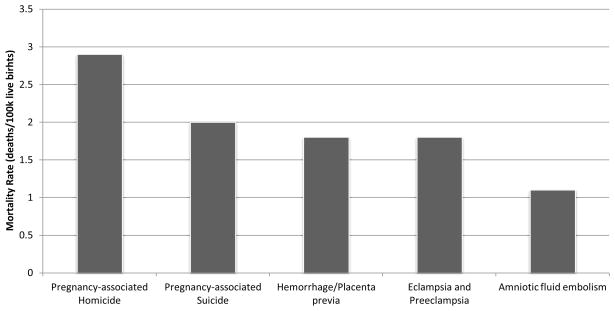
There were 94 counts of pregnancy-associated suicide and 139 counts of pregnancy-associated homicide, yielding pregnancy-associated suicide and homicide rates of 2.0 and 2.9 deaths per 100,000 live births, respectively. Victims of pregnancy-associated suicide were significantly more likely to be older and white or Native American as compared with all live births in National Violent Death Reporting System states. Pregnancy-associated homicide victims were significantly more likely to be at the extremes of the age range and African American. In our study, 54.3% of pregnancy-associated suicides involved intimate partner conflict that appeared to contribute to the suicide, and 45.3% of pregnancy-associated homicides were associated with intimate-partner violence.
Our results indicate that pregnancy-associated homicide and suicide are important contributors to maternal mortality and confirm the need to evaluate the relationships between sociodemographic disparities and intimate-partner violence with pregnancy-associated violent death.
利用国家暴力死亡报告系统(National Violent Death Reporting System)多州样本,估算妊娠相关凶杀和自杀率,与其他孕产妇死亡原因进行比较,并描述受害者的人口统计学特征。
我们分析了 2003 年至 2007 年期间处于生育年龄的女性受害者的数据。我们将妊娠相关的暴力死亡定义为妊娠期间或产后 1 年内归因于凶杀或自杀的死亡,并计算了样本人群中每 10 万例活产的妊娠相关凶杀和自杀率。我们使用描述性统计数据报告了受害者的人口统计学特征和亲密伴侣暴力的流行情况。
共有 94 例妊娠相关自杀和 139 例妊娠相关凶杀,妊娠相关自杀和凶杀率分别为每 10 万例活产 2.0 和 2.9 例。与国家暴力死亡报告系统各州的所有活产相比,妊娠相关自杀的受害者年龄更大,更有可能是白人或美洲原住民。妊娠相关凶杀的受害者更有可能处于年龄范围的极端,且为非裔美国人。在我们的研究中,54.3%的妊娠相关自杀涉及似乎导致自杀的亲密伴侣冲突,45.3%的妊娠相关凶杀与亲密伴侣暴力有关。
我们的研究结果表明,妊娠相关凶杀和自杀是孕产妇死亡的重要原因,并证实了需要评估社会人口统计学差异和亲密伴侣暴力与妊娠相关暴力死亡之间的关系。