Lemcke Johannes, Al-Zain Ferass, Meier Ullrich, Suess Olaf
Department of Neurosurgery, Unfallkrankenhaus Berlin, Germany.
Open Orthop J. 2011;5:348-53. doi: 10.2174/1874325001105010348. Epub 2011 Oct 7.
Anterior cervical decompression and fusion (ACDF) is the standard surgical treatment for radiculopathy and myelopathy. Polyetheretherketone (PEEK) has an elasticity similar to bone and thus appears well suited for use as the implant in ACDF procedures. The aim of this study is to examine the clinical and radiographic outcome of patients treated with standing alone PEEK spacers without bone morphogenic protein (BMP) or plating and to examine the influence of the different design of the two spacers on the rate of subsidence and dislocation.
This retrospective comparative study reviewed 335 patients treated by ACDF in a specialized urban hospital for radiculopathy or myelopathy due to degenerative pathologies. The Intromed PEEK spacer was used in 181 patients from 3/2002 to 11/2004, and the AMT SHELL spacer was implanted in 154 patients from 4/2004 to 12/2007. The follow-up rate was 100% at three months post-op and 82.7% (277 patients) at one year. The patients were assessed with the Japanese Orthopedic Association (JOA) questionnaire and radiographically.
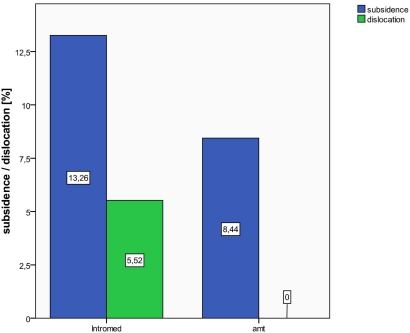
At the one-year follow-up there were 118/277 patients with an excellent clinical outcome on the JOA, 112/277 with a good outcome, 20/277 with a fair outcome, and 27/277 with a poor outcome. Subsidence was observed in 13.3% of patients with the Intromed spacer vs 8.4% of the patients with the AMT SHELL. Dislocation of the spacer was observed in 10 of the 181 patients with Intromed spacers but in none of the 154 patients with Shell spacers.
The study demonstrates that ACDF with standing alone PEEK cages leads to excellent and good clinical outcomes. The differences we observed in the subsidence rate between the two spacers were not significant and cannot be related to a single design feature of the spacers.
颈椎前路减压融合术(ACDF)是神经根病和脊髓病的标准外科治疗方法。聚醚醚酮(PEEK)具有与骨相似的弹性,因此似乎非常适合用作ACDF手术中的植入物。本研究的目的是检查单独使用PEEK椎间融合器、不使用骨形态发生蛋白(BMP)或钢板治疗的患者的临床和影像学结果,并检查两种椎间融合器的不同设计对下沉率和脱位率的影响。
这项回顾性比较研究回顾了一家城市专科医院因退行性病变导致神经根病或脊髓病而接受ACDF治疗的335例患者。2002年3月至2004年11月,181例患者使用了Intromed PEEK椎间融合器,2004年4月至2007年12月,154例患者植入了AMT SHELL椎间融合器。术后3个月的随访率为100%,1年时为82.7%(277例患者)。采用日本骨科协会(JOA)问卷对患者进行评估,并进行影像学检查。
在1年的随访中,277例患者中,118例JOA临床结果为优,112例为良,20例为中,27例为差。使用Intromed椎间融合器的患者中有13.3%出现下沉,而使用AMT SHELL椎间融合器的患者中这一比例为8.4%。在181例使用Intromed椎间融合器的患者中,有10例出现椎间融合器脱位,但在154例使用Shell椎间融合器的患者中均未出现脱位。
该研究表明,单独使用PEEK椎间融合器进行ACDF可带来良好和优秀的临床结果。我们观察到的两种椎间融合器下沉率差异不显著,且与椎间融合器的单一设计特征无关。