Ng Eugene Pak-Lin, Yip Andrew Siu-Leung, Wan Keith Hay-Man, Tse Michael Siu-Hei, Wong Kam-Kwong, Kwok Tik-Koon, Wong Wing-Cheung
Department of Orthopaedics and Traumatology, Kwong Wah Hospital, Hong Kong.
Asian Spine J. 2019 Apr;13(2):225-232. doi: 10.31616/asj.2018.0193. Epub 2018 Nov 27.
A retrospective review of patients who underwent 2-level anterior cervical discectomy and fusion (ACDF) with standalone polyetheretherketone (PEEK) cages for cervical spondylotic myelopathy (CSM).
To evaluate the efficacy of stand-alone PEEK cage in 2-level cervical interbody fusion for CSM.
ACDF is a standard surgical procedure to treat degenerative disc disease. However, the use of additional anterior plating for 2-level ACDF remains controversial.
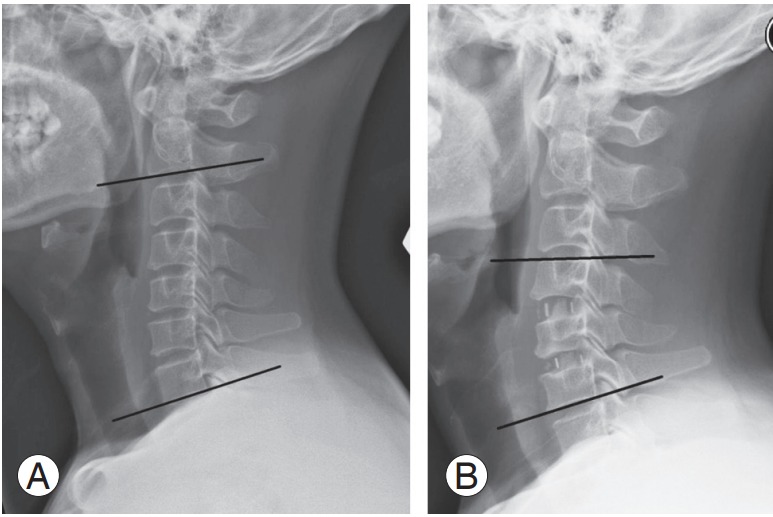
We reviewed outcomes of patients who underwent 2-level ACDF with stand-alone PEEK cages for CSM over a 7-year period (2007-2015) in a regional hospital. Japanese Orthopaedic Association (JOA) score, fusion rate, subsidence rate, cage migration, and cervical alignment by the C2-7 angle as well as the local segmental angle (LSA) of the cervical spine were assessed.
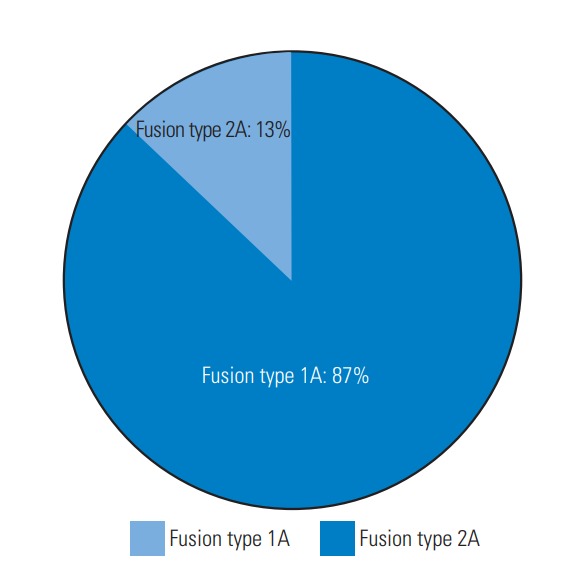
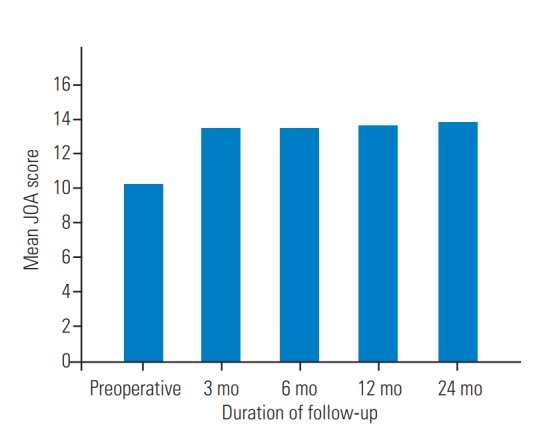
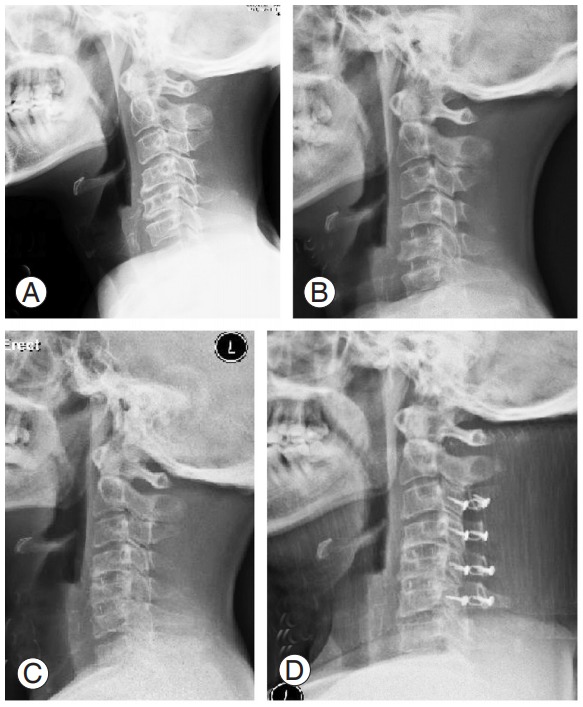
In total, 31 patients (mean age, 59 years; range, 36-87 years) underwent 2-level ACDF with a cage-only construct procedure between 2007 and 2015. The minimum follow-up was 24 months; mean follow-up was 51 months. C3-5 fusion was performed in 45%, C4-6 fusion in 32%, and C5-7 fusion in 23%. Mean JOA score improved from 10.1±2.2 to 13.9±2.1 (p<0.01) at the 24-month follow-up. Fusion was achieved in all patients. Subsidence occurred in 22.5% of the cages but was not associated with differences in JOA scores, age, sex, or levels fused. Lordosis of the C2-7 angle and LSA increased after surgery, which were maintained for up to 1 year but subsequently disappeared after 2 years, yet the difference was not statistically significant. No cage migration was noted; two patients developed adjacent segment disease requiring posterior laminoplasty 3 years after ACDF.
The use of a stand-alone PEEK cage in a 2-level cervical interbody fusion achieves satisfactory improvements in both clinical outcomes and fusion.
对因脊髓型颈椎病(CSM)接受两节段前路颈椎间盘切除融合术(ACDF)并使用独立聚醚醚酮(PEEK)椎间融合器的患者进行回顾性研究。
评估独立PEEK椎间融合器在两节段颈椎椎间融合治疗CSM中的疗效。
ACDF是治疗退行性椎间盘疾病的标准手术方法。然而,两节段ACDF使用额外前路钢板仍存在争议。
我们回顾了一家地区医院在7年期间(2007 - 2015年)因CSM接受两节段ACDF并使用独立PEEK椎间融合器的患者的治疗结果。评估了日本骨科协会(JOA)评分、融合率、下沉率、椎间融合器移位情况,以及通过C2 - 7角和颈椎局部节段角(LSA)评估的颈椎排列情况。
2007年至2015年期间,共有31例患者(平均年龄59岁;范围36 - 87岁)接受了仅使用椎间融合器的两节段ACDF手术。最短随访时间为24个月;平均随访时间为51个月。45%的患者进行了C3 - 5融合,32%进行了C4 - 6融合,23%进行了C5 - 7融合。在24个月随访时,JOA平均评分从10.1±2.2提高到13.9±2.1(p<0.01)。所有患者均实现融合。22.5%的椎间融合器出现下沉,但与JOA评分、年龄、性别或融合节段无关。术后C2 - 7角和LSA的前凸增加,这种情况持续了1年,但2年后消失,不过差异无统计学意义。未发现椎间融合器移位;两名患者在ACDF术后3年出现相邻节段疾病,需要进行后路椎板成形术。
在两节段颈椎椎间融合中使用独立PEEK椎间融合器在临床疗效和融合方面均取得了令人满意的改善。