Department of Pathology and Laboratory Medicine, University of Texas Medical School at Houston, Houston, TX 77030, USA.
Virology. 2011 Dec 20;421(2):141-8. doi: 10.1016/j.virol.2011.08.028. Epub 2011 Oct 21.
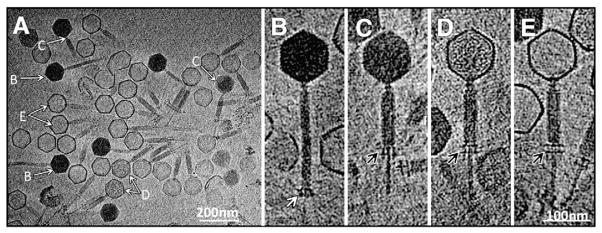
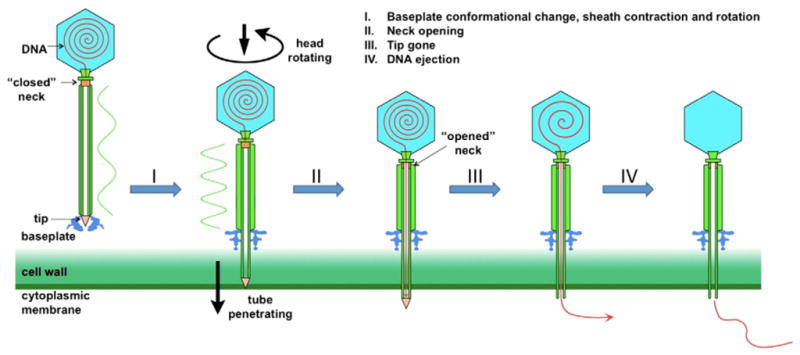
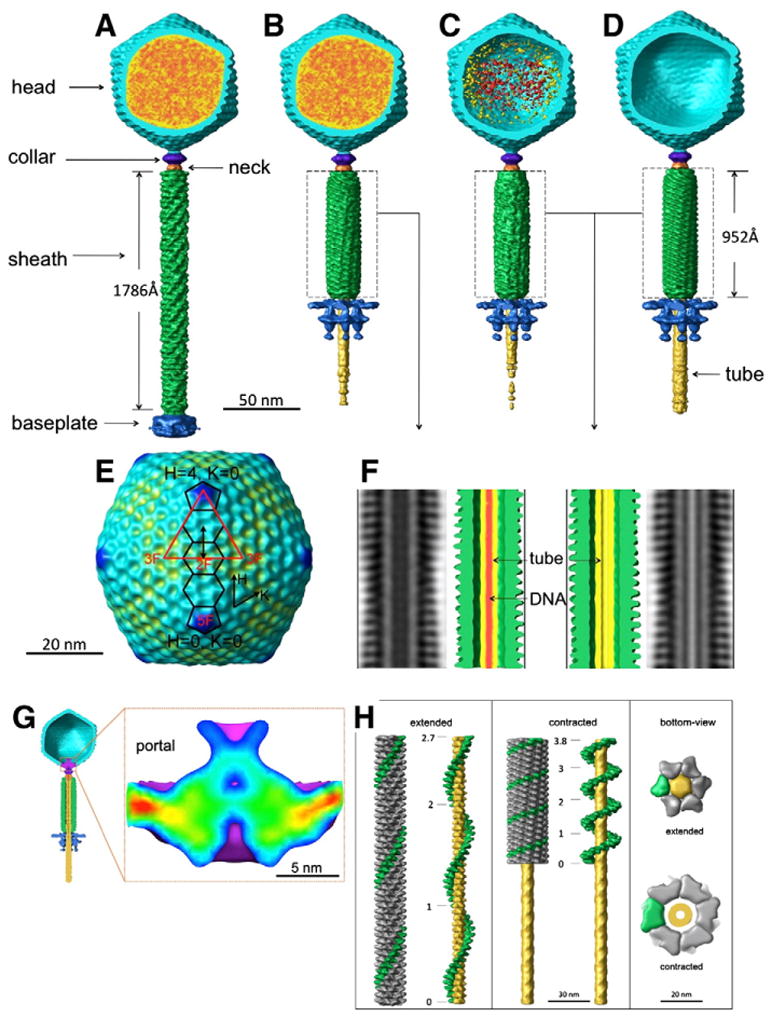
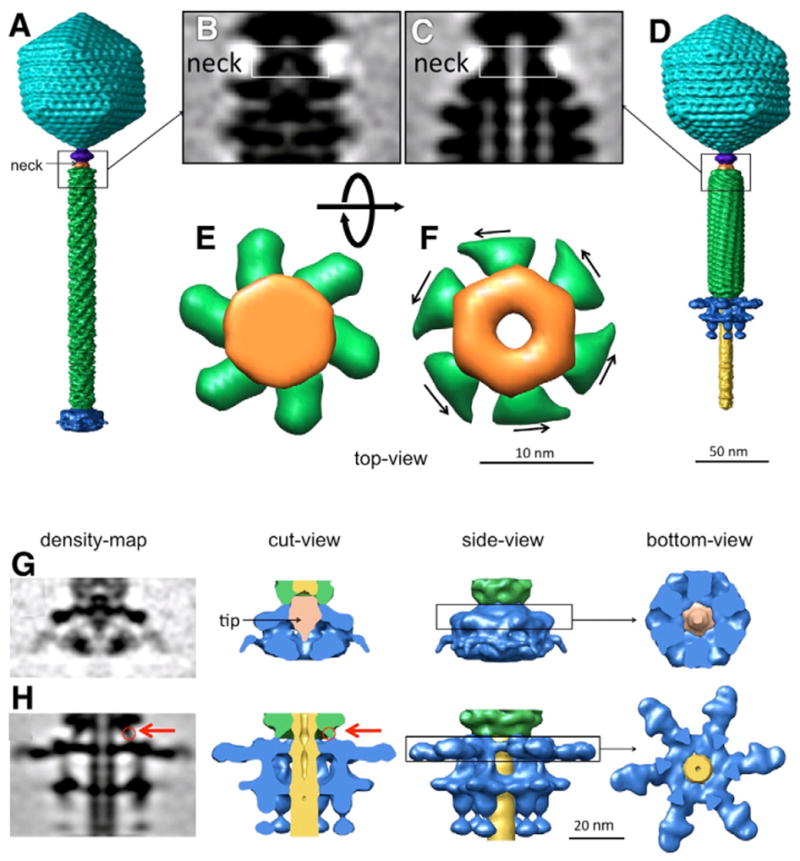
The structure of the Bacillus anthracis spore-binding phage 8a was determined by cryo-electron tomography. The phage capsid forms a T=16 icosahedron attached to a contractile tail via a head-tail connector protein. The tail consists of a six-start helical sheath surrounding a central tail tube, and a structurally novel baseplate at the distal end of the tail that recognizes and attaches to host cells. The parameters of the icosahedral capsid lattice and the helical tail sheath suggest protein folds for the capsid and tail-sheath proteins, respectively, and indicate evolutionary relationships to other dsDNA viruses. Analysis of 2518 intact phage particles show four distinct conformations that likely correspond to four sequential states of the DNA ejection process during infection. Comparison of the four observed conformations suggests a mechanism for DNA ejection, including the molecular basis underlying coordination of tail sheath contraction and genome release from the capsid.
炭疽杆菌噬菌体 8a 的结构通过冷冻电镜断层扫描技术确定。噬菌体衣壳形成一个 T=16 的二十面体,通过头部-尾部连接蛋白附着在一个可收缩的尾部上。尾部由一个六螺旋的螺旋鞘围绕着一个中心尾管组成,在尾部的远端有一个结构新颖的基板,用于识别和附着宿主细胞。二十面体衣壳晶格和螺旋尾鞘的参数分别提示了衣壳和尾鞘蛋白的蛋白折叠,并与其他双链 DNA 病毒存在进化关系。对 2518 个完整噬菌体颗粒的分析表明,存在四种不同的构象,可能对应于感染过程中 DNA 射出的四个连续状态。对这四种观察到的构象的比较表明了 DNA 射出的机制,包括尾鞘收缩和从衣壳中释放基因组的协调的分子基础。