Lee Hye Ah, Lee Won Kyung, Kong Kyoung-Ae, Chang Namsoo, Ha Eun-Hee, Hong Young Sun, Park Hyesook
Department of Preventive Medicine, School of Medicine, Ewha Womans University, Seoul, Korea.
J Prev Med Public Health. 2011 Sep;44(5):226-33. doi: 10.3961/jpmph.2011.44.5.226.
Being overweight or obese is central to metabolic syndrome, and these characteristics constitute dominant risk factors for chronic diseases. Although behavioral factors, including eating habits and sedentary lifestyles, are considered to be determinants of obesity, the specific childhood factors that contribute to this condition have not been clearly defined.
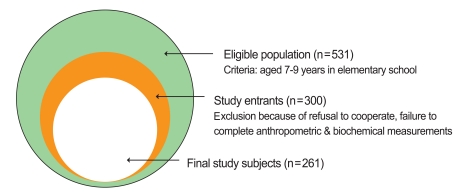
The subjects consisted of 261 children aged 7-9 years who were recruited from an elementary school during October 2003. Information was obtained from their parents using a questionnaire focused on eating behaviors and lifestyle factors, additional data were also collected via anthropometric measurements and biochemical examinations, including blood tests.
A total of 48 (18.4%) of the 261 children were overweight, and 34 (70.8%) had at least one other component of metabolic syndrome. Eating behaviors emerged as significant lifestyle-related risk factors for being overweight or obese. Those who engaged in overeating more than twice per week had three times the risk of being overweight (odds ratio [OR], 3.10, 95% confidence interval [CI], 1.39 to 6.92), and those who ate rapidly had three times the risk of being overweight (OR, 3.28; 95% CI, 1.68 to 6.41). Those who had fewer family meals (fewer than 2-3/month) had a nine times higher risk of being overweight than those who had family meals more frequently (at least 1/day) (OR, 9.51; 95% CI, 1.21 to 74.82).
This study showed that being overweight or obese during preadolescence is associated with a higher risk of metabolic syndrome and is related to unhealthy eating behaviors. Thus, weight-control strategies and healthy eating behaviors should be developed early in life to reduce the risk for metabolic syndrome.
超重或肥胖是代谢综合征的核心问题,这些特征是慢性疾病的主要危险因素。尽管包括饮食习惯和久坐不动的生活方式在内的行为因素被认为是肥胖的决定因素,但导致这种状况的具体儿童期因素尚未明确界定。
研究对象为2003年10月从一所小学招募的261名7至9岁的儿童。通过一份聚焦于饮食行为和生活方式因素的问卷从他们的父母那里获取信息,还通过人体测量和生化检查(包括血液检测)收集了其他数据。
261名儿童中共有48名(18.4%)超重,34名(70.8%)至少有代谢综合征的其他一项指标。饮食行为成为超重或肥胖的与生活方式相关的重要危险因素。每周暴饮暴食超过两次的儿童超重风险是常人的三倍(比值比[OR]为3.10,95%置信区间[CI]为1.39至6.92),吃饭快的儿童超重风险是常人的三倍(OR为3.28;95%CI为1.68至6.41)。家庭聚餐次数少(每月少于2至3次)的儿童超重风险比家庭聚餐频繁(至少每天1次)的儿童高九倍(OR为9.51;95%CI为1.21至74.82)。
本研究表明青春期前超重或肥胖与代谢综合征风险较高相关,且与不健康饮食行为有关。因此,应在生命早期制定体重控制策略和健康饮食行为,以降低代谢综合征风险。