
阿尔茨海默病患者默认模式网络中枢纽节点连接模式的改变:基于 Granger 因果关系建模方法的研究。
Altered connectivity pattern of hubs in default-mode network with Alzheimer's disease: an Granger causality modeling approach.
机构信息
State Key Laboratory of Cognitive Neuroscience and Learning, Beijing Normal University, Beijing, China.
出版信息
PLoS One. 2011;6(10):e25546. doi: 10.1371/journal.pone.0025546. Epub 2011 Oct 11.
BACKGROUND
Evidences from normal subjects suggest that the default-mode network (DMN) has posterior cingulate cortex (PCC), medial prefrontal cortex (MPFC) and inferior parietal cortex (IPC) as its hubs; meanwhile, these DMN nodes are often found to be abnormally recruited in Alzheimer's disease (AD) patients. The issues on how these hubs interact to each other, with the rest nodes of the DMN and the altered pattern of hubs with respect to AD, are still on going discussion for eventual final clarification.
PRINCIPAL FINDINGS
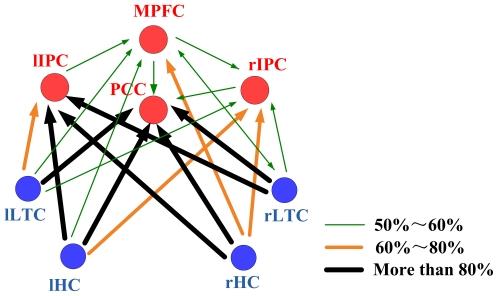
To address these issues, we investigated the causal influences between any pair of nodes within the DMN using Granger causality analysis and graph-theoretic methods on resting-state fMRI data of 12 young subjects, 16 old normal controls and 15 AD patients respectively. We found that: (1) PCC/MPFC/IPC, especially the PCC, showed the widest and distinctive causal effects on the DMN dynamics in young group; (2) the pattern of DMN hubs was abnormal in AD patients compared to old control: MPFC and IPC had obvious causal interaction disruption with other nodes; the PCC showed outstanding performance for it was the only region having causal relation with all other nodes significantly; (3) the altered relation between hubs and other DMN nodes held potential as a noninvasive biomarker of AD.
CONCLUSIONS
Our study, to the best of our knowledge, is the first to support the hub configuration of the DMN from the perspective of causal relationship, and reveal abnormal pattern of the DMN hubs in AD. Findings from young subjects provide additional evidence for the role of PCC/MPFC/IPC acting as hubs in the DMN. Compared to old control, MPFC and IPC lost their roles as hubs owing to the obvious causal interaction disruption, and PCC was preserved as the only hub showing significant causal relations with all other nodes.
背景
来自正常个体的证据表明,默认模式网络(DMN)以后扣带回皮层(PCC)、内侧前额叶皮层(MPFC)和下顶叶皮层(IPC)为其枢纽;同时,这些 DMN 节点在阿尔茨海默病(AD)患者中经常被发现异常募集。这些枢纽如何相互作用,以及与 AD 相关的 DMN 其余节点和枢纽模式的改变,仍然是正在讨论的问题,最终需要澄清。
主要发现
为了解决这些问题,我们分别使用静息态 fMRI 数据对 12 名年轻受试者、16 名老年正常对照者和 15 名 AD 患者的 DMN 中的任意两个节点之间的因果影响进行了 Granger 因果分析和图论方法的研究。我们发现:(1)PCC/MPFC/IPC,特别是 PCC,在年轻组中对 DMN 动力学表现出最广泛和独特的因果影响;(2)与老年对照组相比,AD 患者的 DMN 枢纽模式异常:MPFC 和 IPC 与其他节点的因果相互作用明显中断;PCC 表现出色,因为它是唯一与所有其他节点都有显著因果关系的区域;(3)枢纽与其他 DMN 节点之间的改变关系具有作为 AD 非侵入性生物标志物的潜力。
结论
据我们所知,我们的研究首次从因果关系的角度支持 DMN 的枢纽结构,并揭示了 AD 中 DMN 枢纽的异常模式。年轻受试者的研究结果为 PCC/MPFC/IPC 作为 DMN 枢纽的作用提供了额外的证据。与老年对照组相比,MPFC 和 IPC 由于明显的因果相互作用中断而失去了枢纽作用,而 PCC 则作为唯一的枢纽保留下来,与所有其他节点都有显著的因果关系。


 Zotero 插件