Department of Developmental Biology, Center for Regenerative and Developmental Biology, Tufts University, Medford, Massachusetts, United States of America.
PLoS One. 2011;6(10):e26382. doi: 10.1371/journal.pone.0026382. Epub 2011 Oct 14.
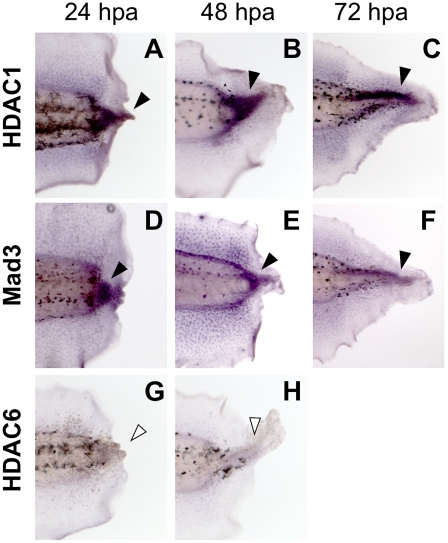
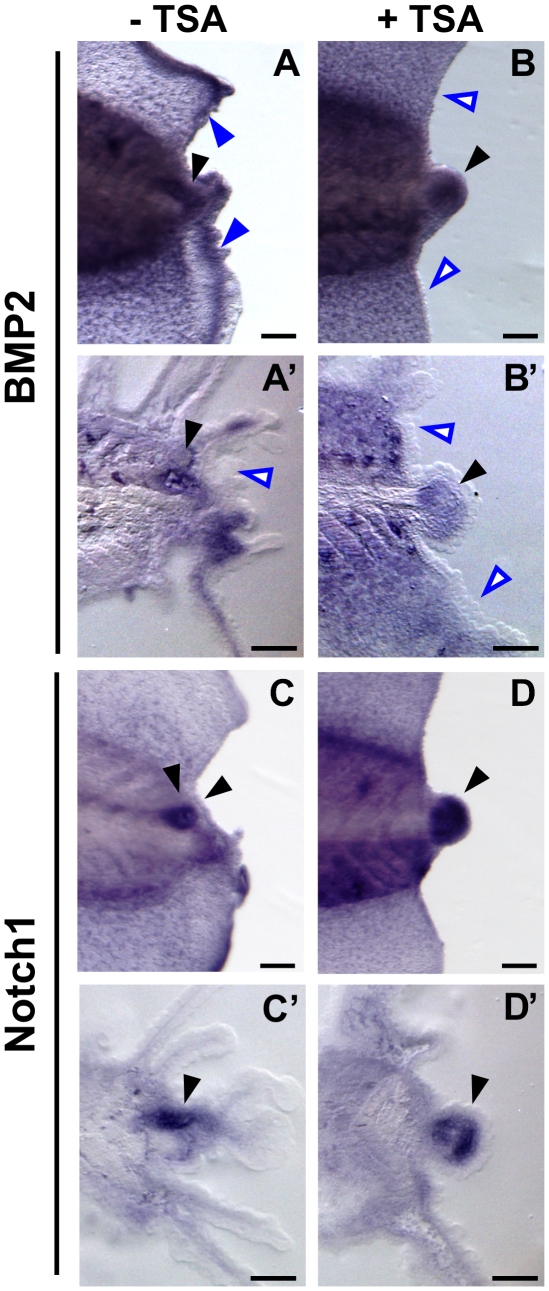
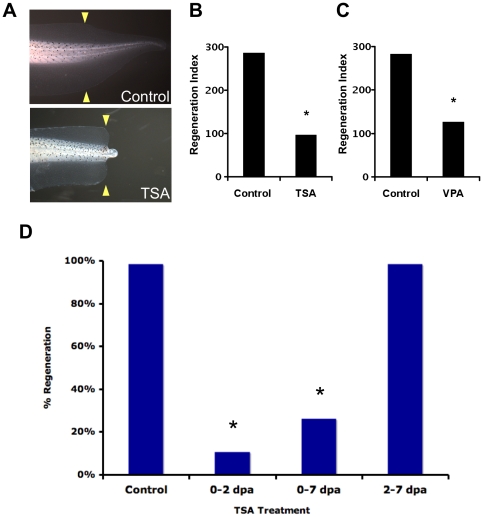
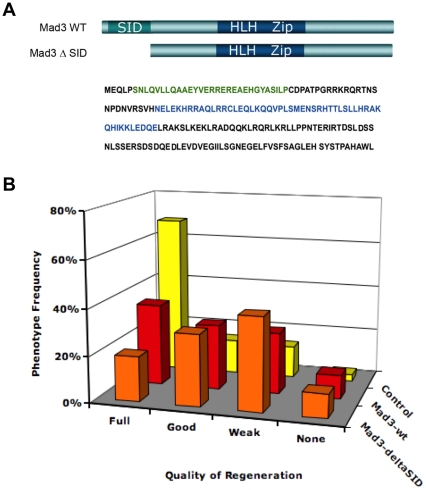
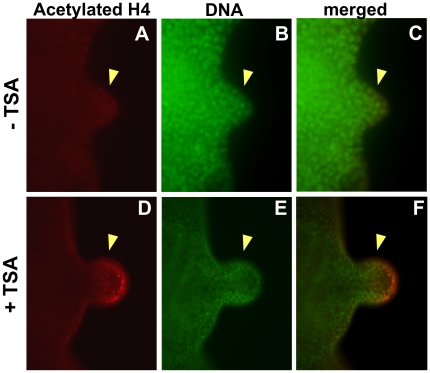
The ability to fully restore damaged or lost organs is present in only a subset of animals. The Xenopus tadpole tail is a complex appendage, containing epidermis, muscle, nerves, spinal cord, and vasculature, which regenerates after amputation. Understanding the mechanisms of tail regeneration may lead to new insights to promote biomedical regeneration in non-regenerative tissues. Although chromatin remodeling is known to be critical for stem cell pluripotency, its role in complex organ regeneration in vivo remains largely uncharacterized. Here we show that histone deacetylase (HDAC) activity is required for the early stages of tail regeneration. HDAC1 is expressed during the 1(st) two days of regeneration. Pharmacological blockade of HDACs using Trichostatin A (TSA) increased histone acetylation levels in the amputated tail. Furthermore, treatment with TSA or another HDAC inhibitor, valproic acid, specifically inhibited regeneration. Over-expression of wild-type Mad3, a transcriptional repressor known to associate in a complex with HDACs via Sin3, inhibited regeneration. Similarly, expression of a Mad3 mutant lacking the Sin3-interacting domain that is required for HDAC binding also blocks regeneration, suggesting that HDAC and Mad3 may act together to regulate regeneration. Inhibition of HDAC function resulted in aberrant expression of Notch1 and BMP2, two genes known to be required for tail regeneration. Our results identify a novel early role for HDAC in appendage regeneration and suggest that modulation of histone acetylation is important in regenerative repair of complex appendages.
只有一部分动物具有完全修复受损或丢失器官的能力。非洲爪蟾的尾巴是一种复杂的附肢,包含表皮、肌肉、神经、脊髓和脉管系统,在截肢后会再生。了解尾巴再生的机制可能会为促进非再生组织的生物医学再生提供新的见解。尽管染色质重塑被认为对干细胞多能性至关重要,但它在体内复杂器官再生中的作用在很大程度上仍未被描述。在这里,我们表明组蛋白去乙酰化酶 (HDAC) 活性是尾巴再生早期阶段所必需的。HDAC1 在再生的前 2 天表达。使用 Trichostatin A (TSA) 抑制 HDACs 的药理阻断增加了截肢尾巴中的组蛋白乙酰化水平。此外,用 TSA 或另一种 HDAC 抑制剂丙戊酸处理会特异性抑制再生。野生型 Mad3 的过表达,一种已知与 HDACs 通过 Sin3 形成复合物的转录抑制剂,抑制了再生。同样,表达缺乏与 HDAC 结合所必需的 Sin3 相互作用结构域的 Mad3 突变体也阻止了再生,这表明 HDAC 和 Mad3 可能共同作用来调节再生。抑制 HDAC 功能导致 Notch1 和 BMP2 的异常表达,这两种基因已知是尾巴再生所必需的。我们的结果确定了 HDAC 在附肢再生中的新的早期作用,并表明组蛋白乙酰化的调节在复杂附肢的再生修复中很重要。