Wang Mu-Hui, Hsu Chia-Lang, Wu Cheng-Han, Chiou Ling-Ling, Tsai Yi-Tzang, Lee Hsuan-Shu, Lin Shau-Ping
College of Bioresources and Agriculture, Institute of Biotechnology, National Taiwan University, Taipei, Taiwan.
Department of Medical Research, National Taiwan University Hospital, Taipei, Taiwan.
Front Cell Dev Biol. 2021 May 10;9:641987. doi: 10.3389/fcell.2021.641987. eCollection 2021.
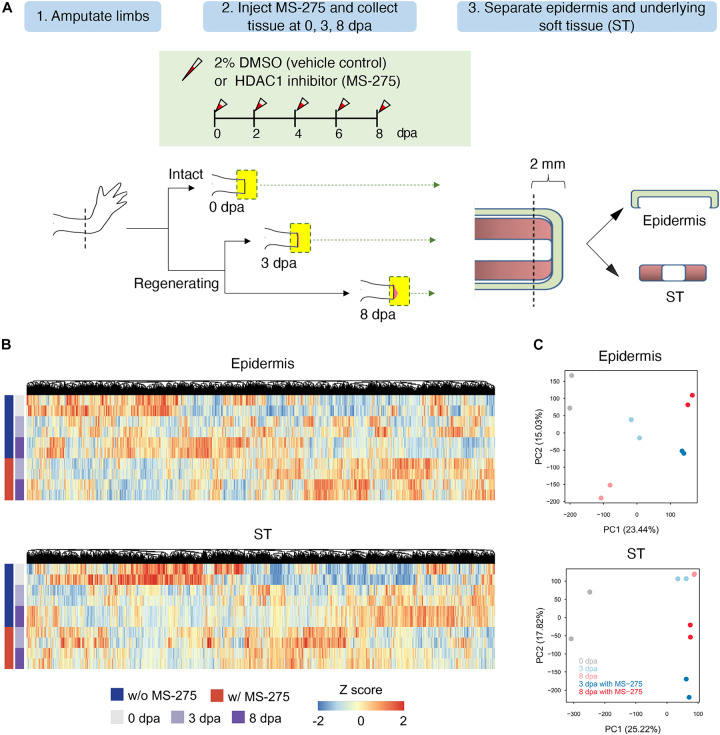
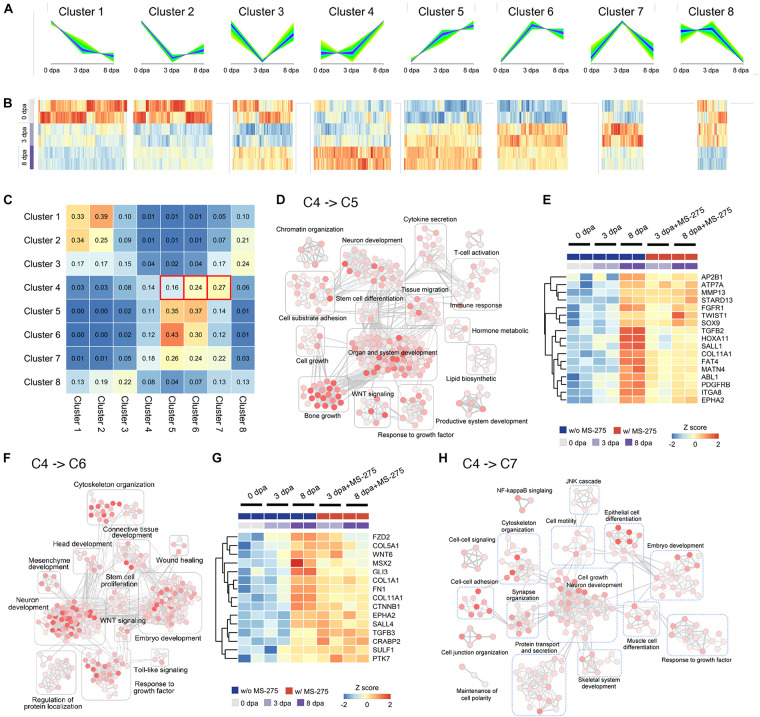
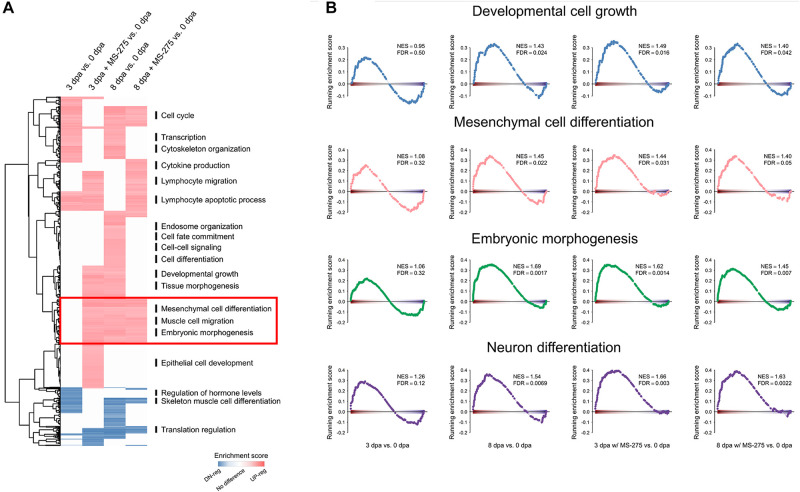
Sophisticated axolotl limb regeneration is a highly orchestrated process that requires highly regulated gene expression and epigenetic modification patterns at precise positions and timings. We previously demonstrated two waves of post-amputation expression of a nerve-mediated repressive epigenetic modulator, histone deacetylase 1 (HDAC1), at the wound healing (3 days post-amputation; 3 dpa) and blastema formation (8 dpa onward) stages in juvenile axolotls. Limb regeneration was profoundly inhibited by local injection of an HDAC inhibitor, MS-275, at the amputation sites. To explore the transcriptional response of post-amputation axolotl limb regeneration in a tissue-specific and time course-dependent manner after MS-275 treatment, we performed transcriptome sequencing of the epidermis and soft tissue (ST) at 0, 3, and 8 dpa with and without MS-275 treatment. Gene Ontology (GO) enrichment analysis of each coregulated gene cluster revealed a complex array of functional pathways in both the epidermis and ST. In particular, HDAC activities were required to inhibit the premature elevation of genes related to tissue development, differentiation, and morphogenesis. Further validation by Q-PCR in independent animals demonstrated that the expression of 5 out of 6 development- and regeneration-relevant genes that should only be elevated at the blastema stage was indeed prematurely upregulated at the wound healing stage when HDAC1 activity was inhibited. WNT pathway-associated genes were also prematurely activated under HDAC1 inhibition. Applying a WNT inhibitor to MS-275-treated amputated limbs partially rescued HDAC1 inhibition, resulting in blastema formation defects. We propose that post-amputation HDAC1 expression is at least partially responsible for pacing the expression timing of morphogenic genes to facilitate proper limb regeneration.
墨西哥钝口螈复杂的肢体再生是一个高度协调的过程,需要在精确的位置和时间进行高度调控的基因表达和表观遗传修饰模式。我们之前证明,在幼年墨西哥钝口螈的伤口愈合阶段(截肢后3天;3 dpa)和芽基形成阶段(8 dpa及之后),神经介导的抑制性表观遗传调节剂组蛋白去乙酰化酶1(HDAC1)会出现两波截肢后表达。在截肢部位局部注射HDAC抑制剂MS-275可显著抑制肢体再生。为了以组织特异性和时间进程依赖性方式探索MS-275处理后截肢的墨西哥钝口螈肢体再生的转录反应,我们对0、3和8 dpa时有无MS-275处理的表皮和软组织(ST)进行了转录组测序。对每个共调控基因簇的基因本体(GO)富集分析揭示了表皮和ST中一系列复杂的功能途径。特别是,需要HDAC活性来抑制与组织发育、分化和形态发生相关基因的过早升高。在独立动物中通过Q-PCR进一步验证表明,6个与发育和再生相关的基因中,有5个在芽基阶段才应升高,而当HDAC1活性受到抑制时,它们在伤口愈合阶段确实过早地上调。WNT通路相关基因在HDAC1抑制下也被过早激活。将WNT抑制剂应用于MS-275处理的截肢肢体可部分挽救HDAC1抑制,导致芽基形成缺陷。我们提出,截肢后HDAC1的表达至少部分负责调节形态发生基因的表达时间,以促进适当的肢体再生。