Department of Public Health and Primary Care, Institute of Public Health, Robinson Way, Cambridge, UK.
BMC Med Educ. 2011 Oct 25;11:90. doi: 10.1186/1472-6920-11-90.
Empathy is important to patient care. The prevailing view is that empathy declines during university medical education. The significance of that decline has been debated.This paper reports the findings in respect of two questions relating to university medical education: 1. Do men and women medical students differ in empathy? 2. Does empathy change amongst men and women over time?
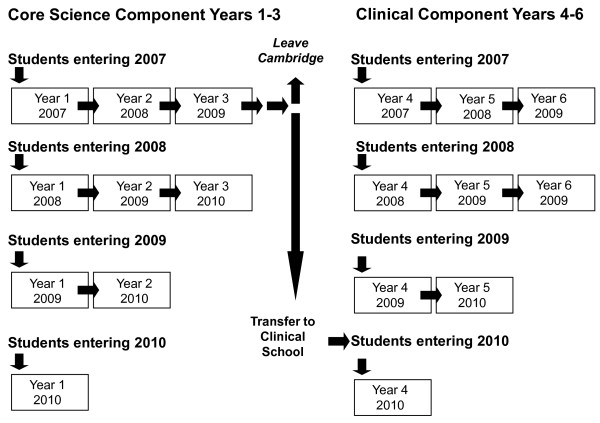
The medical course at the University of Cambridge comprises two components: Core Science (Years 1-3) and Clinical (Years 4-6). Data were obtained from repeated questionnaire surveys of medical students from each component over a period of four years: 2007-2010. Participation in the study was voluntary.Empathy was measured using two subscales of the Interpersonal Reactivity Index: IRI-EC (affective empathy) and IRI-PT (cognitive empathy). We analysed data separately for men and women from the Core Science and Clinical components. We undertook missing value analyses using logistic regression separately, for each measure of empathy, to examine non-response bias. We used Student's t-tests to examine gender differences and linear mixed effects regression analyses to examine changes over time. To assess the influence of outliers, we repeated the linear mixed effects regression analyses having excluded them.
Women displayed statistically significant higher mean scores than men for affective empathy in all 6 years of medical training and for cognitive empathy in 4 out of 6 years - Years 1 and 2 (Core Science component) and Years 4 and 5 (Clinical component).Amongst men, affective empathy declined slightly during both Core Science and Clinical components. Although statistically significant, both of these changes were extremely small. Cognitive empathy was unchanged during either component. Amongst women, neither affective empathy nor cognitive empathy changed during either component of the course.Analysis following removal of outliers showed a statistically significant slight increase in men's cognitive empathy during the Core Science component and slight decline in women's affective empathy during the Clinical component. Again, although statistically significant, these changes were extremely small and do not influence the study's overall conclusions.
Amongst medical students at the University of Cambridge, women are more empathetic than men (a generally observed phenomenon). Men's affective empathy declined slightly across the course overall, whilst women's affective empathy showed no change. Neither men nor women showed any change in cognitive empathy during the course. Although statistically significant, the size of such changes as occurred makes their practical significance questionable. Neither men nor women appear to become meaningfully less empathetic during their medical education at the University of Cambridge.
同理心对于患者护理至关重要。普遍观点认为,同理心在大学医学教育期间会下降。这种下降的意义一直存在争议。本文报告了与大学医学教育相关的两个问题的研究结果:1. 男女医学生的同理心是否存在差异?2. 同理心是否会随时间在男女之间发生变化?
剑桥大学的医学课程包括两个部分:核心科学(1-3 年级)和临床(4-6 年级)。我们从四年间的每个阶段重复问卷调查中获得了医学生的数据:2007-2010 年。研究的参与是自愿的。同理心使用人际反应指数的两个分量表进行测量:IRI-EC(情感同理心)和 IRI-PT(认知同理心)。我们分别分析了核心科学和临床部分的男女学生的数据。我们针对每个同理心测量值分别使用逻辑回归进行缺失值分析,以检查非响应偏差。我们使用学生 t 检验检查性别差异,使用线性混合效应回归分析检查随时间的变化。为了评估异常值的影响,我们在排除它们后重复了线性混合效应回归分析。
在整个医学培训的 6 年中,女性在所有 6 年的情感同理心和在 4 年中的认知同理心上的平均得分均显著高于男性,这 4 年是:第 1 年和第 2 年(核心科学部分)和第 4 年和第 5 年(临床部分)。在男性中,情感同理心在核心科学和临床两个部分都略有下降。尽管具有统计学意义,但这两个变化都非常小。认知同理心在两个部分都没有变化。在女性中,情感同理心和认知同理心在课程的任何一个部分都没有变化。在排除异常值后进行的分析表明,男性在核心科学部分的认知同理心略有增加,女性在临床部分的情感同理心略有下降。尽管具有统计学意义,但这些变化非常小,不会影响研究的总体结论。
在剑桥大学的医学生中,女性比男性更有同理心(这是一个普遍观察到的现象)。男性的情感同理心在整个课程中略有下降,而女性的情感同理心没有变化。男性和女性在课程期间的认知同理心都没有变化。尽管具有统计学意义,但发生的变化如此之小,使得它们的实际意义值得怀疑。在剑桥大学接受医学教育期间,男性和女性似乎都没有变得明显缺乏同理心。