Yamazaki Tsuyoshi, Kawai Chikage, Yamauchi Akira, Kuribayashi Futoshi
Department of Information and Communication Technology, School of High-Technology for Human Welfare, Tokai University, 317 Nishino, Numazu, Shizuoka 410-0395, Japan.
Trop Med Health. 2011 Jun;39(2):41-5. doi: 10.2149/tmh.2011-08. Epub 2011 Jun 14.
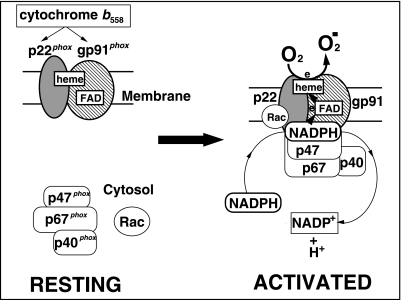
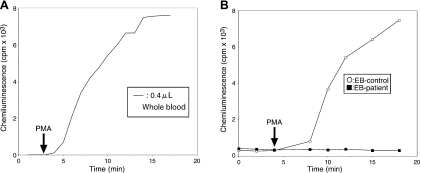
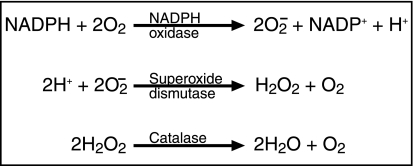
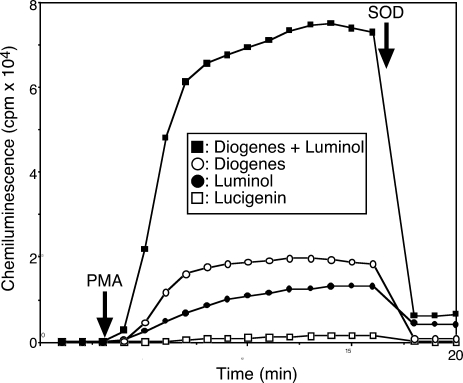
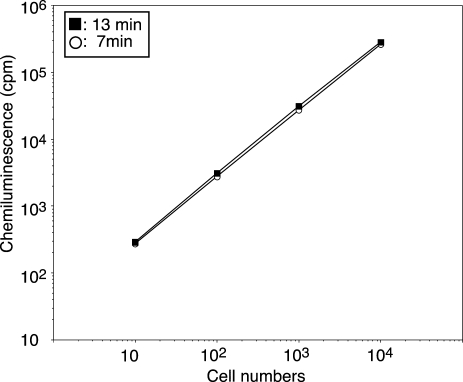
Reactive oxygen species (ROS) produced by neutrophils are crucial for defense against infectious diseases, and the adequate measurement of ROS levels is an important way to evaluate the possibility of infections. The fluorescent probe dihydrorhodamine 123 has been applied exclusively to the measurement of ROS thus far. We developed a novel method for detecting ROS, which utilizes the chemiluminescent probes Luminol and Diogenes. The new method quantitatively detects ROS produced by as few as 10 to 10(4) neutrophils. Furthermore, this method can detect ROS levels in one microliter of whole blood or ROS produced by Epstein-Barr immortalized B lymphocytes. This method will be valuable for prompt diagnosis of neonatal chronic granulomatous diseases in which neutrophils aberrantly produce superoxide.
中性粒细胞产生的活性氧(ROS)对于抵御传染病至关重要,而对ROS水平的适当测量是评估感染可能性的重要途径。迄今为止,荧光探针二氢罗丹明123仅用于ROS的测量。我们开发了一种检测ROS的新方法,该方法利用化学发光探针鲁米诺和Diogenes。这种新方法能够定量检测少至10到10⁴个中性粒细胞产生的ROS。此外,该方法可以检测一微升全血中的ROS水平或爱泼斯坦-巴尔病毒永生化B淋巴细胞产生的ROS。该方法对于快速诊断中性粒细胞异常产生超氧化物的新生儿慢性肉芽肿病将具有重要价值。