Oxford Centre for Integrative Systems Biology, Department of Biochemistry, University of Oxford, Oxford, United Kingdom.
PLoS Comput Biol. 2011 Oct;7(10):e1002204. doi: 10.1371/journal.pcbi.1002204. Epub 2011 Oct 20.
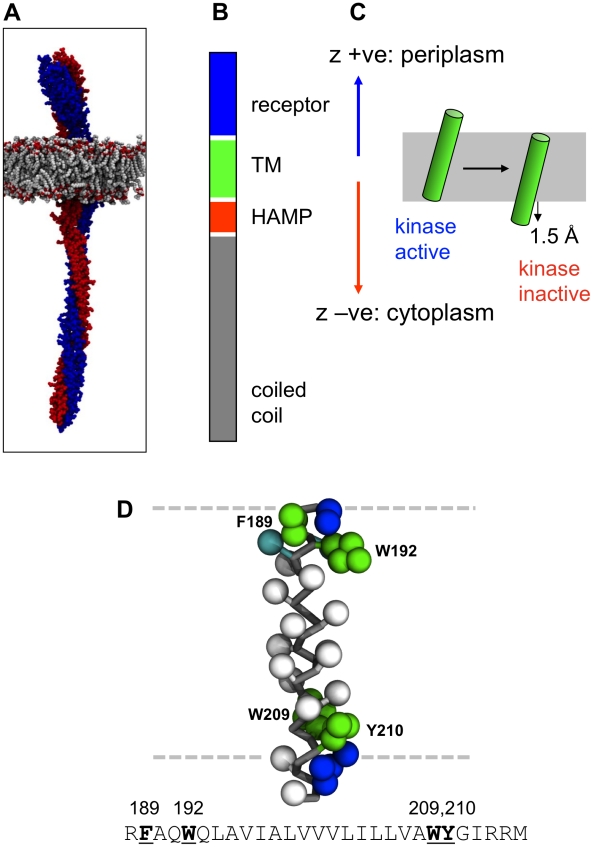
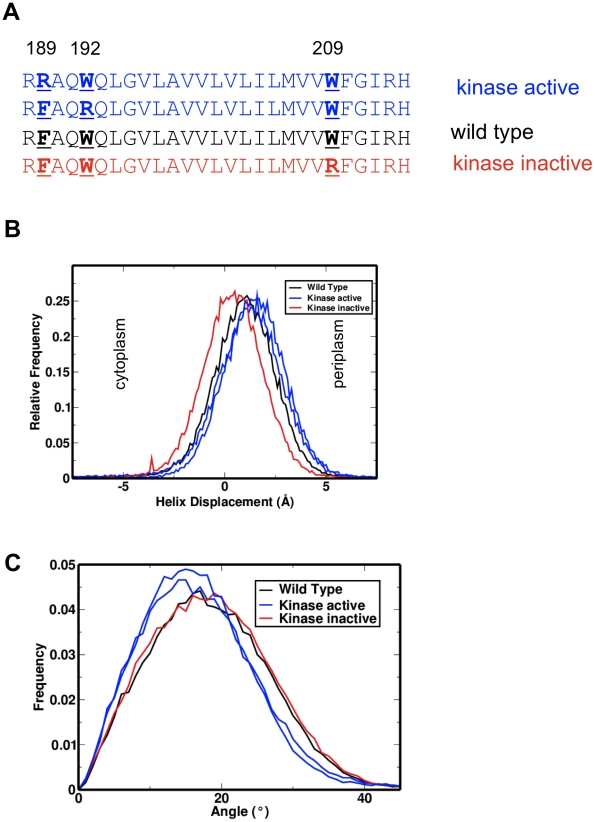
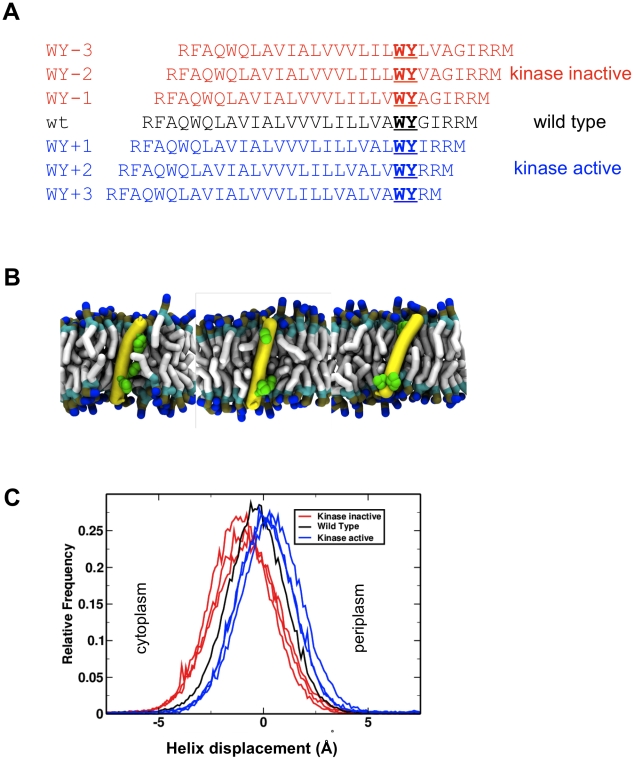
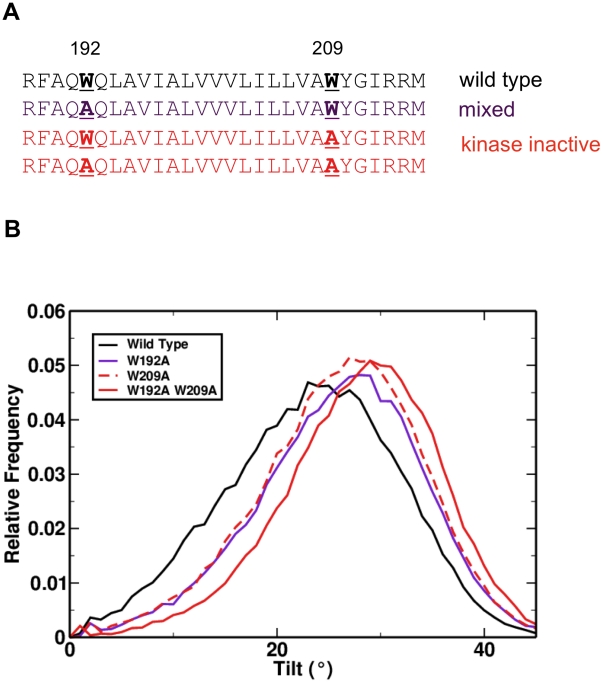
Transmembrane α-helices play a key role in many receptors, transmitting a signal from one side to the other of the lipid bilayer membrane. Bacterial chemoreceptors are one of the best studied such systems, with a wealth of biophysical and mutational data indicating a key role for the TM2 helix in signalling. In particular, aromatic (Trp and Tyr) and basic (Arg) residues help to lock α-helices into a membrane. Mutants in TM2 of E. coli Tar and related chemoreceptors involving these residues implicate changes in helix location and/or orientation in signalling. We have investigated the detailed structural basis of this via high throughput coarse-grained molecular dynamics (CG-MD) of Tar TM2 and its mutants in lipid bilayers. We focus on the position (shift) and orientation (tilt, rotation) of TM2 relative to the bilayer and how these are perturbed in mutants relative to the wildtype. The simulations reveal a clear correlation between small (ca. 1.5 Å) shift in position of TM2 along the bilayer normal and downstream changes in signalling activity. Weaker correlations are seen with helix tilt, and little/none between signalling and helix twist. This analysis of relatively subtle changes was only possible because the high throughput simulation method allowed us to run large (n = 100) ensembles for substantial numbers of different helix sequences, amounting to ca. 2000 simulations in total. Overall, this analysis supports a swinging-piston model of transmembrane signalling by Tar and related chemoreceptors.
跨膜 α-螺旋在许多受体中起着关键作用,将信号从脂质双层膜的一侧传递到另一侧。细菌化学感受器是研究得最好的此类系统之一,有大量的生物物理和突变数据表明 TM2 螺旋在信号转导中起着关键作用。特别是芳香族(色氨酸和酪氨酸)和碱性(精氨酸)残基有助于将 α-螺旋锁定在膜中。涉及这些残基的大肠杆菌 Tar 和相关化学感受器 TM2 中的突变体暗示了信号转导中螺旋位置和/或取向的变化。我们通过 Tar TM2 及其突变体在脂质双层中的高通量粗粒度分子动力学 (CG-MD) 研究了这种情况的详细结构基础。我们专注于 TM2 相对于双层的位置(移动)和取向(倾斜、旋转),以及突变体相对于野生型的这些位置如何受到干扰。模拟结果表明 TM2 位置沿双层法线的小(约 1.5 Å)移动与信号活性的下游变化之间存在明显的相关性。与螺旋倾斜的相关性较弱,与信号转导的相关性更弱。这种对相对细微变化的分析之所以成为可能,是因为高通量模拟方法允许我们对大量不同的螺旋序列运行大型(n=100)集合,总共进行了大约 2000 次模拟。总的来说,这项分析支持 Tar 和相关化学感受器的跨膜信号转导的摆动活塞模型。