Laboratory of Zoonoses, St. Petersburg Pasteur Institute, St. Petersburg, Russia.
Glob Health Action. 2011;4:8448. doi: 10.3402/gha.v4i0.8448. Epub 2011 Oct 21.
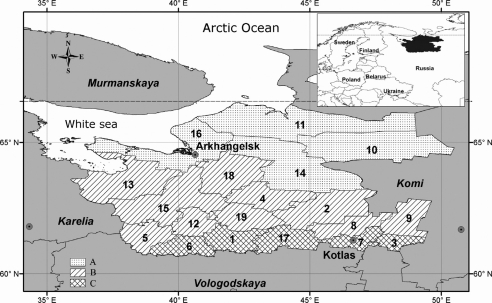
The increase in tick-borne encephalitis (TBE) incidence is observed in recent decades in a number of subarctic countries. The reasons of it are widely discussed in scientific publications. The objective of this study was to understand if the climate change in Arkhangelsk Oblast (AO) situated in the north of European subarctic zone of Russia has real impact on the northward expansion of Ixodid ticks and stipulates the increase in TBE incidence.
This study analyzes: TBE incidence in AO and throughout Russia, the results of Ixodid ticks collecting in a number of sites in AO, and TBE virus prevalence in those ticks, the data on tick bite incidence in AO, and meteorological data on AO mean annual air temperatures and precipitations.
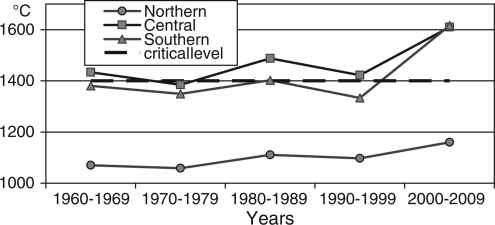
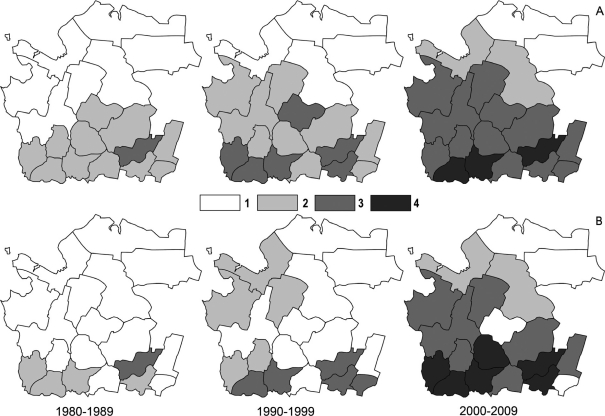
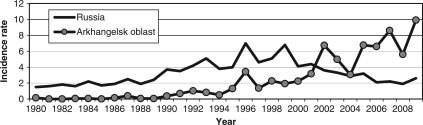
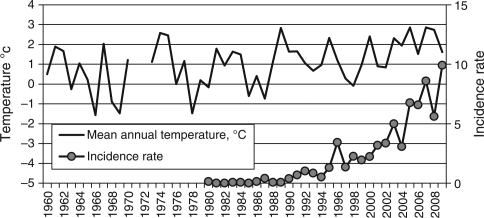
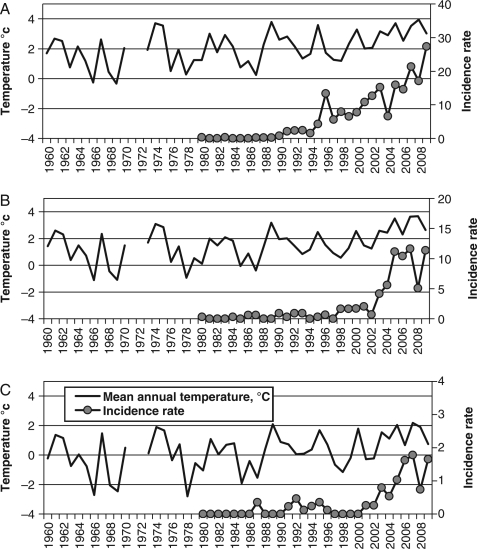
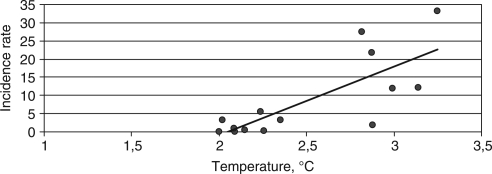
It is established that in recent years TBE incidence in AO tended to increase contrary to its apparent decrease nationwide. In last 10 years, there was nearly 50-fold rise in TBE incidence in AO when compared with 1980-1989. Probably, the increase both in mean annual air temperatures and temperatures during tick active season resulted in the northward expansion of Ixodes Persulcatus, main TBE virus vector. The Ixodid ticks expansion is confirmed both by the results of ticks flagging from the surface vegetation and by the tick bite incidence in the population of AO locations earlier free from ticks. Our mathematical (correlation and regression) analysis of available data revealed a distinct correlation between TBE incidence and the growth of mean annual air temperatures in AO in 1990-2009.
Not ruling out other factors, we conclude that climate change contributed much to the TBE incidence increase in AO.
近年来,在许多亚北极国家,蜱传脑炎(TBE)的发病率有所上升。这一现象在科学文献中被广泛讨论。本研究旨在了解俄罗斯欧洲亚北极地区北部的阿尔汉格尔斯克州(AO)的气候变化是否对蜱虫向北扩张以及 TBE 发病率的上升有实际影响。
本研究分析了 AO 和俄罗斯全境的 TBE 发病率、AO 多个地点采集的蜱虫的结果以及这些蜱虫中的 TBE 病毒流行情况、AO 中的蜱虫叮咬发病率数据以及 AO 的气象数据,包括年平均气温和降水量。
研究表明,近年来,AO 的 TBE 发病率呈上升趋势,与全国范围内的明显下降趋势相反。在过去的 10 年中,AO 的 TBE 发病率与 1980-1989 年相比增长了近 50 倍。可能是由于年平均气温和蜱虫活跃季节的温度升高,导致主要的 TBE 病毒载体 Ixodes Persulcatus 向北扩张。蜱虫的扩张既通过从地表植被中采集的蜱虫的标记结果得到证实,也通过 AO 无蜱虫地区的人群中的蜱虫叮咬发病率得到证实。我们对现有数据进行的数学(相关和回归)分析表明,在 1990-2009 年期间,AO 的 TBE 发病率与年平均气温的增长之间存在明显的相关性。
在不排除其他因素的情况下,我们得出结论,气候变化是 AO 中 TBE 发病率上升的主要原因之一。